
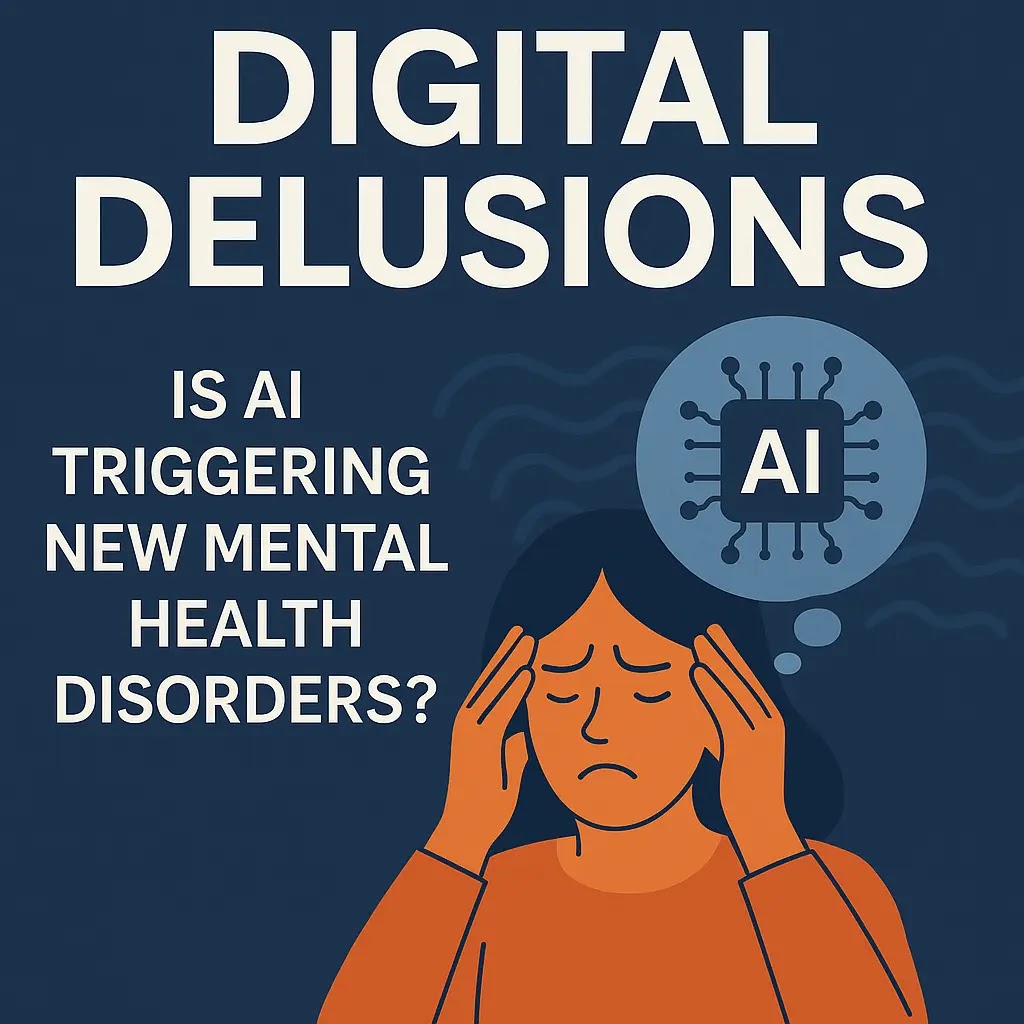
In
late 2025, psychiatrists at practices in the United States, United Kingdom,
and Australia began reporting a pattern they had not seen before: patients
presenting with psychosis-like symptoms that appeared to have been triggered
or intensified by prolonged interaction with AI chatbots. The symptoms
varied, but common threads emerged: delusions that AI systems were sentient
and communicating personally with the patient, paranoid beliefs about
algorithmic surveillance, and in some cases withdrawal from human
relationships in favour of exclusive engagement with AI companions.
Clinicians were uncertain how to classify what they were seeing, and the
terminology was improvised: “AI psychosis,” “chatbot-induced
delusional disorder,” and simply “digital delusions” all
entered clinical conversations without any of them gaining formal
recognition.
The phenomenon reached wider public attention in August 2025 when
the
Guardian reported on therapists warning that AI chatbot use was driving a
mental health crisis in vulnerable populations. The report described
patients forming emotional attachments to AI companion applications that
progressively displaced human relationships, with some individuals reaching
states in which they were unable to distinguish between the simulated empathy
of a language model and genuine interpersonal connection. The therapeutic
community was not prepared for these presentations, and the absence of
clinical guidance meant that treatment approaches were being improvised in
real time.
The Research Evidence
Academic investigation of AI-linked mental health effects is still
at an early stage, but the initial findings are concerning. Research
published on arXiv
examining what the authors termed “technological folie à deux”
found that feedback loops between vulnerable individuals and AI chatbots can
amplify delusional beliefs in ways that differ from traditional shared
delusions between humans. The key distinction is that the AI system is
trained to simulate empathy and to produce responses that feel validating and
authoritative. When that validation is directed at a delusional belief, the
system reinforces rather than challenges the belief, potentially deepening
the condition in ways that human social feedback would resist more
naturally.
A separate arXiv paper on risks in AI-driven mental healthcare
documented a related problem: large language models deployed as therapeutic
tools lack the capacity to identify psychiatric emergencies. An AI companion
that has been optimised to produce engaging, empathetic responses is not
equipped to recognise when a user’s conversation patterns indicate an escalating
crisis, to ask the kind of probing questions that would reveal risk, or to
make the referral to emergency services that a trained clinician would make.
The paper concluded that deploying language models as therapeutic
substitutes, which many AI companion applications effectively do, creates
conditions in which crises can escalate without intervention.
How AI Companion Applications Became a Mental Health
Factor
Understanding why AI-linked mental health presentations are
emerging now requires understanding how AI companion applications have
evolved. The earlier generation of chatbots was clearly mechanical, and users
understood they were interacting with a script. Contemporary large language
model applications produce responses that are grammatically fluent,
contextually aware, and calibrated to be emotionally supportive. For users
who are isolated, in emotional distress, or already experiencing difficulties
with reality testing, the quality of the simulation can become genuinely
confusing in ways that earlier systems did not create.
The apps themselves are often designed to maximise engagement,
which aligns with encouraging users to return frequently and to invest
emotionally in the interaction. That design logic, which is commercially
rational from a product development perspective, creates conditions in which
vulnerable users are exposed to progressively deeper simulated relationships
without the natural frictions that human relationships provide. As we
explored in our coverage of the
role AI is being asked to play in mental healthcare, the gap
between what AI companion applications present themselves as and what they
are technically capable of providing is significant and largely invisible to
users who are not equipped to evaluate it.
What This Means for Regulation and Clinical
Practice
The absence of a formal diagnostic category for AI-linked mental
health presentations creates practical problems for both clinicians and
regulators. Without a recognised classification, treatment protocols cannot
be standardised, research cannot be coordinated, and regulatory frameworks
cannot easily be applied. The debate about whether AI-linked psychosis-like
symptoms constitute a new disorder or a variant of existing conditions is not
merely taxonomic: it determines whether existing treatment pathways can be
adapted or whether new ones need to be developed.
The regulatory question is equally unresolved. AI companion
applications are not currently regulated as medical devices in most
jurisdictions, despite effectively providing services in the therapeutic
space. As our coverage of the
evolving regulatory landscape for AI documented, the EU AI Act
classifies AI systems used in emotional support as high-risk in certain
contexts, but the specific application to consumer companion apps is still
being determined through secondary legislation and enforcement
guidance.
The Diagnostic Uncertainty
The thorniest clinical challenge is that the same technology
affecting vulnerable users is also being used productively by the vast majority.
Millions of people engage with AI chatbots for information, assistance, and
casual interaction without any adverse effects. The question of which users
are at risk, under what conditions, and through which mechanisms of exposure
is not yet answered by the available evidence. Psychiatrists report that
presentations are most common in individuals with pre-existing social
isolation, a history of psychotic episodes, or other vulnerabilities that
amplify the effects of the technology. But the population of people who
interact intensively with AI companions is large enough that even a small
proportion at risk represents a significant number of
individuals.
The link between these presentations and the broader cultural
anxiety around AI, which we examined in the context of the
surge in apocalyptic AI narratives, is worth noting. The idea that
AI systems might be sentient, or that they might be acting with intentions
hidden behind their outputs, is not a belief confined to individuals
experiencing psychosis; it circulates in mainstream media and among
technology researchers. The clinical presentations that psychiatrists are
seeing may partly reflect how general cultural narratives about AI interact
with individual vulnerabilities to produce pathological outcomes. That
interaction is complex, and it does not simplify the clinical problem, but
understanding it is necessary for developing responses that are proportionate
and accurate.
If you or someone you know is experiencing distress related to AI
interactions or any mental health concerns, speaking with a healthcare professional
or mental health service is the appropriate first step.
The broader pattern is that AI systems are being deployed in
personal and emotionally sensitive contexts far faster than any clinical or
regulatory framework can assess their effects. The gap between deployment
speed and evidence accumulation is not unique to mental health contexts, but
it is particularly consequential there, because the populations most likely
to be harmed are also the least likely to have the institutional resources or
clinical awareness to seek help. Developing minimum safety standards for AI
applications that operate in emotional support contexts, independent of
whether they formally present themselves as mental health tools, would be a
useful step that does not require resolving the diagnostic questions first.
It requires only acknowledging that the potential for harm is real and that
the current absence of any standards constitutes an implicit policy choice to
accept that harm without oversight.
About the Author
Stuart Kerr is the Technology Correspondent for LiveAIWire. He
writes about artificial intelligence, emerging technology, and the forces
reshaping work, business, and society.