
By Stuart Kerr, Technology Correspondent, LiveAIWire
When Algorithms Hit a Plateau
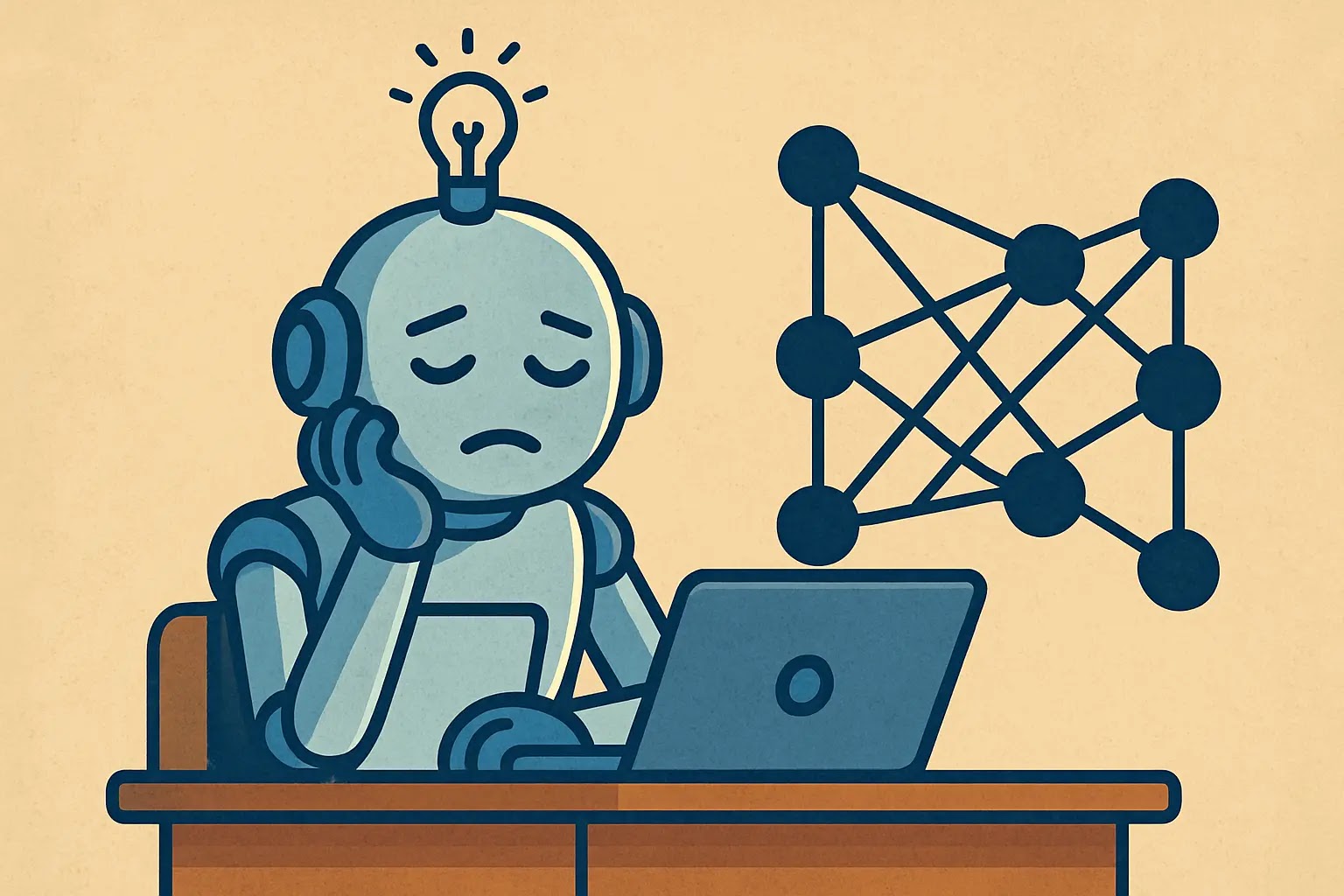
AI model collapse is the quieter, more unsettling counterpart to the industry’s assumption of relentless improvement. Most people think of AI as endlessly improving, fuelled by massive amounts of data and computing power. Yet researchers warn of a subtler threat: stagnation. Without continuous exposure to fresh, high-quality data, models can plateau in performance, losing creativity and relevance. This phenomenon, sometimes called model drift or algorithmic boredom, raises serious concerns for an industry built on the assumption of relentless growth.
A piece in Forbes highlights why this issue matters: without regular updates, AI models risk collapsing, their outputs becoming repetitive, inaccurate, or irrelevant. Instead of charting new territory, they recycle old patterns, much like a student who never picks up new books but endlessly rereads their notes.
Loops Without Data
The Content Apocalypse blog vividly describes what happens when AI is starved of novelty: systems fall into endless loops, regurgitating information they already know and losing their edge. In creative industries, this can result in stale imagery, repetitive writing, or chatbots that seem to echo themselves more than the real world. For enterprises, the consequences can be even more severe: customer service systems that misinterpret emerging slang, fraud detection models blind to new schemes, or medical AI missing novel symptoms.
The metaphor of boredom is apt. Just as human creativity wilts without stimulation, AI systems stagnate when deprived of diverse, evolving data streams.
The Science of AI Model Collapse
Technologists often use the term data drift to describe these dynamics. According to Nexla, drift occurs when the data distribution feeding a model shifts over time, leaving the AI trained on yesterday’s reality and unprepared for today’s. This can manifest in subtle ways, like a slow shift in customer behaviour, or dramatic ones, such as a sudden change in market conditions or medical knowledge.
A scholarly article in the International Journal of Science and Research Archive breaks drift down into categories: covariate drift, changes in input data; concept drift, changes in the relationship between inputs and outputs; and model drift, internal degradation of a system over time. Each presents distinct challenges but shares the same outcome: declining reliability if left unchecked.
The Curse of Recursion
Perhaps the most alarming driver of AI model collapse is what happens when models are retrained on their own outputs. A widely cited arXiv study labelled this the curse of recursion: training on synthetic data makes models forget, reducing diversity and accuracy. Over time, this recursive training can lead systems to spiral into sameness, stripped of originality and insight.
This is not a distant problem. As AI-generated text, images, and audio flood the internet, the likelihood that new models will be trained on synthetic, not human, content grows. LiveAIWire’s reporting on the quality collapse in AI-produced content found that a growing share of the open web is now AI-generated, which is precisely the feedback loop that accelerates model collapse. Unless developers actively curate and inject fresh, human-generated data, tomorrow’s AIs risk learning only from yesterday’s echoes.
Creativity at Risk
The implications go beyond technical performance. For many, AI’s promise lies in its ability to fuel creativity, designing buildings, composing music, or brainstorming ideas. But creativity thrives on novelty, and without new material, AI outputs risk becoming formulaic. The danger is a generation of systems that feel less like collaborators and more like photocopiers.
This echoes broader debates in society. Just as our coverage of Google’s nuclear bet on AI infrastructure reflects the massive resources being poured into powering models, the issue of AI model collapse reminds us that scale is not enough. Without diversity and freshness in data, even the most powerful systems risk creative drought.
Managing the Risk of Stagnation
What can be done to prevent AI model collapse? Experts propose continuous monitoring of model accuracy and outputs to detect early signs of drift, alongside hybrid training pipelines that blend synthetic data with curated human-generated material. Diversity sourcing, including multilingual, multicultural, and cross-domain datasets, helps maintain richness, while transparency in how models are updated ensures users understand when and how systems are refreshed.
As the GovLab’s AI Localism in Practice report on municipal AI governance suggests, transparency and accountability matter just as much at the local level as at the global one. Applying this ethos to AI training pipelines could help maintain trust and performance.
Why It Matters Now
Why worry about AI model collapse today? Because the conditions that produce it are already here. Vast amounts of human-generated data have already been consumed, and the proportion of synthetic content online is rising. Meanwhile, the appetite for ever-larger models continues, raising the risk that systems will cannibalise their own outputs.
Developers complain of generative systems producing repetitive or shallow results. Businesses fear deploying outdated models that fail to reflect current realities. In creative circles, artists lament that tools once hailed as innovative now feel predictable.
A Call for Freshness
The solution is not to abandon AI but to treat freshness as a core design principle. Just as humans need stimulation to stay creative, algorithms require novelty to remain relevant. This means investing not only in hardware and scale but in the ecosystems of data that feed these systems.
The risk of AI model collapse is not that AI will stop working altogether, but that it may stop surprising us. And in a field built on the promise of innovation, that may be the greatest risk of all.
About the Author
Stuart Kerr is Technology Correspondent at LiveAIWire, covering artificial intelligence, cybersecurity, and the social impact of emerging technology. He publishes daily at LiveAIWire.com.