
By Stuart Kerr, Technology Correspondent, LiveAIWire
Google AI Mode has surpassed one billion monthly users, with queries more than doubling every quarter since its debut, according to Google’s own May 2026 announcement. What launched in March 2025 as an experimental tab for asking complex, multi-part questions has since become, by Google’s own description, the biggest change to how Search works in over two decades, moving from a tool that answers questions to one that increasingly acts on them.
The features that first put AI Mode on the map, Canvas, PDF uploads, and Search Live, were genuinely significant when they arrived in mid-2025. But treating that snapshot as the current state of the product badly undersells what has happened since. AI Mode now runs on its third distinct default model in under a year, books restaurants and services on a user’s behalf, and as of May 2026 can spin up autonomous “Search agents” that keep working in the background without being asked twice.
Table of Contents
What Canvas, PDF Uploads and Search Live Actually Started
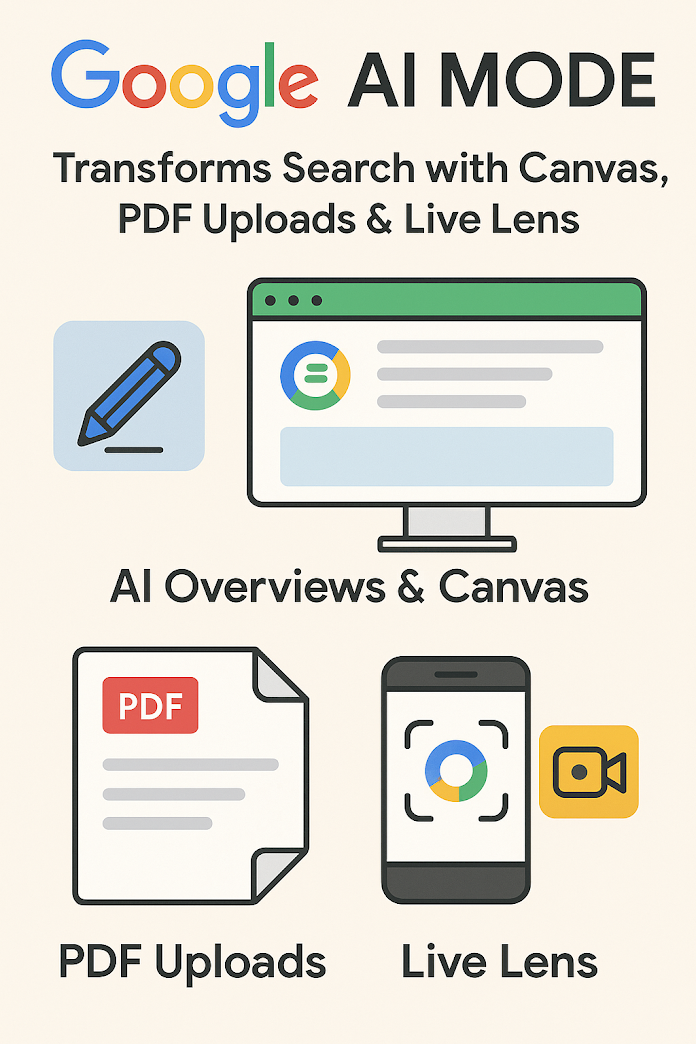
The original wave of upgrades, detailed by Google’s Robby Stein when they launched, gave AI Mode a persistent side-panel called Canvas for building study plans and project trackers across multiple sessions, the ability to upload PDFs and images on desktop for deeper document-based questions, and Search Live, which paired Google Lens with real-time conversational back-and-forth through a phone’s camera. At the time, these were rolling out gradually to users enrolled in Google’s AI Mode Labs experiment in the US.
Those features have since gone from experimental to standard. Search Live expanded to more than 200 countries by March 2026, and Canvas picked up support for creative writing and coding tasks directly inside a search session. Both are now simply part of what AI Mode does by default, rather than a preview feature a subset of users had opted into.
What This Means for You
If you still think of Google as a place you type a keyword and get ten blue links, that model no longer describes a meaningful share of what happens when people search. For everyday use, the practical shift is that AI Mode increasingly expects a fuller question rather than a keyword fragment, and rewards it with a synthesized answer, a generated visual, or in some cases a task actually completed, a restaurant booked, a business called, an item purchased, rather than a list of places to go find that information yourself. Getting comfortable asking Search a genuinely detailed question, the way you might phrase it to a knowledgeable person, now gets meaningfully better results than keyword-style searching does.
From Answering Questions to Running Errands
The most consequential shift has been AI Mode’s move into taking actions rather than only describing them. Agentic booking capabilities, letting a user specify detailed criteria like a private karaoke room for six on a Friday night and have AI Mode handle pricing, availability and provider links, expanded significantly through 2026. For select categories including home repair, beauty and pet care, Google now lets AI Mode call businesses directly on a user’s behalf to check availability or make a booking, a capability the company confirmed is rolling out to everyone in the US.
Shopping has followed the same trajectory. Since January 2026, the Gemini app and AI Mode have supported product checkout directly inside a conversation, and Google has framed this as part of a broader push into what it calls agentic shopping. As LiveAIWire’s reporting on AI agents taking over everyday digital tasks has covered, this pattern, software quietly shifting from answering to acting, is not unique to Google, but AI Mode’s billion-plus monthly user base makes it one of the largest single deployments of that shift anywhere.
Search Agents: The Next Escalation
At Google I/O in May 2026, the company introduced the concept of Search agents, starting with what it calls information agents, persistent, background processes that continuously monitor the web on a user’s behalf. Google’s own example describes someone apartment hunting who describes their exact requirements once, after which the agent continuously scans new listings and notifies them only when something genuinely matches, rather than requiring them to repeat the same search every day. Information agents began rolling out to Google AI Pro and Ultra subscribers that summer.
This sits alongside a new intelligent Search box, which Google describes as its biggest redesign in over 25 years, expanding dynamically to accept longer, more descriptive queries and accepting text, images, files, video or Chrome tabs as combined input. Underlying all of it is Gemini 3.5 Flash, which became AI Mode’s global default model in May 2026, succeeding Gemini 3 and, before that, the Gemini 2.5 model that powered the platform’s initial mainstream expansion in 2025.
What Publishers Are Getting in Return
The rapid expansion of AI Mode has not happened without friction, particularly from the publishers whose content underpins its answers. As LiveAIWire’s companion reporting on AI Mode’s impact on SEO and publisher traffic has detailed, the format’s high zero-click rate has made it one of the more consequential recent shifts in how search referral traffic flows to the open web. Google has responded with a handful of concessions: publishers can now set Preferred Sources that get highlighted inside AI Mode and AI Overviews, source links have been made more visually prominent within generated answers, and as of June 2026, publishers can choose whether their sites are used by AI Mode and AI Overviews independently of how they appear in standard search results.
Whether those concessions meaningfully offset the traffic pattern shift is a separate and contested question, one that sits alongside a competitive landscape where LiveAIWire’s comparison of ChatGPT, Gemini and Claude found each major AI assistant increasingly overlapping with what a search engine used to do exclusively. Google’s answer to that competitive pressure has been to move faster on AI Mode rather than slower, which is part of why the feature set looks so different now than it did even six months ago.
What Hasn’t Changed
For all the expansion, the core proposition Google described when Canvas and Search Live first launched still holds: AI Mode is built for questions too complex or too personal to fit neatly into a keyword search, and for turning a one-off information need into something that persists across a session or, increasingly, across days and weeks. What has changed is the ceiling on what “handling” a question can mean, from summarising a document, to building a live tracker, to placing a phone call on your behalf.
Google has been explicit that this expansion is not slowing down. With information agents still in early rollout and generative UI capabilities like custom dashboards expected to reach all US users through the rest of 2026, the gap between what AI Mode looked like at launch and what it looks like now is likely to keep widening rather than settling into a stable, final form.
About the Author
Stuart Kerr is Technology Correspondent at LiveAIWire, covering artificial intelligence, emerging technology, and their impact on business, society, and everyday life. LiveAIWire publishes original AI journalism every weekday at liveaiwire.com.