
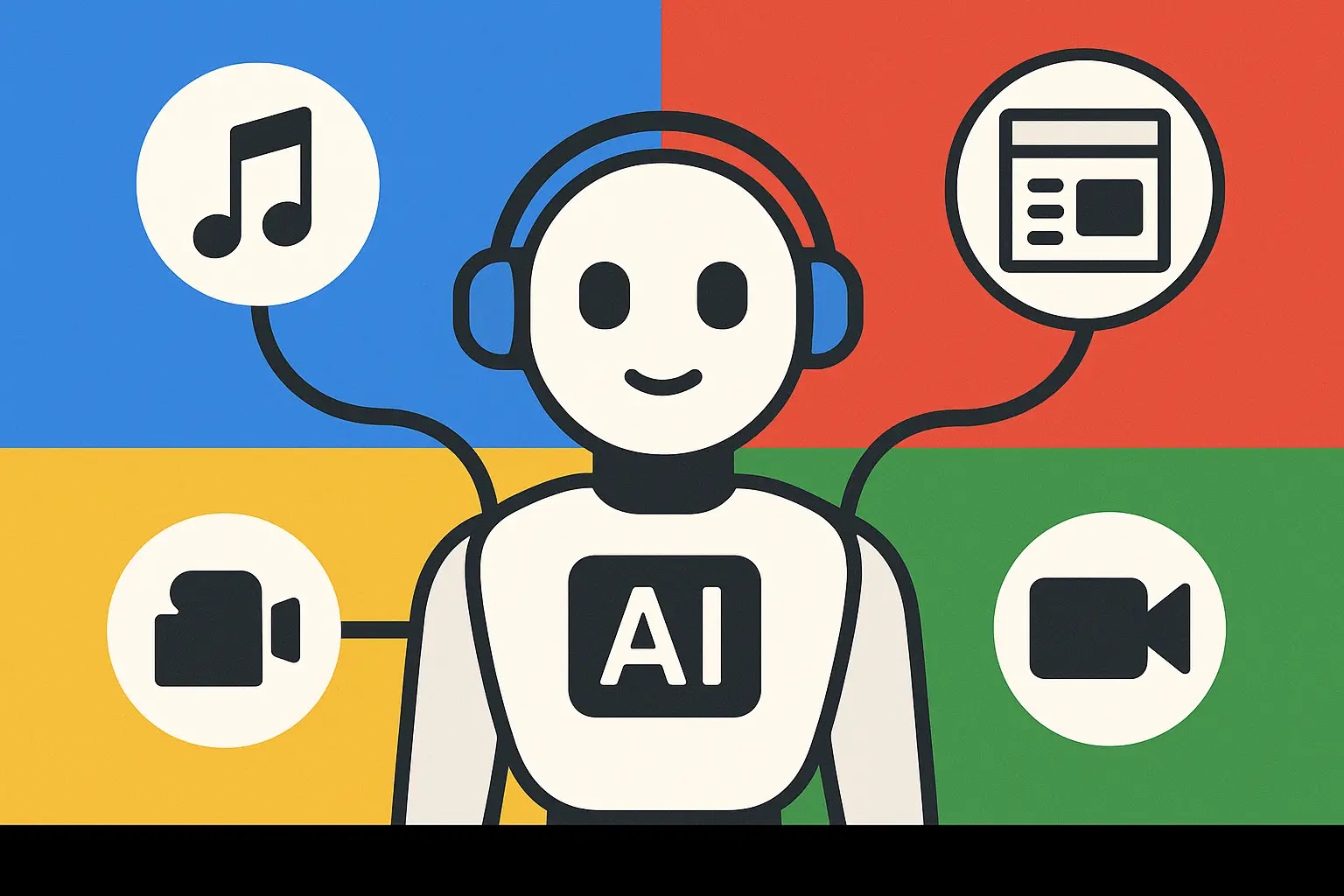
Google
Redefines What a Productivity Suite Can Do
Google has announced a sweeping upgrade to its Workspace suite,
rolling out Gemini-powered features across Docs, Slides, and an expanding
video platform called Google Vids. The updates are substantial enough to be
read as a strategic repositioning, not merely a feature release. Google is no
longer describing Workspace as a set of productivity tools. It is positioning
it as an AI-native media creation environment capable of handling writing,
presentation design, and video production within a single integrated
platform.
The timing is pointed. Microsoft has spent two years embedding
Copilot across its Office suite, and the enterprise software market is
watching closely to see whether Google’s Gemini integration can match or
exceed what Microsoft is offering. These updates suggest that Google believes
it can, and that it is prepared to move quickly enough to prevent Copilot
from establishing an insurmountable lead in AI-augmented
productivity.
Audio in Docs
The most immediately practical addition is audio playback in
Google Docs. Gemini can now convert any document into spoken audio, with
users selecting from voice styles including Narrator, Educator, and
Conversational. According to WebProNews, the
feature allows teams to collaborate in new ways, using audio annotations and
playback buttons embedded directly within documents. A floating controller
lets users pause, rewind, and adjust speed without leaving the document
view.
The accessibility implications are significant. For users with
visual impairments, dyslexia, or attention-related challenges, listen-back
transforms a tool that was essentially text-only into something genuinely
inclusive. For the much larger population of knowledge workers who need to
process long documents while commuting, exercising, or managing other tasks,
it provides a practical alternative to screen-based reading that will quickly
feel indispensable once adopted.
The feature launched on Gemini Business and Enterprise tiers, a
distribution decision that limits its immediate reach but reflects Google’s
strategy of using premium AI capabilities to differentiate higher-value
subscriptions. Whether this proves commercially effective depends on whether
enterprise buyers see it as a meaningful advantage over Microsoft’s
comparable Copilot features in Word.
Slides With a Smarter Edge
Google Slides is also receiving a significant Gemini upgrade.
Presenters can now generate draft slide decks directly from text prompts,
embed AI-generated visuals without leaving the application, and rehearse
presentations with AI feedback on clarity, pacing, and structure. These
enhancements push Slides toward territory previously occupied by specialist
presentation coaching tools and design applications.
The ability to generate slides from a prompt is not new in the AI
landscape. Several third-party tools have offered this capability for over a
year. What Google is offering is integration: the generated content arrives
inside the Workspace environment where it will ultimately be edited,
presented, and shared, without requiring export, import, or format
conversion. For enterprise users who live in Workspace, that integration is a
genuine time saving rather than a marginal convenience.
The rehearsal feedback feature is the more interesting addition
from a product design perspective. Rather than simply generating content, it
positions Gemini as a preparation partner that can improve the quality of
human communication rather than merely accelerating its production. That
distinction matters in the context of debates
about how businesses should balance AI capability with human
responsibility. A tool that makes humans better at presenting is
different from one that presents on their behalf.
Google Vids and the Video Frontier
The highest-profile element of the update is Google Vids, a
Workspace application focused on video content creation. Gemini integration
now supports auto-storyboarding, script-to-video conversion, and real-time
editing powered by Veo 3, Google’s latest video foundation model. According
to Google Workspace
documentation, these tools are explicitly positioned as enterprise-grade
alternatives to consumer video platforms, enabling companies to create
training content, marketing materials, and onboarding guides without relying
on third-party video production software.
This is an ambitious claim. Professional video production involves
colour grading, audio mixing, motion graphics, and editing discipline that AI
generation does not yet replicate at the quality level that polished
corporate content typically requires. What Google Vids can plausibly offer is
a significantly lower barrier to entry for organisations that currently
produce no video content at all because the perceived complexity and cost is
too high. A team that has never been able to afford external video production
might now produce functional training videos internally, even if those videos
fall short of broadcast quality.
The competitive logic is clear. YouTube, which Google owns,
established that video is now the default medium for learning, marketing, and
internal communication at scale. If Workspace can make video creation as
straightforward as document creation, it extends Workspace’s value
proposition into a domain that currently requires organisations to use
external tools. Whether Veo 3’s output quality is sufficient to make that
transition compelling will determine how much of this ambition converts into
actual adoption.
Security and Enterprise Trust
Alongside the creative expansion, Google has emphasised security
and compliance. A Workspace Prompting Guide details guardrails for enterprise
deployments of Gemini, covering encryption protocols and policy-aligned data
handling across all three applications. This is not incidental to the product
strategy. Enterprise buyers are increasingly wary of AI tools that introduce
new data flows into environments governed by strict regulatory requirements,
particularly in sectors like financial services, healthcare, and legal.
Google’s argument is that by keeping AI capabilities within the
Workspace perimeter rather than requiring users to export data to external AI
platforms, it reduces rather than increases the compliance risk. The Gemini
integration processes document content within the same security architecture
that already governs Workspace data. Whether that argument satisfies
enterprise security teams will vary by sector and jurisdiction, particularly
in markets where AI
regulation is advancing rapidly.
What Success Would Look Like
The updates to Docs, Slides, and Vids are individually meaningful.
Together, they make a coherent argument about where Google wants Workspace to
sit in the next generation of enterprise software. If the vision succeeds,
the distinction between writing a document, designing a presentation, and
producing a video collapses into a single creative workflow where Gemini
handles the technical transitions between formats while humans focus on the
content and message.
That is a significant enough shift in how knowledge work operates
that it deserves serious attention beyond the product release cycle. It also
raises questions that the launch documentation does not address: about
creative ownership of AI-generated content, about the skill implications for
roles that currently specialise in presentation design or video production,
and about what it means when the barrier to producing polished communication
materials effectively disappears. The
gaming industry’s experience with generative AI in creative
workflows offers some early lessons about how creative
professionals adapt when AI tools begin to take on tasks they previously
owned exclusively.
For now, the most honest assessment is that Google has made
Workspace more capable in ways that will be genuinely useful to a large
number of users, and genuinely transformative for a smaller number who will
adopt these features deeply. Whether it proves to be the competitive response
to Microsoft Copilot that Google needs is a question that adoption figures
over the next twelve months will answer more reliably than any product
announcement can.
About the Author
By Stuart Kerr, Technology Correspondent, LiveAIWire. Stuart
covers artificial intelligence, technology strategy, and the ways AI is
reshaping how organisations work. About
LiveAIWire.