
By Stuart Kerr, Technology Correspondent, LiveAIWire
Generative AI in Game Development Goes Mainstream
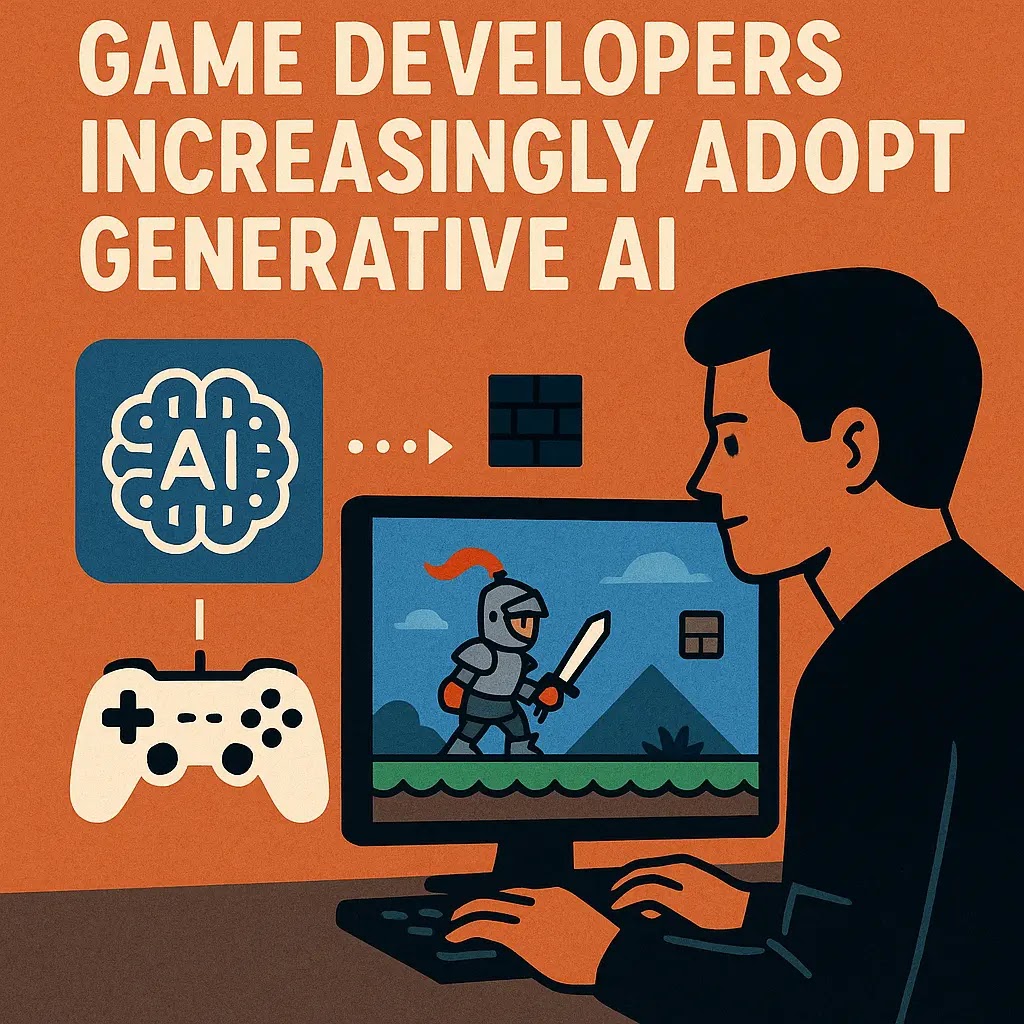
Generative AI in game development is no longer a fringe experiment, it has become a central tool in production pipelines. From automated playtesting to localisation, from procedural code support to non-player character dialogue, studios are increasingly adopting AI to cut costs and meet the rising expectations of global audiences.
A Reuters survey conducted by Google Cloud and The Harris Poll found that 87 percent of developers now use AI agents somewhere in their workflow. This includes 47 percent for playtesting and balancing, 45 percent for localisation, and 44 percent for scripting and code generation. Crucially, more than a third are now using AI for creative elements such as dialogue writing and level design.
How Studios Are Using Generative AI in Game Development
PC Gamer expands on this, noting that 36 percent of developers employ AI for creative storytelling tasks, while 37 percent use it to experiment with gameplay mechanics. These numbers suggest that generative AI in game development has moved beyond efficiency gains, it is actively shaping the artistic direction of games.
Immersive NPCs and Player Experience
Generative AI is also transforming how players interact with worlds. AP News highlights how studios are using AI to create dynamic NPCs capable of responding in real time to player choices. This evolution moves NPCs away from pre-scripted dialogue trees toward immersive, unscripted interactions that feel closer to human conversation.
The Legal and Ethical Questions
However, widespread generative AI in game development also raises thorny questions about ownership and creative integrity. A Harvard Journal of Entertainment and Sports Law paper explores how intellectual property rights may be challenged when AI systems generate characters, assets, or entire gameplay sequences. If a model designs a level, who owns it, the developer, the studio, or the AI vendor?
A ResearchGate review further examines the academic landscape, pointing to adaptive difficulty, procedural world-building, and ethical concerns around AI-driven behavioural prediction. There is also a quieter risk that mirrors what LiveAIWire has documented in our coverage of AI model collapse: procedurally generated content trained too heavily on prior AI output can flatten into repetitive, formulaic design rather than genuine creative variety.
Economic Pressures and Creative Opportunities
The shift toward generative AI in game development is also a response to mounting economic pressures. Development budgets for AAA titles now exceed hundreds of millions of dollars, while user expectations for realism and immersion continue to rise. This mirrors a broader pattern LiveAIWire has tracked across creative industries, including our reporting on the quality risks of AI-generated content flooding professional fields as production volume increases faster than editorial oversight can keep pace.
Yet not all uses of AI are reductive. For many smaller studios, AI represents a chance to compete with industry giants by automating routine work while focusing human effort on innovation, a dynamic also visible in how Gemini in Google Workspace is being positioned to let small teams produce polished video and presentation content without dedicated production staff.
Looking Forward
The trajectory is clear: generative AI in game development is becoming a co-creator in the production process. Whether building believable NPCs, localising text for global markets, or assisting with testing and bug-hunting, AI is embedding itself into the very DNA of modern game development.
The challenge now is not whether studios will adopt AI, but how they will balance its efficiency and creativity with the ethical, legal, and cultural questions it raises. As the industry continues to evolve, one thing is certain: the games of tomorrow will not just be coded by humans, but shaped by collaboration between human imagination and machine generation.
About the Author
Stuart Kerr is Technology Correspondent at LiveAIWire, covering artificial intelligence, cybersecurity, and the social impact of emerging technology. He publishes daily at LiveAIWire.com.