
By Stuart Kerr, Technology Correspondent, LiveAIWire
A New Battlefield for Influence
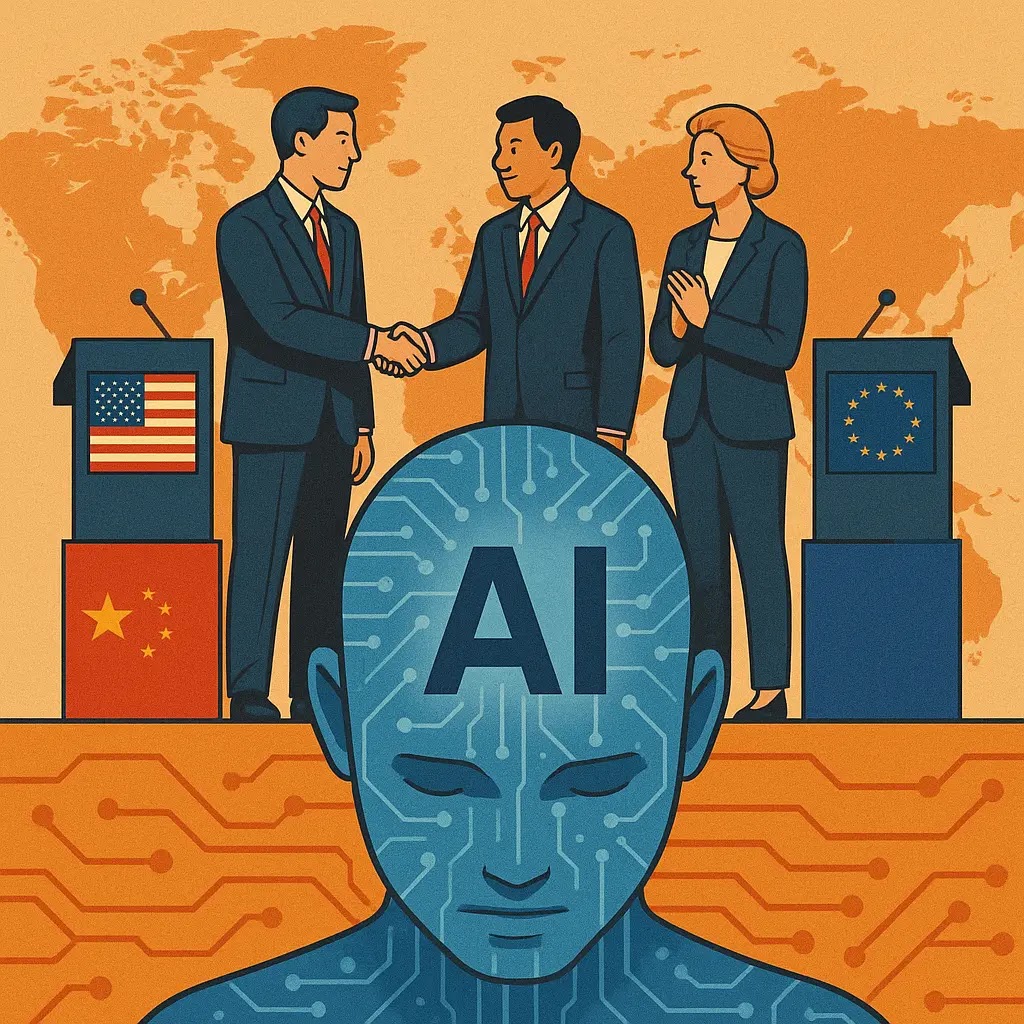
AI diplomacy has become the newest frontier in how nations project power abroad. Diplomacy has always evolved alongside technology. From the printing press to radio, and later the internet, states have used communication innovations to shape narratives and project influence abroad. Rather than deploying tanks or trade embargoes, countries are increasingly exporting state-backed AI models, systems trained not only on language, but also on national values, politics, and strategic interests. These models are quietly reshaping how influence travels across borders.
Unlike traditional propaganda, AI systems are packaged as neutral tools for productivity, education, or public service. Yet beneath their code lies an architecture of influence. As a recent analysis from the Diplomatic Courier noted, China’s Digital Silk Road strategy positions AI and data infrastructure as key components of its soft power exports. By embedding Chinese-built AI platforms into African universities, Asian startups, and Latin American government offices, Beijing ensures that its worldview and technological standards spread far beyond its borders.
The Global South as a Battleground for AI Diplomacy
Much of this contest is playing out in the Global South, where infrastructure gaps provide openings for external partners. According to the Carnegie Endowment, countries like Brazil, Indonesia, and Kenya are not just passive recipients but are actively shaping the AI landscape through export strategies and local alliances. These states recognise AI as both a development tool and a means to assert influence on the global stage.
For Africa, Chinese investment often comes bundled: fibre-optic networks, cloud infrastructure, and AI-enabled governance tools. In South America, partnerships with both China and the US are producing rival ecosystems, with Brazil at the forefront of regional innovation. In Asia, India has positioned itself as a counterweight, exporting its own AI systems with an emphasis on open-source frameworks and democratic safeguards.
The Digital Silk Road and Beyond
China remains the most aggressive in promoting AI as diplomacy. Sundial Press highlighted how Beijing’s Digital Silk Road integrates AI into a larger toolkit of fibre networks, surveillance systems, and smart city platforms across Africa and Asia. By tying critical infrastructure to Chinese-built AI, Beijing creates dependencies that extend beyond trade agreements.
This approach mirrors earlier soft power strategies, such as Confucius Institutes spreading Chinese language and culture. But the stakes are higher now. AI systems do not simply teach language, they mediate access to information, frame conversations, and even influence decision-making in subtle but powerful ways. When a government ministry in Nairobi or a classroom in São Paulo relies on a Chinese-trained AI assistant, that interaction quietly reinforces Beijing’s presence.
Academic and Strategic Frameworks for AI Diplomacy
The idea of AI diplomacy is not merely speculative. Scholars have begun developing frameworks to understand its strategic implications. A paper on arXiv outlines how generative AI models are already shaping public diplomacy and international negotiation practices. Meanwhile, a ResearchGate study traces the conceptual evolution of AI diplomacy as a distinct branch of foreign policy, where states export not just culture or technology, but coded influence.
These academic explorations underscore a central point: this is not only about competition between superpowers but also about how middle powers and developing nations use AI to amplify their voices. By building their own models or adopting those aligned with their political values, states can reposition themselves in the hierarchy of global influence.
When AI Diplomacy Becomes a Kill Switch
Yet this new frontier raises pressing concerns. If AI models become vectors of state influence, what safeguards prevent misuse? Unlike traditional media, where biases are often overt, algorithmic influence is subtle. The framing of search results, the prioritisation of certain narratives, or the shaping of cultural idioms within AI responses all embed political leanings beneath a veneer of objectivity.
The stakes of AI diplomacy became concrete rather than theoretical when a June 2026 Five Eyes joint warning on AI-enabled cyberattacks was followed weeks later by a US export-control order that cut European access to Anthropic’s most advanced models overnight, prompting Austria to formally ask the EU to explore hosting Anthropic within its own borders. The episode illustrated a pattern LiveAIWire has also traced in the debate over Nvidia chip export controls between the US and China: access to frontier AI capability is now a lever of national power, and the country that controls the switch controls far more than trade.
Toward Responsible AI Diplomacy
The question now is whether AI diplomacy can evolve responsibly. Scholars and policymakers alike stress the need for transparency, interoperability, and accountability. States that export AI models should disclose training data sources, governance structures, and intended use cases. Recipient countries must invest in AI literacy to evaluate these systems critically rather than blindly adopting them.
Multilateral forums may also play a role. Just as climate negotiations created shared norms for carbon accountability, international agreements could establish guardrails for AI diplomacy. Without such frameworks, the risk is a fragmented digital order, where competing AI blocs pull the Global South in conflicting directions.
A Future Written in Code
Diplomacy has always been about narratives, persuasion, and alliances. What has changed is the medium. Today, instead of pamphlets, radio broadcasts, or satellite TV, nations are projecting influence through algorithms and datasets. Code has become a new lingua franca of international politics.
The rise of AI diplomacy underscores the reality that power is no longer only measured in armies or GDP. Increasingly, it is measured in the ability to shape digital ecosystems and the values embedded within them. The battlegrounds of the future may not be deserts or seas but servers and cloud networks, spaces where influence is exerted not by soldiers, but by lines of code.
About the Author
Stuart Kerr is Technology Correspondent at LiveAIWire, covering artificial intelligence, cybersecurity, and the social impact of emerging technology. He publishes daily at LiveAIWire.com.