
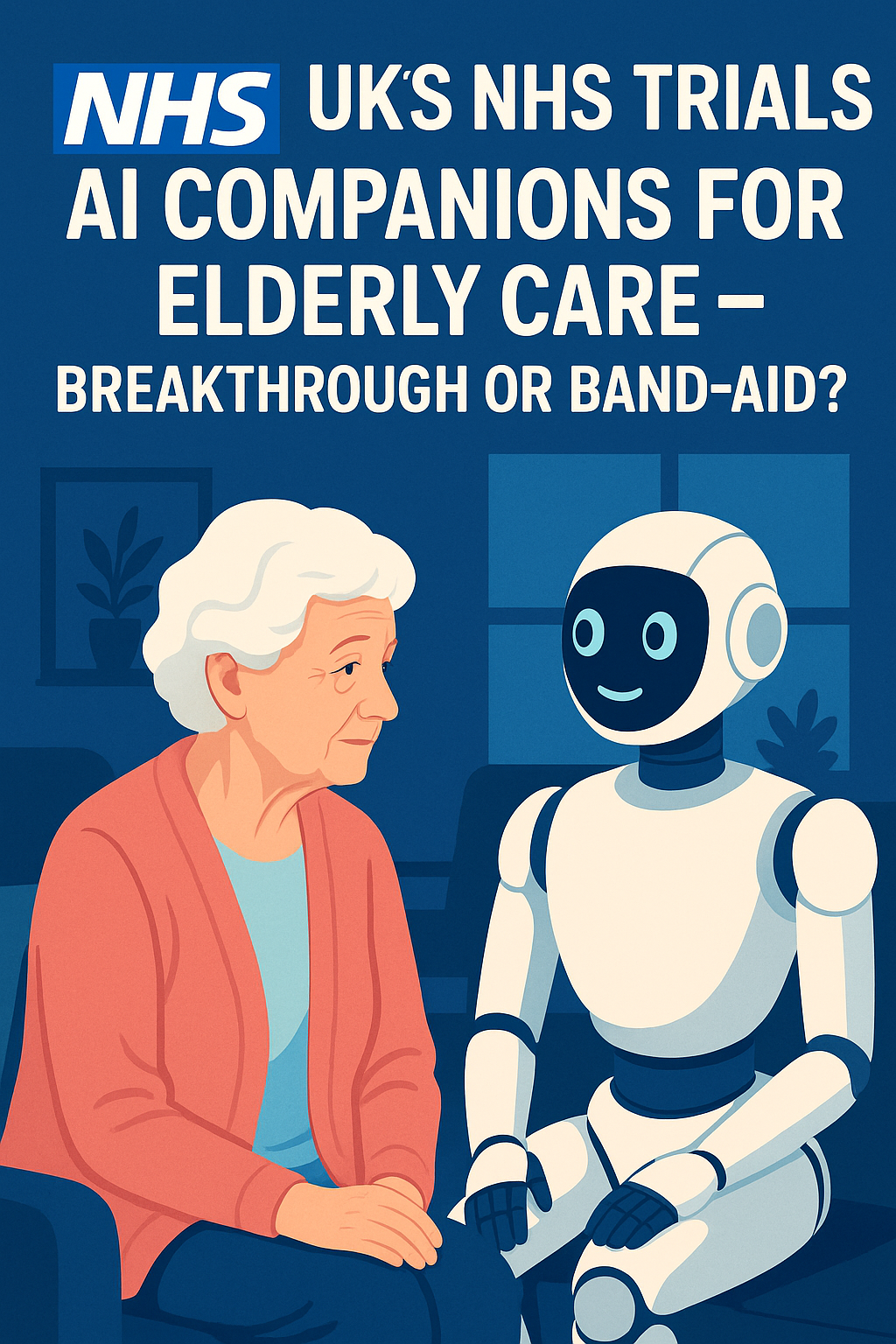
The
NHS is piloting AI companion robots in care homes across three English
regions, and the early results are generating both genuine excitement and
serious concern in equal measure. Designed to provide conversation, cognitive
stimulation, and companionship to elderly residents, these systems aim to
address one of the most pervasive and damaging conditions in older adult
care: loneliness. Research consistently shows that chronic loneliness among
older adults is associated with cognitive decline, increased risk of
dementia, depression, and significantly higher mortality rates. If AI
companions can meaningfully reduce loneliness at scale and at affordable
cost, the potential health benefit is substantial. If they simply provide a
cheaper substitute for human contact without addressing its underlying
causes, they may make a serious problem worse by making it less
visible.
The context is critical. The UK’s social care system is facing an
unprecedented crisis of funding, workforce, and demand. An ageing population
is increasing the number of people needing care. A workforce recruitment and
retention crisis means care homes are chronically understaffed. Government
funding has not kept pace with demand despite years of political attention.
NHS waiting times for services relevant to older adults, including community
mental health support, physiotherapy, and specialist assessment, are at
historic highs. Against this backdrop, AI companions are being offered as
part of a package of innovation-led responses to a system that is, in the
judgement of most independent analysts, fundamentally underfunded rather than
fundamentally inefficient.
What the Technology Does
The AI companion systems being piloted by the NHS range
considerably in sophistication. Simple tablet-based applications provide
conversation, reminders, and cognitive games through a chat interface. More
advanced robotic companions, including the PARO therapeutic robot developed
in Japan and used in several UK trials, use sensor responses and movement to
provide physical presence alongside digital interaction. Voice
assistant-based companions including those developed by companies such as
Intuition Robotics provide continuous ambient interaction that can alert
carers when residents show concerning changes in behaviour or communication
patterns.
The evidence from previous deployments of similar technology is
mixed but more encouraging than sceptics often acknowledge. A systematic
review published in the British
Medical Journal in 2023 found that AI companion interventions
produced measurable reductions in loneliness and depression scores in elderly
care home residents across multiple studies, with effects sustained over
several months. Cognitive outcomes were more variable, with some studies
showing maintenance of cognitive function and others showing no effect. Staff
in participating care homes consistently reported that AI companions seemed
to improve residents’ mood and engagement, though they also reported concerns
about residents forming attachments to systems that might be withdrawn.
The Ethical Questions
The deployment of AI companions in elderly care raises ethical
questions that the initial pilot results cannot settle. The consent question
is particularly acute: residents with dementia or significant cognitive
impairment may not be able to give meaningful informed consent to interacting
with an AI system they may not be able to distinguish from a human one.
Several ethics committees reviewing AI companion deployments have called for
enhanced safeguards for cognitively impaired residents, including proxy
consent processes and regular reassessment of whether continued deployment
remains in residents’ best interests.
The substitution question is equally significant. If AI companions
are used to justify reducing human staffing ratios in care homes, the net
effect on resident wellbeing is likely to be negative. Human care workers
provide not only conversation but also physical assistance, clinical
observation, and the kind of genuine relational care that research
consistently identifies as the most important determinant of care quality.
The UNISON care
workers’ union has opposed AI companion deployment where it is framed as a
workforce substitution measure, arguing that care workers provide
irreplaceable value that AI cannot replicate and that the real solution to
the care crisis is adequate funding and fair pay for human care
workers.
Dementia, Dignity, and the Limits of Simulation
The use of AI companions for people with dementia occupies
particularly difficult ethical ground. Dementia care ethics emphasises the
importance of authentic human relationship and the dignity of persons whose
cognitive capacity may make them unable to recognise that they are
interacting with a machine. Some ethicists argue that the deception implicit
in AI companion interactions, where a person with dementia genuinely believes
they are speaking with a caring human interlocutor, violates the principle of
truth-telling that underpins ethical care practice. Others argue that if the
interaction reduces distress and improves wellbeing, the strict application
of anti-deception principles in this context may not serve the interests of
the person being cared for.
These are not abstract theological disputes. They affect real
decisions about how care is provided to some of the most vulnerable people in
society, and they deserve careful, well-resourced ethical analysis rather
than being settled by procurement decisions driven primarily by cost
pressures.
What This Means for You
If you have elderly relatives in NHS-funded or privately operated
care, AI companion technology may already be part of their care environment
or may become so in the near future. Understanding what the technology does,
what the evidence says about its effects, and what questions to ask care
providers about how it is being used is an important part of informed family
engagement with the care system. The pilots currently underway in England
should generate better evidence about both benefits and risks than is
currently available, and their evaluation framework should include rigorous
assessment of whether AI companions complement or substitute for human care.
The workforce implications of AI companions in care deserve more honest
attention than they typically receive in technology-optimistic pilot reports.
The care workforce in England is chronically undersized, underpaid, and
undervalued, with vacancy rates in some regions exceeding 15 percent according
to Skills for Care annual reports. Addressing these structural workforce
failures requires investment in wages, training, career pathways, and working
conditions that AI companions do not provide. The risk is not that AI
companions will replace care workers in the near term, but that their
deployment will reduce the political urgency of addressing the workforce
crisis by providing visible technological responses to a problem that
requires human ones. Commissioners, inspectors, and campaigning organisations
including Age UK
are well placed to monitor whether AI companion deployment is being used to
justify staffing reductions that compromise fundamental care quality, and
their scrutiny role is essential to ensuring that technological innovation
serves rather than substitutes for genuine care system reform. The NHS
England evaluation framework for the current AI companion pilots specifically
includes workforce impact assessment as a required component, reflecting
awareness of the substitution risk at policy level. Whether this framework is
implemented rigorously in practice, and whether its findings inform both
commissioning decisions and the broader political debate about social care
funding, will determine whether the AI companion pilots produce genuine
evidence that advances the field or simply provide ammunition for those
seeking cheaper alternatives to properly funded human care.
For related coverage of AI in health and care settings, see our
analysis of AI
in mental health detection and AI
emotional intelligence systems.
About the Author
Stuart Kerr is a technology correspondent at LiveAIWire, covering
artificial intelligence, digital innovation, and the social impact of
emerging technologies. Follow LiveAIWire for daily analysis at liveaiwire.com.