
By
Stuart Kerr, Technology Correspondent, LiveAIWire
Japan has more robots per capita than any other country, and the
reason is demographic rather than technological: by 2040, roughly one in
three Japanese citizens will be over sixty-five, and the care workforce
cannot grow fast enough to meet the demand. The robotic care assistant is not
a science fiction proposition in Tokyo or Osaka; it is a procurement decision
being made by nursing homes and municipal governments this
year.
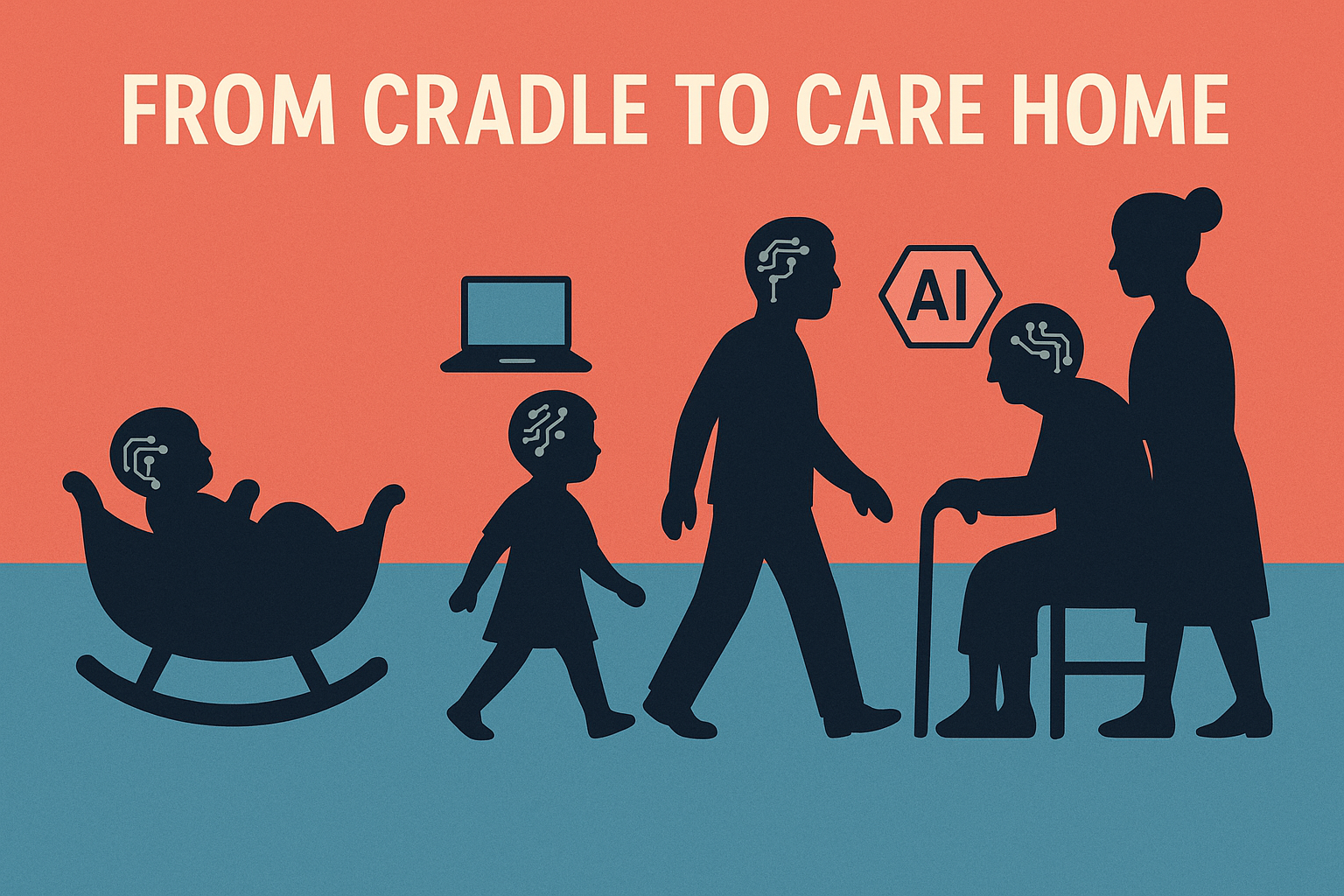
The question of whether robots can genuinely look after people
across the full arc of life, from early childhood support through to
palliative care, is both technical and philosophical. The technology is
advancing faster than anticipated. The human questions it raises are
advancing faster than the governance frameworks designed to answer
them.
What Personal Robots Can Already Do
The current generation of care robots spans a wide functional
range. At the physical end, systems like RIKEN’s ROBEAR can lift and
reposition patients, reducing the musculoskeletal injury risk that makes care
work one of the most physically demanding occupations. Mobility assistance
robots help people with limited lower-body function navigate their homes
independently. Medication dispensing robots ensure correct dosing at correct
intervals without requiring a carer to be present for each administration.
At the social and cognitive end, companion robots such as PARO, a
therapeutic seal-shaped device used extensively in dementia care, have
demonstrated measurable reductions in agitation and anxiety in clinical
trials. The robot does not understand what the person is saying; it responds
to tone, touch, and movement with behaviours that patients interpret as
responsive and caring. That interpretation is real even if the reciprocity is
simulated, and the therapeutic outcomes are documented in peer-reviewed
research published in journals including the Journal
of Medical Internet Research.
For children, social robots have been used in educational settings
to support children with autism spectrum conditions, providing predictable,
low-pressure interaction that helps develop social communication skills. The
evidence base here is growing, though researchers are careful to position
robotic interaction as a complement to, not a substitute for, human
therapeutic relationships.
The Gap Between Capability and Full Care
What personal robots cannot yet do is provide the integrated,
contextually sensitive care that a skilled human carer delivers. Recognising
that a patient’s unusual quietness today is significant requires
understanding that person’s normal baseline over months of interaction. Adjusting
the emotional register of an interaction based on subtle cues about how
someone is feeling requires a level of social intelligence that current
robots do not possess. Navigating the physical complexity of a real home
environment, with its unpredictable layouts, cluttered surfaces, and varied
lighting, remains genuinely difficult for robotic systems designed in
controlled laboratory conditions.
What this means for you or for family members considering care
options: robotic care technology is most effective as a support layer that
extends the reach of human carers rather than as a replacement for them. The
framing of personal robots as a solution to the care workforce crisis can
obscure the risk of using them to justify reducing human staffing levels
before the technology is ready to fill the gap.
The Care Home Deployment Experience
Care homes in the UK, Germany, and the Nordic countries have been
piloting robotic care assistants with mixed results. The physical assistance
applications, particularly for patient lifting and repositioning, have been
well received by care workers who report significant reductions in back
injury. The social companion applications have shown variable results
depending heavily on how they are introduced and how care staff are trained
to integrate them into daily routines.
The most consistent finding across deployment studies is that
robots work best when they are designed to augment the human care
relationship rather than substitute for it. A companion robot that prompts a
person with dementia to take their medication and alerts a human carer when
something seems wrong is a different proposition from a robot deployed to
reduce the number of human carers required per resident. The former improves
outcomes; the evidence for the latter is considerably weaker.
Research from the Oxford
Institute of Population Ageing has examined the ethical dimensions
of robotic care in depth, concluding that the technology’s potential is
genuine but that deployment decisions must be grounded in evidence about
outcomes for care recipients rather than primarily in calculations about cost
reduction for care providers.
The Intimacy Problem
Care is intimate. Bathing, dressing, feeding, and comforting
someone who is vulnerable requires a quality of human presence that most
people believe cannot be replicated by a machine, however sophisticated. The
philosophical question of whether a person with advanced dementia who cannot
distinguish a robot companion from a human one is being deceived, and whether
that deception is harmful, is genuinely contested among
ethicists.
Proponents argue that the therapeutic benefit is real regardless
of whether the patient understands the nature of the interaction. Critics
argue that a society that substitutes robotic care for human care is making a
statement about the value it places on the lives of its most vulnerable
members, and that the statement is one we should examine honestly before the
deployment decisions are made at scale.
The connection to the
broader debate about AI companion relationships is direct: the
questions of attachment, authenticity, and the ethics of simulated emotional
responsiveness apply in care settings with particular acuity because the
stakes, for a person who is ill, isolated, or cognitively declining, are so
high.
Policy, Funding, and the Care Workforce
The political economy of robotic care is shaped by the care
workforce crisis in most developed countries. Care work is physically demanding,
emotionally intensive, and poorly compensated; recruitment and retention are
chronic problems in virtually every healthcare system. Robots are being
positioned partly as a workforce supplement in this context, and the case has
genuine merit when the alternative is unfilled care roles.
The risk is that robotic care becomes a justification for
continued underinvestment in human care workforce pay and conditions, rather
than a genuine addition to the care system’s capacity. Several care worker
unions in the UK and Germany have raised this concern explicitly, arguing
that technology investment should accompany rather than substitute for
workforce investment. The broader
pattern of automation displacing rather than augmenting human
workers in cost-driven sectors gives those concerns empirical
grounding.
The answer to whether robots can really look after us is, for now,
partial. They can do some things well, some things adequately, and some
things not at all. The question that matters more is whether we deploy them
wisely, in ways that genuinely improve the lives of people who need care, or
expeditiously, in ways that primarily improve the balance sheets of those who
provide it.
The deployment experience in care homes connects directly to the
wider challenge of algorithmic
systems making consequential decisions in intimate domains — where
the efficiency case is compelling and the human stakes are
highest.
The international comparison is instructive.
Countries that have invested most heavily in care robotics have done so under
severe demographic pressure. The lesson for countries earlier in the
demographic curve is that the time to develop ethical and regulatory frameworks
for care robotics is before the crisis makes rapid deployment feel
inevitable.
About the Author
Stuart
Kerr is a technology correspondent at LiveAIWire, covering artificial
intelligence, emerging technologies, and their impact on society and
industry.