
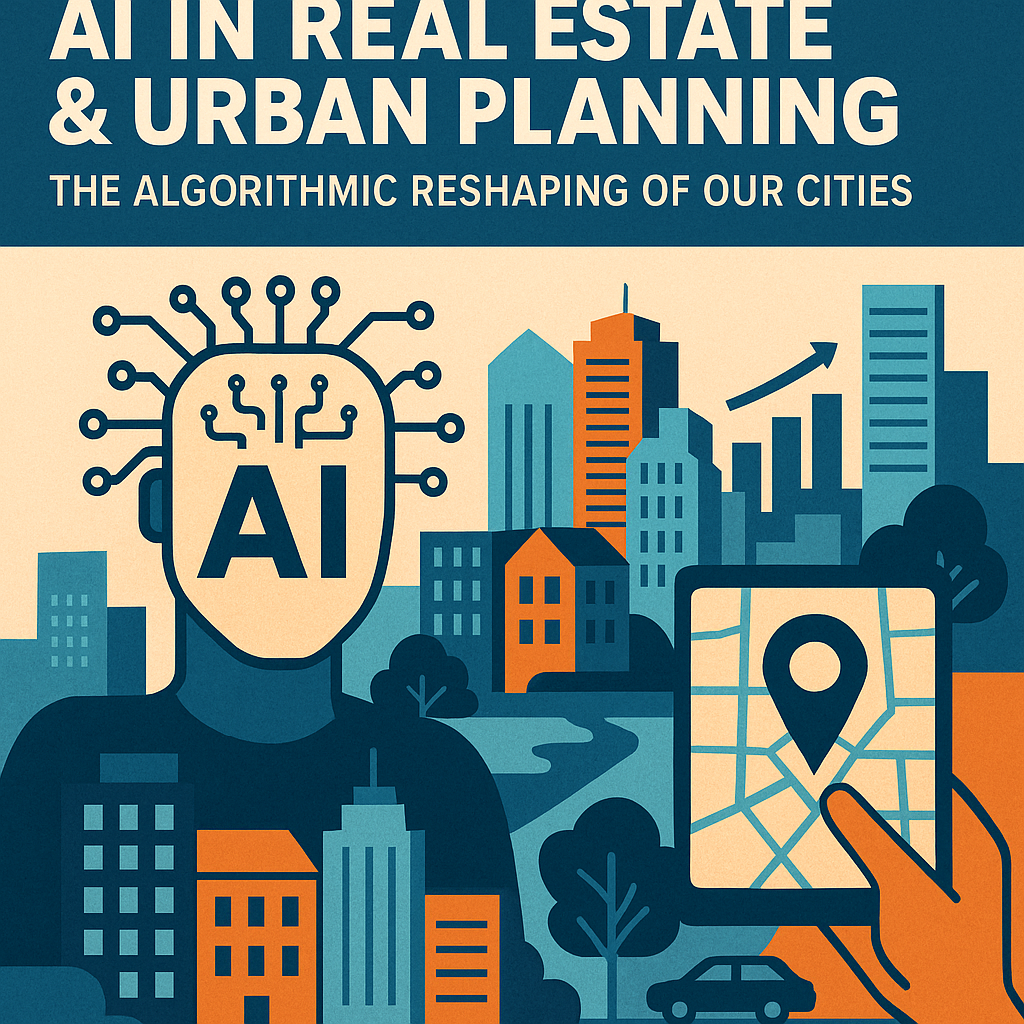
The
value of the property you live in is increasingly determined not just by its
physical attributes but by AI models that process thousands of variables,
including school performance data, crime statistics, local business openings
and closures, transport connectivity changes, and even social media sentiment
about specific neighbourhoods, to generate automated valuations that
influence mortgage decisions, rental pricing, and investment flows. These
models are reshaping the economics of housing in ways that are largely
invisible to the people most affected by them, and they are doing so in a
regulatory environment that was designed for a world where property
valuations were conducted by human professionals with professional
accountability.
AI is simultaneously transforming urban planning in ways that hold
considerable promise for more efficient, equitable, and environmentally
sustainable cities, and considerable risk of encoding existing inequalities
into the infrastructure of the future. The technology is powerful enough to
reshape cities significantly. Whether it reshapes them for better or worse
depends on who designs the systems, what objectives they are optimised for,
and whose interests are centred in the process.
Automated Valuation and the Housing Market
Automated valuation models (AVMs) have been used by mortgage
lenders for decades, but AI has dramatically increased their sophistication
and prevalence. Platforms including Zoopla, Rightmove, and Zillow provide
AI-generated property valuations that millions of people consult when making
buying, selling, and rental decisions. These valuations influence not just
individual transactions but broader market dynamics, as algorithmic pricing
by large landlords and institutional property investors, based on AI demand
signals, is increasingly affecting rental markets in major
cities.
Research from universities including Sheffield and UCL has
documented how AI property valuation systems can perpetuate and amplify
neighbourhood-level inequalities. Properties in areas with lower average
valuations receive AI-generated assessments that reflect their neighbourhood’s
historical position, regardless of individual property quality, creating a
form of algorithmic redlining that limits equity appreciation for homeowners
in already disadvantaged areas. The Royal Institution of Chartered Surveyors
has published guidance on AVM limitations that emphasises the need for human
professional oversight in high-stakes valuations, but the guidance is
advisory and market pressure toward automation is strong.
Urban Planning and the Algorithmic City
AI tools are being integrated into urban planning processes across
the UK and globally. Transport modelling that previously required weeks of
manual analysis can now be completed in hours using machine learning. Traffic
flow optimisation systems in cities including London, Singapore, and
Amsterdam use AI to manage signal timing in real time, reducing congestion
and emissions. Planning departments use AI to model the impact of proposed
developments on local services, infrastructure capacity, and environmental
quality.
The Greater
London Authority has piloted AI planning analysis tools that can
assess planning applications for policy compliance far more rapidly than
human planners, allowing staff to focus on complex cases requiring nuanced
professional judgement. Similar tools are in use in Birmingham, Manchester,
and dozens of smaller authorities. The efficiency gains are genuine, but
planning decisions are not purely technical assessments; they are the
mechanism through which communities shape their own environments, and the
displacement of human judgement by algorithmic assessment raises legitimate
questions about democratic accountability in the planning
process.
Smart City Infrastructure and Surveillance
The smart city concept, in which AI analyses data from sensors,
cameras, and connected devices throughout the urban environment to optimise
city services, has been implemented in various forms in cities worldwide. Air
quality monitoring, pedestrian flow analysis, energy demand management, and
waste collection optimisation are all being implemented using AI in UK
cities, with measurable efficiency and environmental benefits. The same
sensor infrastructure that supports these beneficial applications also
creates comprehensive surveillance capabilities that operate without specific
legal authority in most jurisdictions.
The intersection of smart city infrastructure and surveillance is
an area of active concern for civil liberties organisations. The Big Brother
Watch campaign has documented the deployment of AI-enabled
surveillance systems in UK cities that operate without the transparency and
accountability required for systems of equivalent intrusiveness in other
public sector contexts. The governance frameworks for smart city AI are
significantly less developed than the technology itself.
What This Means for You
The AI systems shaping your city are affecting property values,
planning outcomes, transport patterns, and the quality of public services in
ways you are unlikely to be aware of. If you have received an automated
property valuation, applied for planning permission, or simply used public
transport in a major UK city, AI has been involved in shaping your
experience. Your ability to challenge or influence these systems is limited,
but it is not zero. Planning decisions remain subject to appeal and
democratic scrutiny. Property valuations can be challenged through
professional surveyors. Smart city data governance is increasingly subject to
public consultation requirements. Engaging with these processes, and
supporting advocacy organisations that hold algorithmic urban systems
accountable, is a meaningful form of civic participation in the increasingly
AI-mediated city. The housing affordability crisis intersects with AI in ways
that are only beginning to be understood. Institutional investors using AI to
identify undervalued property markets and execute large-scale acquisitions
can move faster than local planning and housing policy can respond,
accelerating rent increases and displacement in markets that were previously
stable. Research from the Joseph Rowntree
Foundation has documented this dynamic in several UK cities, where
AI-enabled institutional buy-to-let acquisition has contributed to rental
market stress in areas that local authorities did not anticipate as
high-risk. The responsiveness gap between AI-accelerated real estate markets
and the slower pace of planning and housing policy creates conditions in
which market disruption outpaces democratic response, and communities bear
costs that were neither chosen nor anticipated. Planning authorities have
legal tools available to manage these dynamics, including Article 4
directions that restrict permitted development rights in areas at risk of
rapid change, and housing acquisition strategies that allow councils to build
social housing stock in areas where private market activity is displacing
lower-income residents. AI monitoring of real estate market dynamics could
actually support better-informed use of these planning tools, if councils
invest in the analytical capacity to interpret and act on the signals these
systems provide. The interaction between AI-accelerated real estate markets
and existing planning and housing policy frameworks is an area requiring
urgent policy attention in multiple UK cities, and local authorities that have
begun mapping institutional AI property acquisition activity in their areas
are better positioned to respond with proportionate planning and housing
interventions than those that are only discovering the problem after
significant displacement has already occurred.
The tenant rights implications of AI in private rented markets
deserve specific attention. AI dynamic pricing systems that adjust rents in
real time based on demand signals, similar to hotel and airline pricing
models, are being piloted by large institutional landlords in the US and UK.
For tenants on fixed incomes or in housing benefit, the interaction between
dynamic AI pricing and the slow-moving housing benefit system can create
acute affordability crises. The Renters Rights Act in England, which
strengthens security of tenure for private tenants, provides some protection,
but the specific risks created by AI dynamic pricing are not adequately
addressed by existing tenancy law in most jurisdictions. The housing charity
Shelter has called for specific regulation of AI rental pricing
practices.
For related analysis, see our coverage of AI
in local government and AI
in infrastructure systems.
About the Author
Stuart Kerr is a technology correspondent at LiveAIWire, covering
artificial intelligence, digital innovation, and the social impact of
emerging technologies. Follow LiveAIWire for daily analysis at liveaiwire.com.