When AI Gets Boring — And What Developers Should Do About It
By Stuart Kerr, Technology Correspondent — LiveAIWire
Published: Nov 29 2025 | Updated: Nov 29 2025 • Contact: liveaiwire@gmail.com
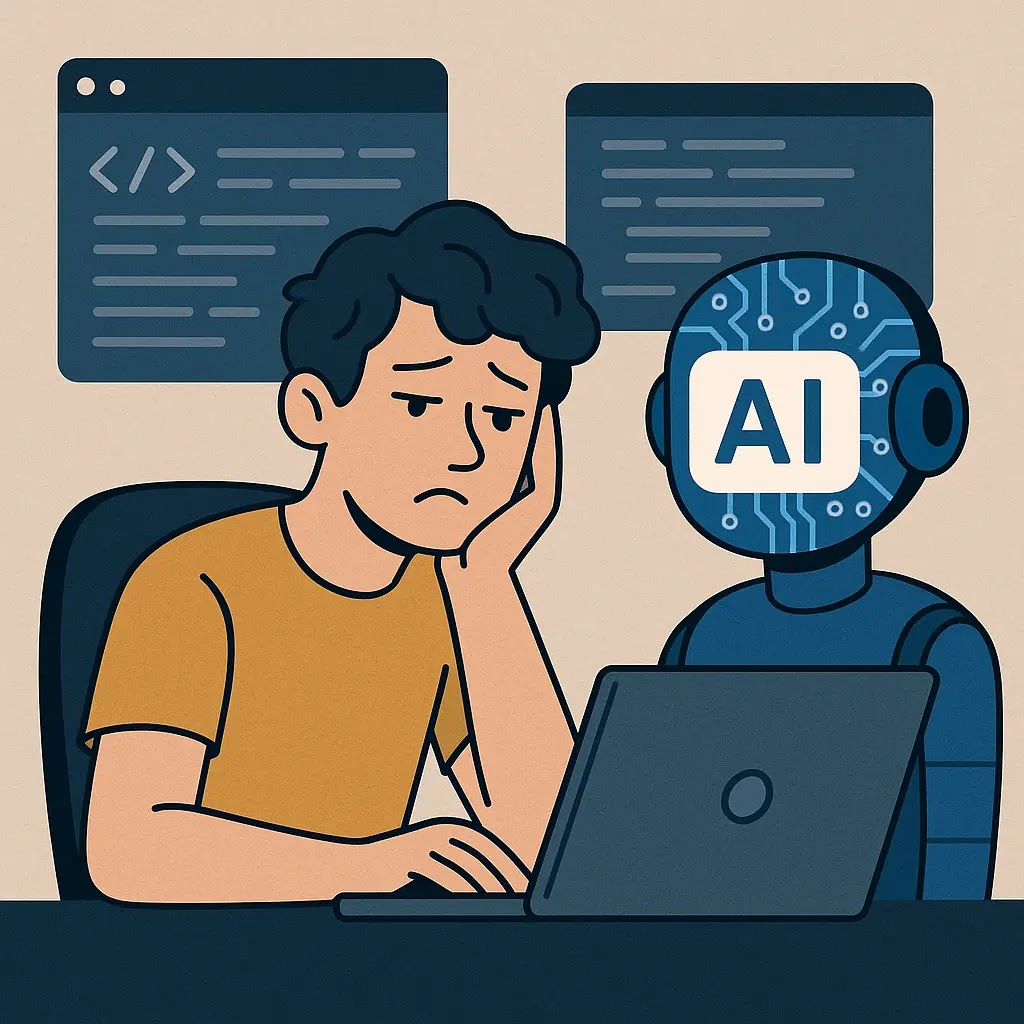
At first, generative AI dazzled — limitless ideas, speedy execution, dazzling visuals, and copy at the press of a button. But now? For many, there’s a creeping sense of monotony. Articles blur together. Images start feeling formulaic. Even creative workflows can feel hollow. The magic feels tired. The excitement dulls. Welcome to the age of “boring AI.”
But the boredom isn’t just in our heads. In 2025 researchers are warning: some of today’s most popular generative systems are slowly degrading — not because hardware is failing, but because the very data and methods that built them are breeding repetition, collapse and creative atrophy. VKTR.com+2AICompetence.org+2
This article explores why that’s happening — and what developers can do to keep AI alive, surprising — and meaningful.
Why AI Feels Boring: From Fatigue to Feedback Loops
Content overload and audience fatigue
As more people adopt AI-driven content tools, the internet is drowning in rapid-fire blog posts, marketing copy, generic essays, and derivative short-form content. That flood makes everything blur together — originality becomes rare, and audiences grow tired. Column+1
A 2025 industry analysis described a phenomenon many now recognise: an “AI content fatigue,” where users stop engaging, not because of quality alone — but because of sheer volume and repetition. EY+1
The hidden technical culprit: model collapse and synthetic-data feedback loops
Beyond cultural fatigue lies a deeper structural problem. The more generative AI tools pump out synthetic content — images, text, video — the greater the chance that future AI models will be trained on that synthetic output rather than fresh, human-generated data. When that happens repeatedly, the training loop can degrade the system’s ability to produce novelty, variety, or richness. Researchers call this decay “model collapse.” VKTR.com+2AICompetence.org+2
In simple terms: if a model learns from what previous models created — rather than from human-grounded content — it begins to lose connection with real-world diversity. Over time, outputs become generic, predictable, repetitive — sometimes “fluent but hollow.” arXiv+2ResearchGate+2
Moreover, related failure modes such as “mode collapse” (when generative models stop producing diverse outputs and collapse into repeating a few common patterns) contribute directly to the sense of sameness and creative exhaustion. Wikipedia+1
Productivity paradox: more output, less engagement
AI boosts speed. It ramps up output. But for many users and creators, that comes at a cost to motivation, enjoyment, and engagement. A recent survey found that while generative-AI tools increased productivity, they also caused a drop in intrinsic motivation among workers — many reported feeling bored, disengaged or “less creative.” Rumusc+1
In other words: AI does a lot of the heavy lifting — but sometimes that heavy lifting leaves little room for wonder, challenge, or creative tension. Without friction or struggle, some of the spark goes missing.
What’s at Stake: Creativity, Trust & The Value of Human Voice
As AI-generated content proliferates, the baseline for novelty rises — and yet uniqueness becomes scarcer. That threatens more than audience attention: it threatens authenticity, trust, and the very value of distinctive human voice.
When AI content dominates the landscape, human-generated work risks being drowned out. The result isn’t just boredom — it’s homogenisation. Online spaces may become flooded with slick—but shallow—content. As one critic described it: “AI slop” — polished, coherent, but devoid of depth. Wikipedia+1
Furthermore, heavy reliance on synthetic data and self-referential training poses long-term risks. Models may lose grounding in reality, repeat biases, hallucinate more often, or produce superficially plausible but misleading outputs — eroding trust in AI systems. OpenAI+2Misinformation Review+2
For creators, this means: what was once a powerful creative assistant can slowly become a dull echo machine — one that undercuts originality rather than amplifying it.
What Developers (and Creators) Should Do — Re-engineering Against Boredom
The good news: this isn’t inevitability. There are paths forward — if developers acknowledge the risks and build accordingly.
Diversify training data — avoid synthetic-only diets
The core solution is simple but challenging: ensure AI models continue to train on high-quality, human-generated, diverse data. Synthetic outputs can supplement — but should never dominate the data diet. Multiple studies warn that models retrained primarily on synthetic data are prone to performance degradation, loss of diversity and creative stagnation. AICompetence.org+2Wikipedia+2
Many in the research community now advocate for hybrid data pipelines: mixing real-world text, multimedia, curated human-authored content — and minimising repeated exposure to AI-generated garbage. Recent proposals even suggest techniques like “confidence-aware loss functions” to down-weight overconfident model-generated data during retraining. arXiv+1
Treat AI as assistant — not autopilot
Instead of offloading entire creative workflows to AI, developers and creators should build systems that keep humans in the loop. Use AI to augment — ideation, scaffold, brainstorm — but leave emotional nuance, final editing, nuance, judgment to humans. This maintains quality, surprise, depth — and preserves human creative agency.
In programming contexts, some developers already argue that AI tools shouldn’t replace developers, but act as productivity boosters — prompting iterative thinking, critical review, and final human judgment. DEV Community+1
Monitor outputs for decay — guardrails, ongoing evaluation & diversity checks
As models evolve, teams should build in quality-control processes. Regular audits, diversity sampling, out-of-distribution tests, bias checks, hallucination detection and user feedback loops can catch early signs of collapse or blandness before they spread.
Recent academic work outlines frameworks for tracking “knowledge collapse,” “semantic drift,” and declining output diversity — giving developers tools to respond, retrain, or reset before degeneration becomes entrenched. arXiv+1
Promote freshness — creative prompting, mixed modalities, periodic resets
Creativity thrives on tension, novelty, constraint and surprise. AI workflows should embrace that. Instead of always generating the same type of output, developers can encourage multi-modal content (text + image + audio), constraints, randomness, strategic “noise,” and collaboration — ways that keep outputs fresh and unexpected.
Periodic model resets — retraining on fresh human-curated data rather than recycling synthetic data — can also help break the echo chamber.
Conclusion: Boring AI Is Not the End — But a Reckoning
The early years of generative AI felt magical: breakthrough after breakthrough, every tool expanding what was possible. But as the novelty fades and output scales, we face a reckoning: AI that creates at speed can easily slip into sameness, monotony, creative fossilisation.
Yet this moment doesn’t mark failure — but maturation. It’s a call to builders, developers, creators: design AI not just for output, but for vitality. To protect diversity, novelty, unpredictability. To build systems that don’t just mimic — but continue to surprise, challenge, evolve.
If we do that, AI remains not a content factory — but a creative partner. One that keeps us curious, engaged — and yes, even inspired.
© LiveAIWire 2025 — Supplemented by AI and Caffeine
About the Author
Stuart Kerr is a correspondent on AI at LiveAIWire. He reports on how AI reshapes work, creativity and the systems people rely on.