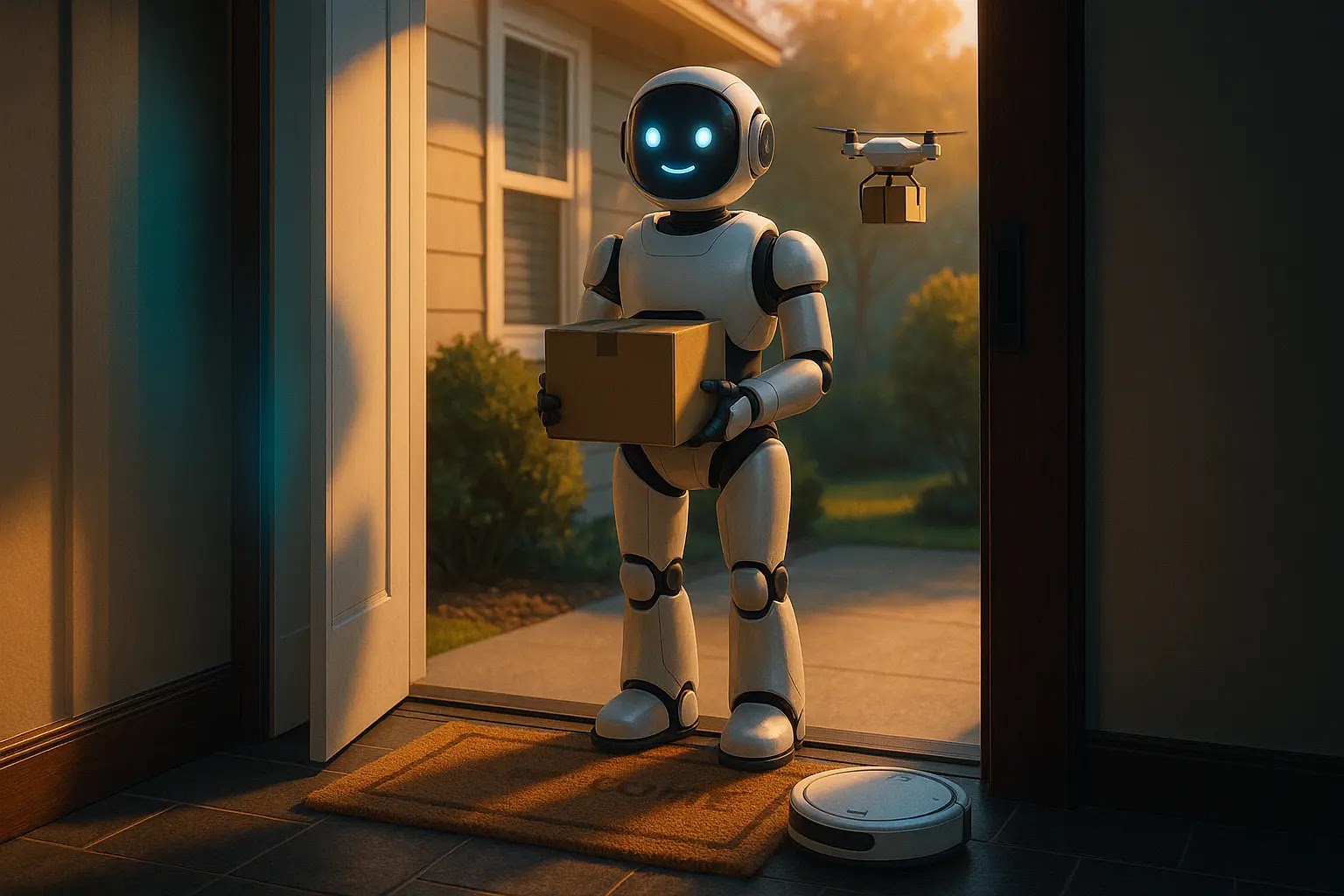
Home droids at the door — now vs next
By Stuart Kerr, Technology Correspondent
Published: 22 October 2025 | Last updated: 9 May 2026
Contact: [email protected] | Follow @LiveAIWire on X
Author Bio: https://liveaiwire.com/p/to-liveaiwire-where-artificial.html
Tesla Optimus V3 Is Coming, But the Home Robot Is Already Here
Home robots are no longer a distant promise, and 2026 is the year that promise is being put to the test. Tesla’s Optimus V3, the third-generation humanoid robot, is now confirmed for a mid-year debut with large-scale production targeted between July and August 2026. The robot features 37 joints, improved hand dexterity, and a walking speed of 1.2 metres per second, designed for both industrial and eventual domestic use. Tesla is converting its Model S and X production lines at the Fremont factory to manufacture Optimus at scale, targeting one million units per year. And yet, as of May 2026, you still cannot buy one. That gap between announcement and availability tells you almost everything about where home robotics actually stands right now.
Elon Musk has been nudging timelines for years. He told reporters that Tesla could sell its humanoid as soon as the end of next year, while simultaneously emphasising factory use first. In Q1 2026 he confirmed Optimus V3 was already walking around but needed finishing touches before its public debut, a short delay that nonetheless missed a timeline Tesla had publicly committed to. The pattern is consistent: bold targets, iterative delivery, factory floors before living rooms. That sequencing is actually sensible. Prove the robot where the environment is controlled and the return on investment is obvious, then talk about folding laundry.
What the Factory-First Approach Tells Us
Outside Tesla, the same factory-first logic is playing out across the industry. BMW’s partnership with Figure to test humanoids on production lines is a clear signal that the proving ground for domestic robots is the warehouse, not the kitchen. NVIDIA’s Isaac GR00T N1 platform is accelerating the pace by training humanoid reasoning and physical skills through simulation and multimodal data rather than hand-crafted programming, which means the gap between factory-capable and home-capable is narrowing faster than hardware timelines suggest.
The near-term skills that translate from factory to home are not cinematic. They are repeatable fetch-and-carry, object hand-off at counter height, and simple tidying that avoids high-risk scenarios involving heat, knives, and wet floors. Even getting those right at consumer-grade reliability is a significant engineering challenge. Reliable perception in messy rooms, safe handling of deformable objects like clothing and food, robust movement on stairs, and a battery duty cycle that lasts longer than a novelty demonstration are all unsolved at scale.
The Robot Already in Your Home
Meanwhile, the home robot that actually exists is already on the wall behind the glass. A tablet by the kettle or a smart hub in the hallway coordinates cameras, answers the door, manages thermostats and lighting, and routes a robotic vacuum with centimetre-level mapping that improves every week. None of that carries shopping across a threshold, but it handles the majority of everyday assistant tasks with far fewer failure modes than any biped. When Amazon wound down Astro for Business to refocus on the home, it underlined that the winning proposition in domestic AI is still a dependable routine, not a showstopping gait.
This is the hybrid reality shaping the next two to three years. Screens and voice models continue to orchestrate the home with growing sophistication. Narrow specialist robots, floor cleaners, garden mowers, window washers, arrive as single-purpose tools that do a handful of things well. And a general-purpose humanoid begins its domestic journey as a supervised, bounded assistant in specific settings, not a universal helper that replaces human judgment.
What Comes Next and What It Will Cost
Tesla has indicated that external customer deliveries could begin in late 2026, initially targeting enterprise clients and industrial partners before consumer access opens, likely in 2027 at the earliest. At production volumes exceeding one million units annually, Tesla projects the manufacturing cost could fall below twenty thousand dollars, roughly half the cost of a Model Y at equivalent scale, though market pricing will reflect demand that Musk expects to significantly outstrip supply.
For readers tracking the energy implications of all this, The Energy Crisis of AI: Why Tech Giants Won’t Reveal Their Real Power Use examines grid reality versus renewable marketing, and AI and Climate Change: Can Machines Help Save the Planet? looks at where optimisation is already measurable. And for the governance frameworks that will matter the moment a humanoid enters a home, AI Bias Guardrails: Why August 2026 Is the Deadline That Changes Everything sets out what real accountability for autonomous systems looks like.
The bottom line is less science fiction than it sounds. A household droid is coming, but it will arrive in stages, factory-hardened, energy-aware, and narrowly useful before it is broadly capable. Until then, the most dependable robot in the room is still the one behind the glass.
About the Author
Stuart Kerr is Technology Correspondent at LiveAIWire. He reports on AI’s impact on energy, infrastructure and the systems people rely on. Follow @LiveAIWire on X.