
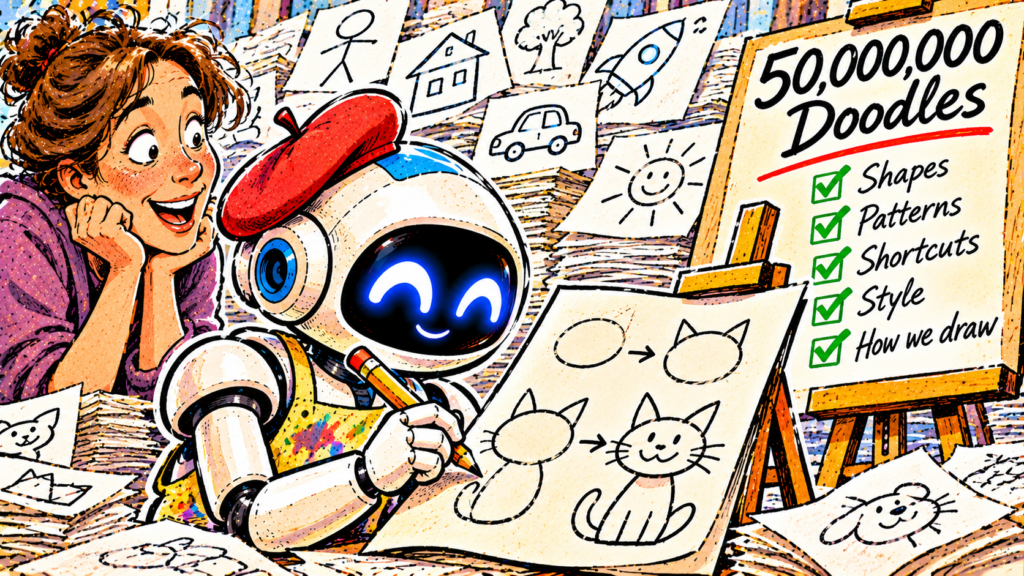
Draw a bicycle before the clock runs out. Do you start with two wheels, the frame or a pair of handlebars? Google’s Quick, Draw! gives players less than twenty seconds to sketch a prompt while a machine tries to recognise it. A public collection from the game contains 50 million drawings in 345 categories. Alongside all those variations on a bicycle, something more unusual survives. Researchers can look at the order in which people chose to make the marks.
A finished sketch shows where the ink ended up. The original stroke record can show whether the rider began with wheels and joined them, or scribbled a frame and added wheels almost as an afterthought. That distinction offers a way to study drawing as a sequence of decisions. It also exposes a limitation. These are drawings by people racing a clock and trying to make a machine say the right word.
How Quick, Draw! turns a guessing game into data
The game itself makes the bargain plain. A player receives an object to draw, sketches against a timer and hears or sees the machine’s guesses. Afterwards, the game can show what it thought the drawing resembled. The arrangement is entertaining partly because the machine sometimes seems to understand an unfinished picture and sometimes sticks stubbornly to a guess that looks absurd to its author.
For a dataset, the prompt is a valuable starting point. The collector already knows what the artist was asked to depict. It can attach the word for bicycle to a very good sketch, an unrecognisable tangle or a mischievous drawing of something else. That last possibility illustrates the limit of the label. It records the assignment. It gives no guarantee that an outside observer would agree about the marks on the screen.
The Google Creative Lab documentation distinguishes raw drawings from simplified versions and small bitmap images. The original records include the timing and coordinates of strokes. The simplified representation retains stroke information in a more economical form, while a bitmap gives a grid of pixels. Choosing among them changes the question the researcher can ask, even when the bicycle in each file looks broadly similar.
A bitmap could be enough to ask whether a programme can distinguish a bicycle from an umbrella. It cannot reveal from the final black marks alone whether the umbrella handle was drawn before the canopy. A sequence with timing can support questions about pauses and order, although even a long pause does not reveal what the player was thinking. The computer recorded an action, rather than an explanation from the artist.
The line that gives the game away
Consider a circle. As the beginning of a drawing it could be a wheel, a clock, a face or a frying pan. Add a short handle pointing away from it and some guesses become less plausible. Add a second circle instead and the possibilities change again. The interesting moment in a guessing game is often the stroke that collapses a large set of possible objects into a very small one.
You can explore that idea without needing a theory of how every player draws. Sketch a familiar object for a friend, pausing between strokes. Ask when the friend feels able to name it, then repeat the exercise starting with a different feature. A tiny change of order can produce an early confident answer or a long run of wrong ones, even if both finished drawings look equally recognisable.
Machines can exploit similar regularities, but regularity has an origin. People playing to win might deliberately start with the most conventional sign for an object. A bicycle shown from the side is a more economical clue than one seen head on. If a model learns that convention, it has learnt something genuine about how players communicate with few strokes. Its skill with bicycles approaching a camera remains a separate question.
This helps explain a familiar gap between a good result in a demonstration and a good result elsewhere. In the game, the prompts come from a known set and the drawings are made through its interface. A sketch on a napkin at a café might include a street, a rider and a bicycle partly hidden behind a tree. For the napkin, even deciding which object the artist wants named is a new problem.
Who gets counted when the machine guesses correctly?
The collection includes an indication of whether the game recognised the drawing. A researcher could select only those marked as recognised to make a tidier set of examples. But that choice would also remove many of the drawings that challenged the original recogniser. A new system trained and judged solely on the tidy subset could inherit the old system’s taste in bicycles without anyone intending it.
There is a productive alternative. Look at recognised and unrecognised sketches together and ask what distinguishes them. Are some perfectly legible to people but drawn from an unusual angle? Did the player get as far as a distinguishing feature? Is there a visible difference between a broad, deliberate line and a cramped one that is hard to make with a mouse? The record can suggest such questions without answering them by itself.
The data also contain country information. This can make geographical comparisons tempting. Location is not a direct measure of culture, education, handedness, drawing experience or even which language someone used at home. People who found a particular online game and decided to play it are a particular group. A map of their drawings needs a careful account of how the examples got onto the map.
The same judgement matters in broader debates over how artists’ work influences image models. Knowing that an example appears in a collection is one kind of information. Knowing which visual habit a model acquired from it is another. A record of the actual strokes lets a researcher test more precise ideas than the simple observation that two finished pictures resemble one another.
A useful classroom experiment with a deliberately unfair test
Choose an object everyone in the room knows and ask people to draw it quickly from the side. Then ask for the same object from above. Keep the two groups of drawings separate. A student designing a guessing rule from the first group might do very well on the other side views and very badly on the overhead ones. The object name and artists have stayed the same while the evidence on the page has changed.
The next question is how to judge improvement. Adding overhead drawings to the examples makes sense, but testing the revised rule on the very drawings used to change it tells only part of the story. Give it fresh drawings from somebody else, or a view nobody was asked to practise. This makes the difference between remembering the lesson and using it on a new problem much easier to see.
There is a creative dimension to the experiment, too. An unusual drawing may communicate a private association that the player values more than immediate recognition. LiveAIWire’s coverage of similarity in AI-assisted creative ideas offers a related question about which choices get encouraged. In a timed guessing game, a conventional drawing is rewarded because a conventional clue is often an effective way to win.
An archive of people drawing for an audience
One revealing way to browse the collection is to imagine the machine as part of the scene. The player knows a guess is coming. An early correct answer can bring a drawing to a speedy conclusion. A series of wrong guesses may invite the player to emphasise a different feature. The marks are traces of that exchange. Treating them simply as pictures people would have made anyway loses much of their interest.
For someone teaching independent learning with AI in the classroom, the wrong guess can be the best point to pause. Ask the pupil which detail they expected the system to use and whether somebody unfamiliar with the object would make the same association. That invites an explanation grounded in a particular line on a particular drawing, where both the child and the adult can inspect the evidence.
A rushed bicycle sketch is a poor test of whether someone can draw a beautiful bicycle. It is an excellent place to ask what they think another observer needs to see first. Across millions of attempts, the extraordinary thing being preserved is a collection of tiny decisions made by people with a clock running and a guess already on its way.
About the Author
Stuart Kerr is Technology Correspondent at LiveAIWire, covering artificial intelligence, cybersecurity and the social impact of emerging technology. LiveAIWire is an independent, human-led technology publication using AI-assisted research, editorial production and original AI-assisted editorial illustrations under his direction.