
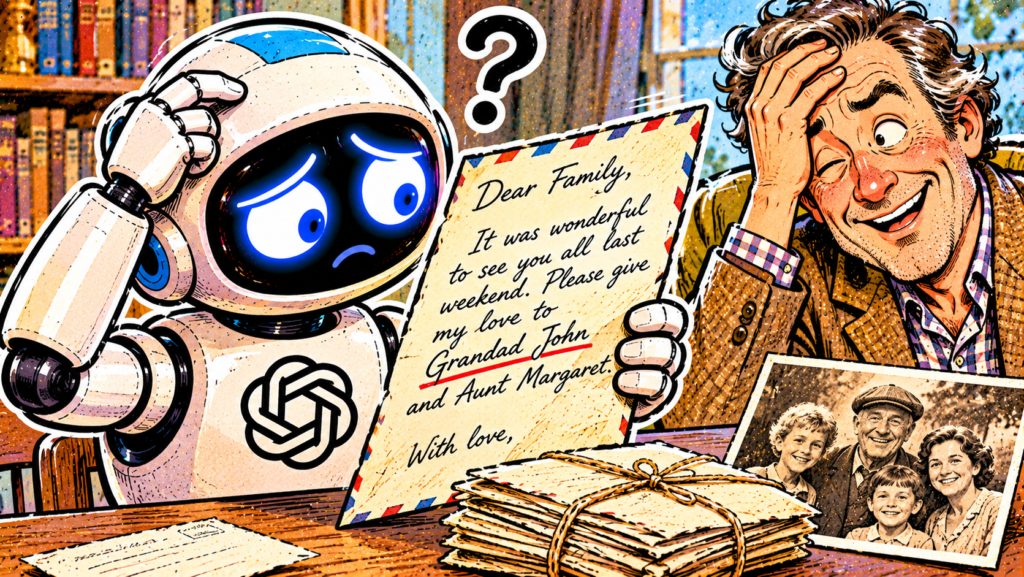
A family name can disappear from a search while remaining perfectly visible on the page. Handwriting recognition turns the marks in an old letter into text, which means a family historian can search for a place or relative without reading every line unaided. But if the software mistakes one letter in a surname, a tidy, readable transcription can quietly remove the best clue in the document.
A useful example comes from Transkribus, which offers a model for historical and modern French handwriting. Its output can give someone a way into a letter they might otherwise leave unread. The important decision comes after the first reading. Which words can serve as a rough guide to the contents, and which must be checked against the page before they are used to connect one person, place or date to another?
Where handwriting recognition earns its keep
Imagine opening a bundle of letters in a language you know reasonably well, written in a hand you find slow to decipher. One concerns household arrangements, another refers to a journey and another appears to mention a relative moving away. An imperfect transcript can help you choose where to spend the next hour. You can work on the promising page with its rough meaning already in mind.
The Transkribus French model is described by its developers as a general model curated for French handwriting, with community material used in updates. Its name tells you the intended language and use. It does not tell you whether a particular aunt’s handwriting, an unusual regional spelling or a postcard written in a hurry resembles the material from which the model learnt.
A handwritten letter offers several kinds of assistance to a human reader. The salutation suggests a name. A familiar phrase can make an awkward word legible. A known address can resolve a street name. These are valuable clues, yet each can encourage a reader to see what they expect. The computer’s version adds another suggestion to that mix. It is worth looking at the original before accepting the suggestion as evidence.
There is a difference between transcription and translation. A French name that looks like a common French word may be rendered perfectly legibly as the wrong thing. Translating that result into English can make the sentence smoother while carrying the error further from the page. Keep a version in the original language, even if a translation is the part of the project you ultimately want the family to read.
Why an impressive average can hide the decisive mistake
Transkribus explains accuracy using a character error rate. The measure counts changes needed to turn a predicted transcription into a reference transcription. A missing letter, a spurious one and a substitution all contribute. It is a useful way to compare models on material for which someone has already prepared a reliable reading. It says something different from the probability that a specific name in your letter is correct.
Consider a hypothetical page of otherwise routine prose in which the only mistake is in a witness’s surname. A reader who wanted the gist might be delighted. Someone trying to find that witness in another collection could spend an afternoon on a false trail. The measured error is small because it affects little of the page. Its importance is large because the user’s question happens to fall on that exact spot.
The reverse can also be true. A model may stumble over a blot in a chatty passage yet preserve a date and address that let the family locate the writer. A single score cannot capture both uses. If your project depends on names and places, sample those fields deliberately. Checking only the easy opening and closing lines can give an unduly generous impression of how well the material is serving your purpose.
The developers distinguish performance on pages used during training from performance on separate validation pages. The latter is more informative about unfamiliar material. Even a carefully chosen validation set belongs to a particular collection and test. It cannot settle the reading of a capital at the top of the letter in front of you. For that, you need evidence from the page and, where possible, the writer’s other work.
Reading a difficult name without writing your own family history into it
Start with the letter shapes the writer repeats elsewhere. An uncertain capital may appear at the beginning of a familiar place name. The join between two lower-case letters might be clearer in a common word further down the page. Compare the parts that distinguish the competing readings. A surname that fits the family story beautifully is still only a candidate if its letters do not fit the hand.
Record uncertainty where it occurs. If the last part of a word is indistinct, preserve the portion you can read and mark the gap in your working notes. If two readings remain possible, keep both as search terms. A confident modern spelling inserted to make a transcript look finished can be surprisingly difficult to dislodge once somebody has copied it into a family tree.
The US National Archives’ transcription guidance makes a useful distinction between representing the record and tidying it. Original spelling can carry information. A writer may use a local form or make an ordinary spelling mistake. Silently correcting it changes what a later reader thinks was on the page. There is room for a modern form in an index or note while preserving the wording of the document itself.
Related work on restoring ancient Greek texts raises another distinction. Trying to infer missing material and transcribing surviving marks answer different questions. A family letter with a torn corner may invite an educated guess, but a guess should remain visibly separate. A plausible completion is easy to mistake for a surviving word once the photograph and the transcript are passed on separately.
Making the collection searchable without losing the evidence
Keep the image and its transcription connected by a stable name or reference. A useful search hit should lead back to the right letter, page and side. Otherwise a descendant may inherit a folder full of smooth text and a separate folder of unlabelled scans, with no easy way to check either. Include an envelope when available, while keeping what appears on it distinct from what appears in the letter.
Search in more than one way. Try part of the name, a nearby place, an occupation or a relative who might appear in the same passage. A failed exact-name search is weak evidence that the person is absent when the text was machine-read. Equally, a convincing search hit needs inspection. A misread word can create a name that appears nowhere in the original.
For a larger collection, distinguish a machine draft from a checked transcript in the filename or catalogue entry. A reader can then decide how heavily to rely on it. This is the less glamorous side of digitising cultural heritage. Capturing an image preserves access to marks on a page. Turning those marks into searchable words is a separate act, with errors and editorial decisions of its own.
The line worth spending time on
A sensible first pass follows the purpose of the project. For a family gathering, a rough account of a journey may be enough to choose a letter to display. For a claim that two people were siblings, the exact name, relationship and wording need more care. When the stakes rise, compare with another document created independently rather than treating repeated copies of the same transcript as confirmation.
If the letter mentions a market day or a journey, make a separate note of that clue before narrowing the search to one spelling. A second letter may describe the same trip more clearly. Independent details can support a reading while leaving the doubtful letters visible to another reader who knows the local names better.
Even in modern speech, the difference between a fluent transcription and an accurate one can be easy to overlook, as illustrated by dictation errors in AI transcripts. Old handwriting adds another obstacle. The original speaker cannot simply repeat the sentence. What remains is the physical trace, the surrounding words and whatever other records the family can find.
A worthwhile outcome may be a letter with most of its contents readable and one stubborn name still marked as uncertain. That leaves the next reader a genuine problem they can investigate. A perfectly smooth page with the wrong surname offers them no such invitation, and may send them looking for a relative who was never there.
About the Author
Stuart Kerr is Technology Correspondent at LiveAIWire, covering artificial intelligence, cybersecurity and the social impact of emerging technology. LiveAIWire is an independent, human-led technology publication using AI-assisted research, editorial production and original AI-assisted editorial illustrations under his direction.