
OpenAI says its latest model answers ChatGPT image questions more successfully, reporting a score of 71.7 per cent on its own image-understanding test, against 47.4 per cent for GPT-6. The update began rolling out in the Chat tab on 23 November. For someone photographing a set of controls or trying to read a confusing diagram, the improvement comes with an important qualification. A score on OpenAI’s test cannot tell you whether the answer about your particular picture is right.
The update brings a version of GPT-6.2 Sol tuned for conversation to Plus, Pro, Business and Enterprise customers. Enterprise access depends on workplace settings. OpenAI describes this as a change to Chat, with Work and Codex outside the scope of this release. That detail matters if two people try the same picture and think they are comparing the same product.
What changed for ChatGPT image questions
The 23 November release notes report the comparison as a test conducted in the Chat tab. The difference is 24.3 percentage points. It is tempting to turn that into a prediction about the next photograph someone uploads. The public figure gives no breakdown here for household objects, small labels, unusual layouts or questions where the vital information is just outside the frame. Your mix of pictures might look quite unlike the evaluation.
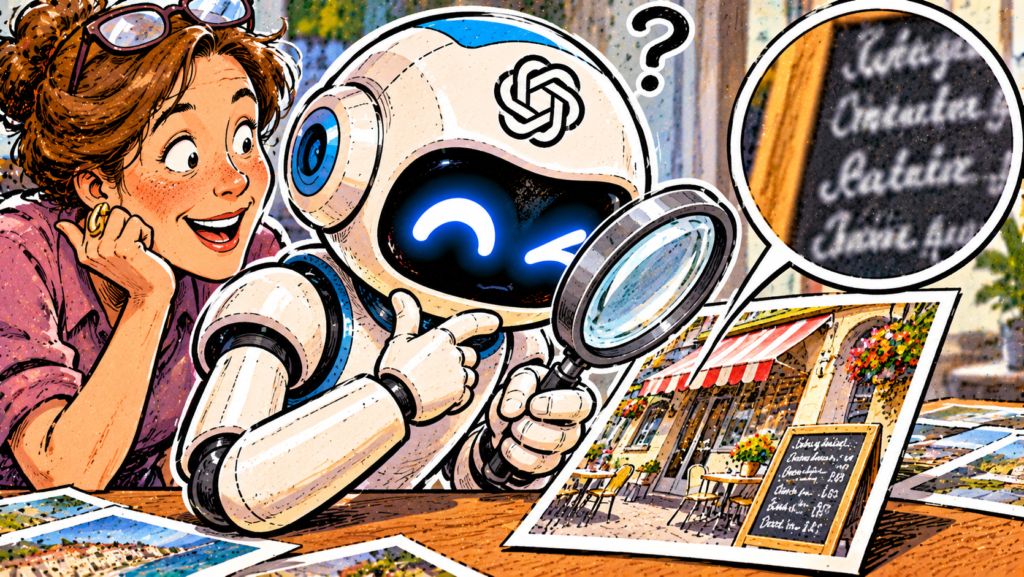
Think of a photo of a washing machine’s control panel. Someone may want the name of the programme shown beside a dial. A model that recognises the general type of appliance can produce a plausible description before it has read the tiny letters that settle the question. Asking it to quote the lettering it can actually see gives the owner something concrete to compare with the original.
That is a different test from asking what the whole panel is for. A broad question might be answered correctly even when a narrow one cannot. If the required detail occupies a small corner, an additional close-up can help. Keeping the wider view as well preserves the relationship between the writing and the control. A crop with no context can leave two adjacent buttons looking equally plausible.
The same photograph can support different answers
OpenAI’s guide to image inputs identifies several difficulties, including counting objects, reading rotated material and locating items precisely. It also says images are resized for analysis. A photograph that a person can enlarge on their own screen may therefore contain lettering that the model struggles to resolve. Repeated insistence that the answer is obvious does little to improve the image.
A more informative follow-up changes the evidence. Rotate the label so it reads normally, take the picture square on, or indicate the part of the diagram that matters. Then ask for the visible details separately from any interpretation. If a dial is pointing between two positions, a useful response should leave room for that ambiguity. Turning an uncertain observation into a confident instruction simply transfers the uncertainty to the person acting on it.
This is also a different activity from checking the origin of a photograph. A system can accurately describe a chair in a room while knowing nothing about who took the picture or when. OpenAI says its image analysis does not process the original filename or metadata. An account of what appears in the frame should not be treated as a provenance check.
Following the instruction is part of reading the picture
The release also reports a change in tests of especially demanding instructions, from 62.5 per cent with GPT-6 to 78.1 per cent with the new model. This is a separate company measure. It matters for a visual task because a useful answer often depends on respecting a small constraint. A user might want only the labels that can be read, with illegible ones left blank, in the order they appear on the panel.
A response can recognise every object and still fail that request by guessing at the missing word. Conversely, a careful statement that a mark is too blurred to identify may be the best possible answer to a well-posed question. Looking at the response beside the original picture can reveal which kind of success the model has delivered.
The appeal of visual tools is particularly clear in live camera assistance for accessibility. There, a person may rely on a description without being able to perform the same visual check. The cost of an error depends heavily on the task. Describing the pattern on a tea towel and identifying an important warning on a container both involve images, yet they warrant different levels of confidence and corroboration.
A household test that reveals something useful
For an ordinary trial, choose an object you know, such as a radio with labelled buttons. Ask Chat to identify the controls and quote their markings. Check the answer, then take a closer photograph of anything it missed. This makes it possible to distinguish an unreadable picture from a mistaken interpretation. It also gives a more useful personal measure of progress than a striking example picked by someone else.
If the second picture changes the answer, the important question is whether it supplied new evidence. A clearer label is a good reason to revise. A change prompted solely by a leading question is a weaker basis for confidence. That distinction is easy to notice on a familiar household object and easy to forget when the object is unfamiliar, which is precisely when people are likely to turn to an assistant.
OpenAI’s reported improvement gives paying Chat users a reason to revisit a visual task that previously failed. The most useful test is one where they can inspect the result. A photograph can provide the model with an enormous amount of context while withholding the one letter, number or position that actually determines the answer.
About the Author
Stuart Kerr is Technology Correspondent at LiveAIWire, covering artificial intelligence, cybersecurity and the social impact of emerging technology. LiveAIWire is an independent, human-led technology publication using AI-assisted research, editorial production and original AI-assisted editorial illustrations under his direction.