
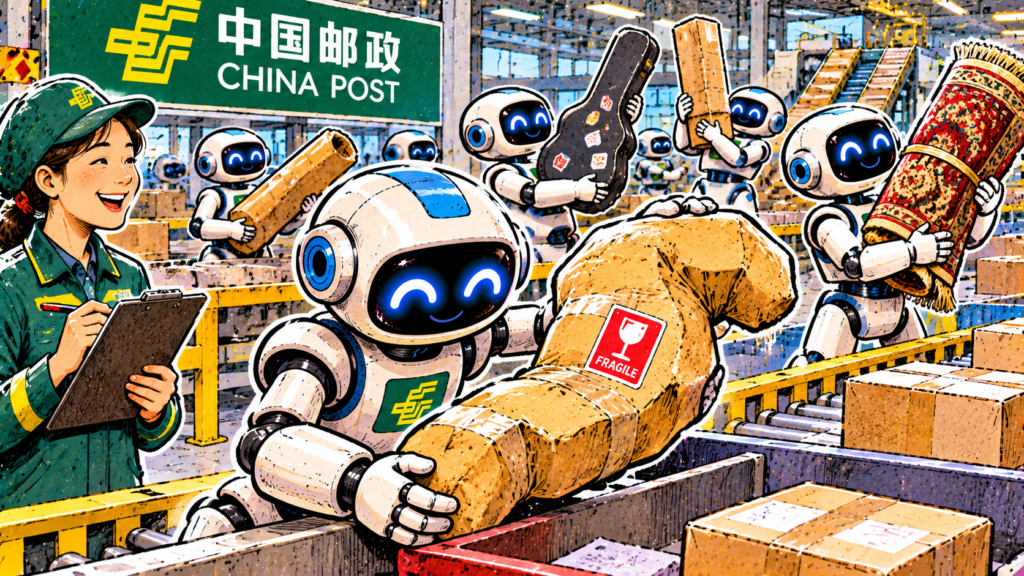
China Post is testing 45 parcel robots at its Hangzhou postal district centre on a job that comes before the familiar business of sorting packages by destination. They pick items up, turn them and present them to the equipment that handles the next stage. Robotera, which supplies the machines, announced the size of the deployment on 26 November. Its speed figures describe particular testing periods.
If you have ever tried to find the label on a soft mailing bag, the problem is easy to picture. One corner folds over, the printed side faces down and a parcel underneath comes up with the one you meant to lift. Give the same bag to a machine further along a conveyor in a predictable position and the next job becomes much easier. Someone or something has to create that order.
What the parcel robots actually handle
Postal operators call the handover into a processing system induction. A destination sorter can have a relatively tidy job if parcels reach it separately and in a usable orientation. The incoming pile has no such obligation. A robot at this point needs to choose what to pick, hold it well enough to move it and release it where the next piece of equipment expects it.
In Robotera’s account of the Hangzhou tests, the tasks include picking and reorienting parcels, identifying and rejecting irregular shapes, and placing suitable items on induction platforms. The company also says the robots can handle operational exceptions. It gives no detailed breakdown of those exceptions. A package sent for separate attention and a package successfully put onto the line are different outcomes, even when the robot makes the right decision in both cases.
Setting something aside is a particularly interesting part of the work. A soft parcel hanging over an edge might be fine for a person to carry but troublesome for the equipment that receives it. Rejecting an unsuitable item can protect the stream of ordinary ones. The judgement has a cost in the other direction, too. Reject too many perfectly usable packages and the work merely moves to a pile somebody else must sort.
Speed at one station and speed through the building
Robotera’s English-language release says its induction rate rose from roughly 500 to 600 parcels an hour initially to around 1,200 during specific test periods. It gives an operational accuracy figure above 90 per cent. The announcement does not supply the denominator for that accuracy measure, a distribution across shifts or a breakdown by parcel type. Multiplying the quoted rate by every robot would give a striking number with no demonstrated relationship to the centre’s daily output.
The distinction is familiar from the history of mail processing. The US Postal Service’s illustrated account of postal mechanisation treats parcel processing as a series of operations. Even without comparing machinery or countries, the sequence explains why a faster feeder might simply move a queue. If downstream equipment is busy, another parcel on its way to that equipment cannot leave the building any earlier.
There is another complication in interpreting reports from Hangzhou. Global Times, citing Robotera’s Chinese announcement, reports more than 1,500 parcels per hour against a design capacity of 1,200 per unit. Robotera’s English release compares an early test with selected later periods. The accounts use different starting points and provide too little detail to reconcile the results. Neither gives an independently audited average across the fleet.
When the packaging changes the task
A rigid box and a padded envelope can contain the same object yet behave differently in a gripper. Lift the box at one end and much of its shape remains predictable. Pick up the loose end of an envelope and the contents may slide away. Handling both calls for judgement about the item during movement as well as recognition before the movement begins.
That is one reason other material-handling research looks at robots predicting trouble while stacking luggage. Identifying a bag is only part of putting it down safely. In Hangzhou, the equivalent question concerns the parcel at the moment of release. If it rolls, folds or lands across a boundary, the system downstream inherits a different object position from the one the robot intended.
There is an instructive parallel in robotic sorting for recycling. What arrives at the start of a physical sorting process is shaped by decisions made elsewhere. Postal customers choose their own wrapping and tape. A test with a tidy collection of regular boxes would therefore answer a narrower question than a shift including the items people have actually sent.
Following the parcels that need a person
For a delivery customer, the relevant clock starts well before this operation and ends later, at the door or collection point. There is no delivery-time promise attached to the Hangzhou figures. For a postal manager, a useful next measure would follow the package that fails the first handover. How long does it wait, who clears it and does it return to the same queue?
The answer could change how an operator deploys the robots. A station with a steady flow of small regular items might make good use of a machine even if awkward packages remain a human speciality. At another station, repeated interruptions could consume much of the gain. Reporting the mix of accepted parcels alongside the number passed per hour would help distinguish those possibilities.
What makes the Hangzhou trial worth following is the opportunity to see many machines encounter everyday packaging in the same working building. A fleet can reveal how often small exceptions happen together and how much attention they demand. The telling parcel may well be the crumpled one a robot correctly declines to pick up, and the telling measurement is what happens to it next.
About the Author
Stuart Kerr is Technology Correspondent at LiveAIWire, covering artificial intelligence, cybersecurity and the social impact of emerging technology. LiveAIWire is an independent, human-led technology publication using AI-assisted research, editorial production and original AI-assisted editorial illustrations under his direction.