
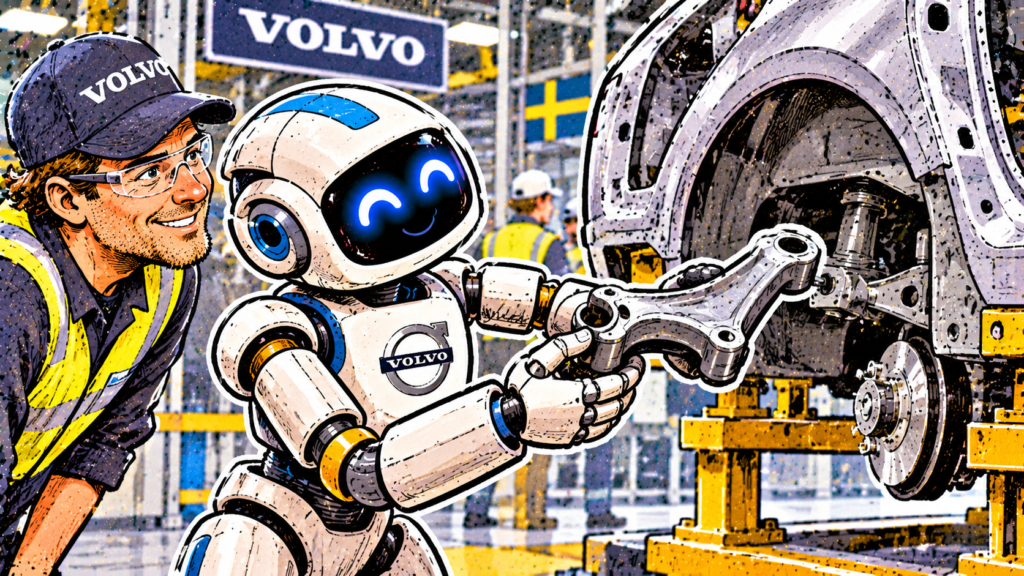
The first lesson for the Volvo factory robot in Ghent, Belgium, is how to put components into two holders. Employees demonstrate the movement and the machine learns from them. Volvo announced the training on 26 November, ahead of a planned factory pilot in the first half of 2027. For now, a worker who knows exactly how a part should sit has something the robot needs.
There is a reason to start with such a small job. On a production line, the person or machine receiving a component expects to find it in a particular place, facing a particular way. Putting it vaguely in the right area may leave somebody else to do the fiddly bit. Ghent gives Volvo a chance to find out whether a humanoid can reliably finish that last part of the handover.
The Volvo factory robot has two targets
A fixture holds a part in a known position so the next operation starts from a repeatable arrangement. Imagine lowering an awkward piece into a cradle. From above it can look correctly placed while one edge is still resting on the lip. A person might feel that something is wrong through their fingers. An automated system needs some way of determining that the job is complete before it lets go or signals that the next step can begin.
According to Volvo’s account of the training, its own team is teaching Hexagon Robotics’ AEON by imitation. The company identifies precise placement in two fixtures as the starting assignment. It gives no published success rate for that task, no time per placement and no comparison with the people demonstrating it. Those missing measurements matter more to an assessment of factory readiness than how human the machine looks while moving.
Imitation learning gives the worker a different role from someone writing out instructions. A demonstration can convey a sequence that is hard to put into words. Consider the small turn of a wrist that brings an edge past an obstruction. A written command to put the part down might leave that out altogether. The challenge for a learner is working out which details of a demonstration matter the next time a part arrives.
Why put a humanoid beside established equipment?
A fixed machine has the advantage of a workplace arranged around it. In Ghent the proposed attraction of AEON is flexibility. If it can eventually move between jobs, a manufacturer might gain an option for repetitive work that changes too often to justify a separate fixed installation at every station. That business case depends on the cost and time of teaching each new job, as well as the time actually spent doing it.
The project description from Hexagon Robotics sets out a progression. After the initial placements, harder work could include handling several different parts, moving around the production area and interacting with existing automated systems. These are separate challenges. A machine might be very good at picking up a component presented in a familiar position yet need substantial help finding its way back into the sequence after an interruption.
That distinction also explains the interest in robots learning a task from a demonstration. A recognisable movement is a helpful starting point. A production team also needs to know which variations the machine can accommodate, which require another demonstration and which should cause it to stop. The difference becomes visible when the incoming part is slightly skewed or the receiving fixture is occupied.
A useful stop can beat a quick placement
Consider the choice if a component fails to settle properly. Pushing harder may damage it. Withdrawing safely and asking for help costs time, yet preserves the part and alerts the operator to an obstruction. A trial that rewards only completed movements could miss the value of that second response. This is a practical setting for the wider question of when a robot should ask a person for help.
Volvo says the intended work includes repetitive tasks that place physical demands on employees. Assessing that aim means looking at a shift from the employee’s side. Moving fewer parts by hand would be a benefit. Having to make frequent awkward reaches to clear failed placements would consume some of it. A useful assessment would record both activities and ask the people covering the station what has changed for them.
The factory also has to keep existing equipment working. If another machine expects a signal that the fixture is ready, a robot must fit into that exchange. Sending the signal early could be more disruptive than taking a little longer over the movement. A video of a successful placement ends at precisely the moment when the person responsible for the rest of the process starts to take an interest.
The date to watch is the production pilot
Ghent is Volvo Cars’ first plant to try humanoids, according to the carmaker. It expects more units to arrive for the pilot and aims to use them in real production from mid-2027. Those are stages in a plan. The November announcement establishes that training is under way and identifies the first task. It leaves open how far the robots will progress by either date.
The most revealing future update would compare a normal run with a difficult one. How often does a worker intervene? Can the robot resume when the cause of a stop has been removed? Does the part reach the following station ready for use? Those questions give a factory team a better basis for choosing work than a list of movements the hardware can perform.
For someone on the next station, success would be almost uneventful. The component would arrive correctly seated, the equipment would carry on, and any exceptional part would be set aside with a clear reason. In Ghent, the person demonstrating the job already knows what that looks like. Teaching a machine to recognise it is the assignment.
About the Author
Stuart Kerr is Technology Correspondent at LiveAIWire, covering artificial intelligence, cybersecurity and the social impact of emerging technology. LiveAIWire is an independent, human-led technology publication using AI-assisted research, editorial production and original AI-assisted editorial illustrations under his direction.