
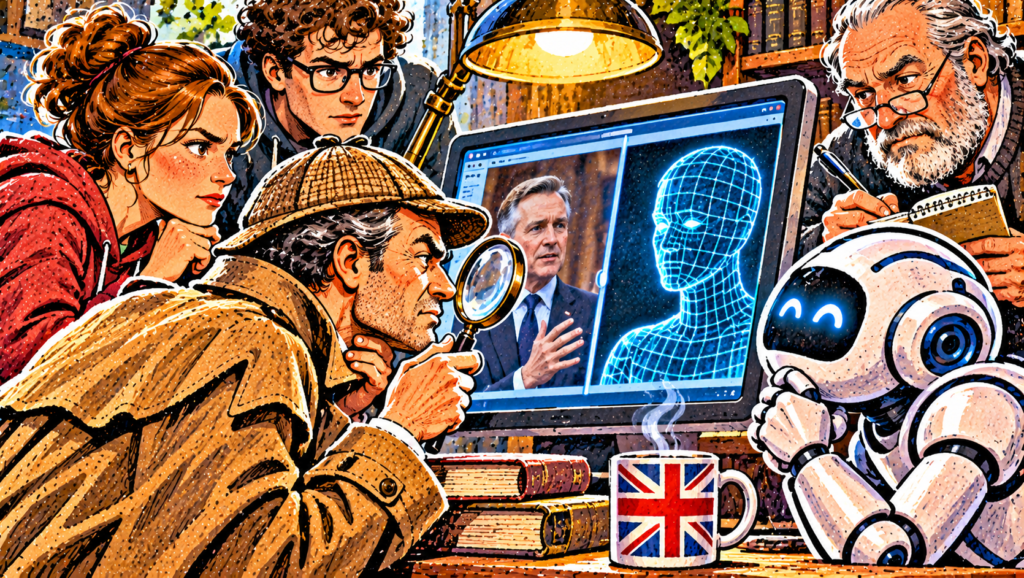
AI detection has become a kind of amateur detective work on parts of the internet. People share pictures and videos that look suspicious, then invite others to examine their details and decide whether a machine generated them. What is particularly interesting about those discussions is how quickly the detective’s handbook can become obsolete.
A research project by academics from the University of Washington and Arizona State University examined 13,098 posts and 222,060 comments across two Reddit communities. The researchers found that participants employed a range of strategies and that their approaches changed as generative technology and online trends developed. The study catalogued reasoning and behaviour within these communities; it was not a controlled measurement of how accurately everybody on the internet can identify AI.
Why AI detection cannot rely on yesterday’s mistakes
An unusual detail in a picture may prompt somebody to take a closer look. A person in the background appears to have an odd hand, a sign contains strange lettering or the reflections in a window seem difficult to reconcile with the objects nearby. These observations can be useful starting points for an investigation.
They also come with a problem. A visible oddity might have several explanations. The photograph could have been taken from an unusual perspective, an object could be partially obscured or the image could have been compressed or edited. A human artist might deliberately depict something unrealistic. The fact that an imperfection could have been produced by AI does not establish that it was.
The usefulness of a particular clue also depends on what the technology can produce at the time. If a widely used generator becomes better at a task it previously struggled with, a rule based on the old weakness may become less informative. An observer who continues to apply the same rule might confidently reach the wrong conclusion.
There is a further complication: the absence of an obvious defect cannot prove human authorship. A generated image that happens to get the details right may leave an amateur investigator with very little visual evidence either way.
What the Reddit communities were looking for
The research team identified different ways participants tried to make sense of suspicious media, including inspecting small visual details, considering what generators were capable of and recognising familiar patterns in circulating content. Its analysis covered more than two years of activity, allowing the researchers to examine changes in the discussions rather than just take a snapshot of attitudes at one moment.
In an Arizona State University interview published on 1 October 2026, co-author Jaron Mink discussed a shift towards considering broader circumstances, including the reputation of a source and the social media trends to which a clip might belong. The interview also warned against treating stylistic features as reliable evidence of artificial authorship.
Recognising a familiar online trend can help explain why something might have been created. A surprisingly dramatic video may resemble other clips circulating on a platform. That context can provide a reason to investigate its origin, but it cannot by itself establish that the video was generated rather than filmed, staged or edited by a person.
Indeed, the existence of a trend may encourage real people to create similar material. The investigator who has correctly recognised the trend still has to establish the origin of the particular item under discussion.
When everybody starts looking for the same thing
Crowds can bring different kinds of knowledge to a difficult question. Someone familiar with an animal’s anatomy may notice a detail that a photographer overlooks. A person who knows a location may be able to explain why an apparently impossible arrangement of buildings is entirely genuine. An illustrator may recognise a technique that others mistake for a software artefact.
That diversity is valuable when the discussion allows competing explanations to be examined. It becomes less useful when participants arrive with the same expectation and concentrate on finding evidence that supports it. Once the first person announces that an image is artificial, subsequent contributors may start examining it specifically for signs of generation.
Imagine a photograph of a bird with feathers that look unusually smooth. One observer might suggest that the texture is artificial. Another might attribute it to a shallow depth of field. A third might have seen photographs taken under similar lighting. The useful conversation is the one in which these explanations can compete, rather than the one in which every observation must support the original suspicion.
The community study does not establish that every discussion follows such a pattern. It highlights a reason to examine how public judgements about authenticity are being formed as well as the technological clues on which those judgements depend.
The consequence for somebody who actually created the work
For an artist, writer or photographer, an incorrect accusation can be more than an irritating comment. People may question whether the creator possesses the skills they claim, whether a product was made as advertised or whether an account of an event deserves to be believed. Correcting a mistaken impression may take considerably more effort than creating it.
A creator might be able to provide earlier drafts, sketches, original photographs or other material explaining the process. That can be useful evidence, but not every legitimate creator will have preserved such records. Some may have good reasons not to share private working files or information about the people depicted.
Requiring everybody to prove their humanity whenever somebody identifies an unusual stylistic feature would impose a substantial burden. This is especially relevant to debates about false accusations arising from AI essay detectors. In both cases, evidence derived from the finished work may fail to reveal how the work was produced.
There are also circumstances in which a work combines human and machine contributions. An artist might use a digital tool to make an adjustment while carrying out the creative work themselves. A simple choice between entirely human and entirely artificial may fail to describe the process accurately. The question of what assistance is acceptable depends on the setting and what the creator has represented to others.
Look for the history of the material rather than a single defect
One useful way to approach a questionable image is to separate the immediate visual impression from the investigation of its origin. If a picture purports to show a public event, the context in which it appeared may provide avenues for checking the claim. Other photographs of the same event, independent accounts and earlier versions of the material can all be informative.
Technical systems can also contribute evidence about origin. The development of content credentials and photographic provenance records is relevant because it offers a way to attach information about the history of a file. But a file may lack such information for entirely legitimate reasons, and a provenance record does not prove that everything depicted happened as the viewer assumes.
Watermarks provide another potentially useful piece of evidence. Tools such as the Google SynthID detector are designed around particular methods of identifying generated material. The result needs to be interpreted in light of the technology it covers. A system that cannot find a watermark should not automatically be treated as having established that a picture was made by a person.
These approaches are not always available or conclusive. Sometimes the most accurate answer is simply that there is insufficient information to establish how something was produced. That is an entirely reasonable conclusion, even if it is less entertaining than a confident accusation.
The real skill may be recognising when a judgement is premature
The growth of these amateur investigations demonstrates a desire to understand material that would once have been accepted at face value. That curiosity is valuable. The challenge is to turn it into a habit of seeking evidence rather than a habit of interpreting every irregularity as proof of deception.
People do not need to decide whether an image was produced by AI before they can decline to share it. If a remarkable clip makes a serious allegation and its origin cannot be established, withholding judgement is sensible regardless of the production method. A genuine recording can be misleading when presented with an inaccurate explanation, while generated imagery can have a legitimate purpose when properly described.
Over time, the best internet detectives may be the people who become comfortable changing their minds. They will need to keep learning about what technology can do while remaining aware of the many ways that ordinary human creativity can surprise them. The ability to spot something strange is useful. The ability to recognise the limits of that observation is more useful still.
About the Author
Stuart Kerr is Technology Correspondent at LiveAIWire, covering artificial intelligence, cybersecurity and the social impact of emerging technology. LiveAIWire is an independent, human-led technology publication using AI-assisted research, editorial production and original AI-assisted editorial illustrations under his direction.