
AI in education can make a piece of schoolwork easier to complete without necessarily helping the pupil understand the subject. A November 2026 review from Stanford University’s SCALE Initiative examined the available causal research and found that learning outcomes vary considerably across tools, tasks and circumstances. Systems used to support learning appear more promising than those used to carry out the work for students, but neither approach produced consistently positive results.
The updated evidence review, published on 10 November, brings together 52 papers examining the effects of generative artificial intelligence in education. It includes school and higher education settings and builds on an earlier review from March. Although the amount of research has grown, the authors say the evidence does not yet establish whether improvements in learning persist over longer periods.
That matters for parents and teachers because an improvement in the work visible on a screen is easy to recognise. Establishing whether the pupil has acquired knowledge they can use independently is much harder. These are two outcomes that can coincide, but they should not be treated as interchangeable.
Why AI in education needs an independent learning test
Imagine a pupil who is learning to solve an unfamiliar type of mathematical problem. An assistant could produce the answer with a detailed explanation, allowing the pupil to complete the exercise. Another assistant might encourage the pupil to attempt a solution and then help them identify where their reasoning went wrong.
Both interactions could lead to a correct answer on the page. They may, however, involve different amounts and types of work on the part of the pupil. If the purpose of the exercise is to learn the underlying method, the relevant question is whether the pupil can apply that method to another problem without the same assistance.
The Stanford researchers distinguish AI used to develop understanding from AI used to produce a submission or complete an assigned task. Their review identifies examples in which outsourcing work to AI was associated with weaker subsequent performance when the tool was unavailable. Other studies found benefits when students used AI to support their learning, although several found no improvement relative to the alternative methods tested.
That mixed evidence is significant. It does not support the claim that chatbots invariably damage education, or the claim that simply providing them will improve attainment. The purpose of the activity, the particular tool and the way it is used can change the educational result.
The distinction is especially important when examining work prepared outside the classroom. A well-written assignment can be useful evidence of certain abilities, but it may not be sufficient evidence of what the student knows. Other opportunities to demonstrate understanding may be required.
A hint is not always the best form of assistance
A popular approach to designing educational AI is to encourage the pupil to think rather than provide the answer immediately. There is a sound educational idea behind this. Attempting a problem can reveal what a student understands and where they need help. Simply receiving a solution may allow them to move past the difficulty without recognising it.
Yet the evidence review describes studies that complicate the idea of a universally superior tutoring technique. In some contexts, providing an answer accompanied by an explanation during practice produced better results than a system that initially withheld answers and offered hints. Other comparisons favoured guided tutoring over less restricted chatbot use.
These findings are not necessarily contradictory. A learner encountering an entirely unfamiliar concept may need a clear worked example before meaningful practice is possible. Someone who already understands much of the subject may benefit from an opportunity to identify their own mistake rather than receive a full solution immediately.
The right form of help also depends on the task. Learning the meaning of a scientific term is different from developing the ability to construct an argument or recognise a flaw in a mathematical proof. An assistant designed around one type of educational activity may not provide equally effective support in another.
Research on AI tutoring through questions is part of the wider effort to explore these differences. A system that is described as an educational tutor should still be evaluated according to what students learn from the interaction, rather than assumed to be beneficial simply because it has been designed to encourage thinking.
Confidence and understanding can move in different directions
The review also examines studies of how students experience AI-assisted learning. In some settings, participants reported a better experience or a reduced workload without a corresponding improvement in measured learning outcomes. Feeling that an explanation is helpful and being able to use the knowledge it contains are not identical achievements.
That is familiar to anyone who has watched an expert demonstrate something. The procedure may look straightforward while the expert is explaining it. The difficulties become apparent when the learner has to repeat the procedure without assistance, particularly if the circumstances are slightly different from those in the demonstration.
An AI assistant can make an explanation clear and accessible, which is potentially valuable. The question is whether the learner then has a chance to engage with it in a way that develops understanding. A useful follow-up activity might involve applying the concept to a different example or explaining the reasoning in their own words.
There is a practical implication for teachers evaluating new software. Student satisfaction can be worth measuring, but it should be considered alongside evidence of learning. A system might make an unpleasant task more manageable without producing better educational results. Alternatively, a tool that requires a pupil to work through difficult questions may be less immediately popular while contributing to useful learning.
The Stanford initiative’s public discussion of the review emphasises that the overall picture is more complicated than either blanket enthusiasm or blanket opposition to AI suggests. The interesting challenge is to identify the circumstances in which it supports the educational purpose of a task.
What does a good mark actually measure?
Assessment practices can make this challenge more or less difficult. If all the emphasis is placed on the quality of a finished document, students have a strong reason to use any permitted technology that improves that document. They may have much less reason to spend time establishing whether they can perform the underlying work themselves.
This does not make AI-assisted work intrinsically worthless. In many occupations, the ability to use available technology responsibly is a legitimate skill. Someone who can examine a generated report, correct its errors and communicate a useful conclusion has demonstrated abilities that may matter outside school.
The educational issue is whether a particular assessment is intended to measure that combination of skills or something else. A teacher assessing basic mathematical understanding may need evidence that differs from the evidence required when assessing a student’s ability to undertake a complex project using appropriate tools.
Related research into ChatGPT and critical thinking in student assignments examines another aspect of the distinction between a polished submission and the capabilities that contributed to it. The Stanford review goes beyond any single experiment by comparing research across a range of contexts, helping identify where results have been consistent and where important uncertainties remain.
A school could address the problem by retaining activities that explicitly test unaided understanding alongside activities in which students are encouraged to use AI. The results of the two types of work would provide different information. Neither needs to be treated as the sole measure of a pupil’s abilities.
Why evidence from a university does not settle a school decision
A substantial part of the available student research comes from postsecondary settings. That limits the extent to which its findings can be applied directly to children in school. Older students may have different background knowledge, different habits of independent study and different reasons for using the technology.
Subject matter is another consideration. A tool that assists university students studying computer programming may have little in common with a tool intended to help primary school pupils read. Even where the same underlying model is used, the design of the activity and the expected learning outcomes may differ substantially.
The review’s authors identify the limited evidence in school settings as an ongoing gap. The expansion of research is encouraging because it creates more opportunities to examine the relevant questions, but it does not automatically make the results representative of all students or schools.
This is why the distinction between the immediate and longer-term effects of AI is so important. A lesson that produces a measurable improvement during or shortly after an exercise may be useful. Whether the improvement lasts and can be applied to different tasks remains a further question.
What parents and teachers can look for now
One useful principle is to consider which parts of an activity the pupil needs to practise personally. An assistant can help clarify an unfamiliar instruction, provide a different explanation or suggest questions for further study. If it routinely carries out the central intellectual task, the pupil may be missing an opportunity to develop the relevant skill.
Teachers can examine the work a student does with the assistant and then give them a related activity without it. This is not a foolproof measure of learning, because performance can be influenced by many factors. It is nevertheless a useful way to investigate whether apparent progress depends entirely on continuing access to the tool.
Parents may find it helpful to discuss how a child reached an answer rather than concentrating solely on whether the answer is correct. Asking for a simple explanation can reveal whether a concept is familiar or whether the child has accepted a response they do not yet understand. The purpose is to identify where further assistance would be useful, not to treat every use of technology as misconduct.
Research on AI assistance and independent human skills makes this distinction relevant beyond education. A person who relies on a system to complete an activity may become very efficient with that system while still needing opportunities to practise important underlying abilities.
Stanford’s review offers a measured starting point. Artificial intelligence can contribute to useful educational activities, but the existing causal evidence does not settle how to obtain dependable, lasting benefits across different kinds of schoolwork. As more research becomes available, the distinction between completing work and learning from it should remain central to the decisions teachers and parents make.
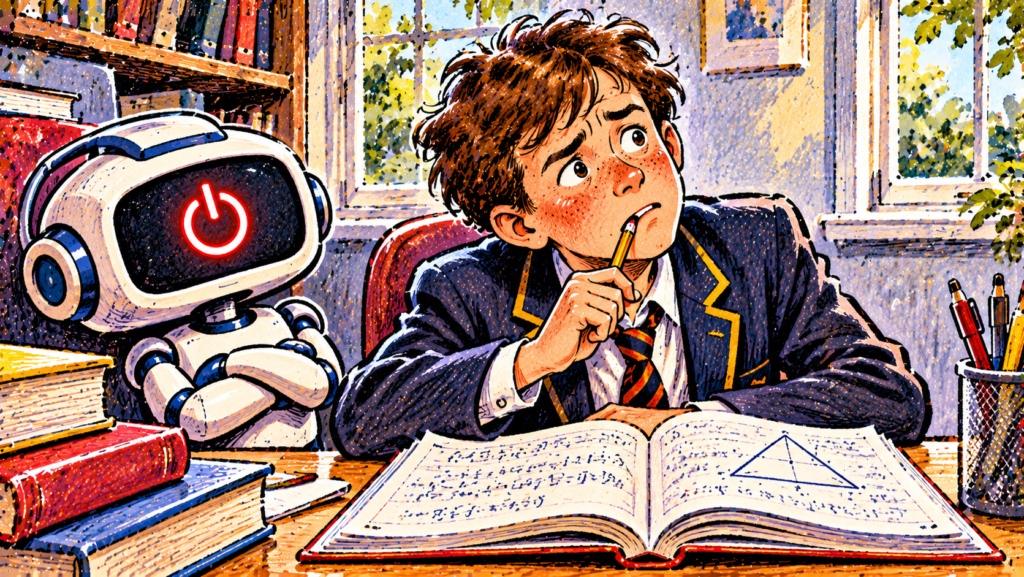
The most revealing moment may come after the assistant has been switched off, when a pupil encounters a fresh question and has the opportunity to show what they have understood.
About the Author
Stuart Kerr is Technology Correspondent at LiveAIWire, covering artificial intelligence, cybersecurity and the social impact of emerging technology. LiveAIWire is an independent, human-led technology publication using AI-assisted research, editorial production and original AI-assisted editorial illustrations under his direction.