
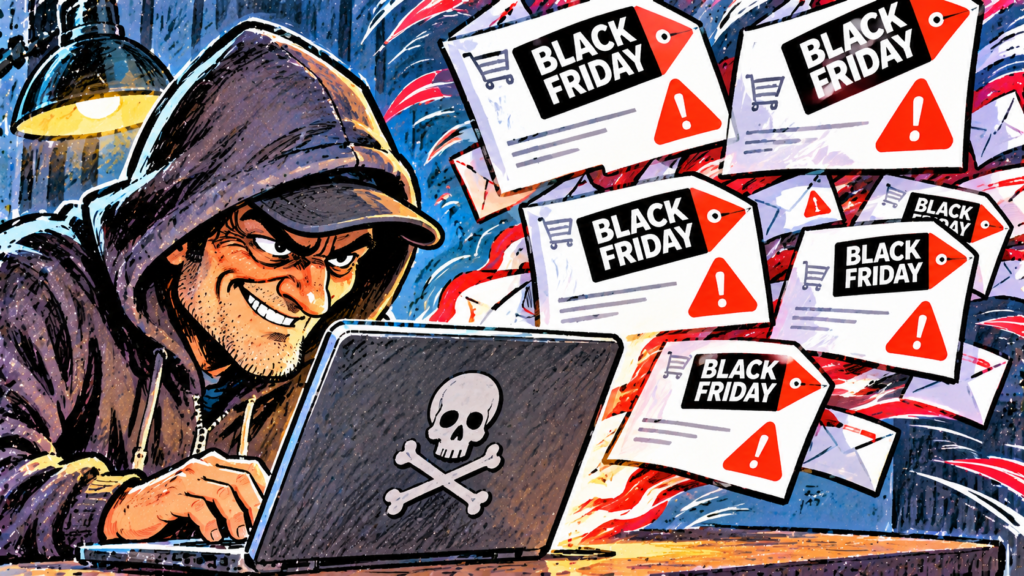
Black Friday phishing has risen sharply in the email environments monitored by cybersecurity company Darktrace. Its artificial intelligence-based detection analysis indicates that daily detections of messages using Black Friday as a theme were thirteen times as high during 1 to 21 November than during October. The finding arrives just before the shopping weekend, when a message offering a discount can seem especially plausible.
The analysis published on 24 November is a report from a security provider about events observed through its own detection systems. It is not a count of every attempted scam worldwide, and it does not establish how many of the messages were written using generative AI. The technology is important to this story because it helps identify suspicious behaviour, rather than because every detected email can be attributed to an AI system.
What the Black Friday phishing figures tell us
Darktrace examined detected activity over a period beginning in September and ending on 21 November. It used October as the comparison baseline for the reported seasonal increase and excluded identified phishing simulations from its Black Friday and Christmas figures.
The use of average daily activity matters. Comparing the raw total for an incomplete month with a complete month could give a misleading picture of whether activity was rising. A daily measure gives a clearer indication of the change in the monitored environments, although it remains dependent on what the provider’s systems are able to identify.
It is also important not to translate a large increase in detections into a corresponding increase in financial losses. A fraudulent email may be intercepted before anyone sees it. Someone may receive it and recognise the deception. Another person may follow a link without completing a transaction. Those are distinct stages, and the reported detection figures do not tell us how many people reached each one.
Why a discount can be such an effective disguise
A shopping message looks more ordinary during a period when genuine retailers are also sending promotions. The recipient may already be considering a purchase, comparing prices or waiting for a delivery. A fraudulent message can exploit that context without requiring a particularly original story.
Artificial intelligence can complicate the wider security picture by making it easier to produce natural-sounding text. A message does not have to contain awkward grammar or obvious spelling errors to be suspicious. As the research landscape around AI phishing personalisation demonstrates, the relationship between relevant context and trust deserves attention.
However, the most important practical question is whether the offer is genuine. Trying to decide whether a message was composed by a human or a machine can distract from the much more useful question of whether the recipient can independently verify its claims.
Someone who receives an offer purporting to come from a favourite shop can open the shop’s known website or official application separately. If the discount is genuine and available to them, it may be possible to locate it without relying on an unfamiliar link. Where an offer cannot be verified, it is reasonable to avoid proceeding through the unsolicited message.
The risk does not end at the inbox
An email may claim that a parcel is awaiting delivery, that a payment has failed or that an order needs confirmation. The consequences can be similar to a fake promotion if the message persuades someone to enter payment details or account credentials on an unauthorised site.
It is worth separating a real purchase from any subsequent communication about it. If a shopper genuinely ordered something, the existence of that order does not prove that a later message about it comes from the retailer. An independent check through the order history or established contact channels remains valuable.
That same principle applies in business, where a message about an invoice or changed bank details may be dangerous precisely because it appears to fit an expected transaction. Familiar circumstances can make a request seem legitimate even when the communication channel has not been authenticated.
The moment someone is asked to provide sensitive information or authorise a payment is a good opportunity to check the source separately. It is a small interruption compared with the disruption that may follow a fraudulent transaction.
What to do if something has already gone wrong
The UK’s National Cyber Security Centre guidance on shopping fraud advises people who have lost money to contact their bank promptly through official channels. It also explains routes for reporting suspicious websites and emails. Reporting arrangements differ by jurisdiction, so shoppers elsewhere should use the appropriate authorities where they live.
If a message claims to be from a bank, the contact details contained in that message should not be treated as independently verified. Using a known number or the bank’s official website avoids depending on information supplied by the suspected sender.
A person who has not lost money but has spotted a suspicious message can still benefit others by reporting it through the relevant official channel. The report may help security organisations identify suspicious activity and improve their understanding of campaigns.
A security lesson that lasts beyond Friday
Darktrace’s analysis captures a seasonal pattern within a particular monitored population. It is a useful reminder that an increase in legitimate commercial communication provides cover for dishonest messages, even though it cannot quantify every consumer’s individual risk.
The point is not to avoid shopping online or assume that every discount is fraudulent. It is to avoid treating the message that brought an offer to your attention as the only route to the purchase.
Technology companies will continue developing systems to detect suspicious communications, while fraudsters may continue changing the ways they approach potential victims. A habit that works independently of those developments is to verify the seller, transaction and destination through a trusted route before providing sensitive information. A genuine bargain is still a bargain when you have checked it for yourself.
About the Author
Stuart Kerr is Technology Correspondent at LiveAIWire, covering artificial intelligence, cybersecurity and the social impact of emerging technology. LiveAIWire is an independent, human-led technology publication using AI-assisted research, editorial production and original AI-assisted editorial illustrations under his direction.