
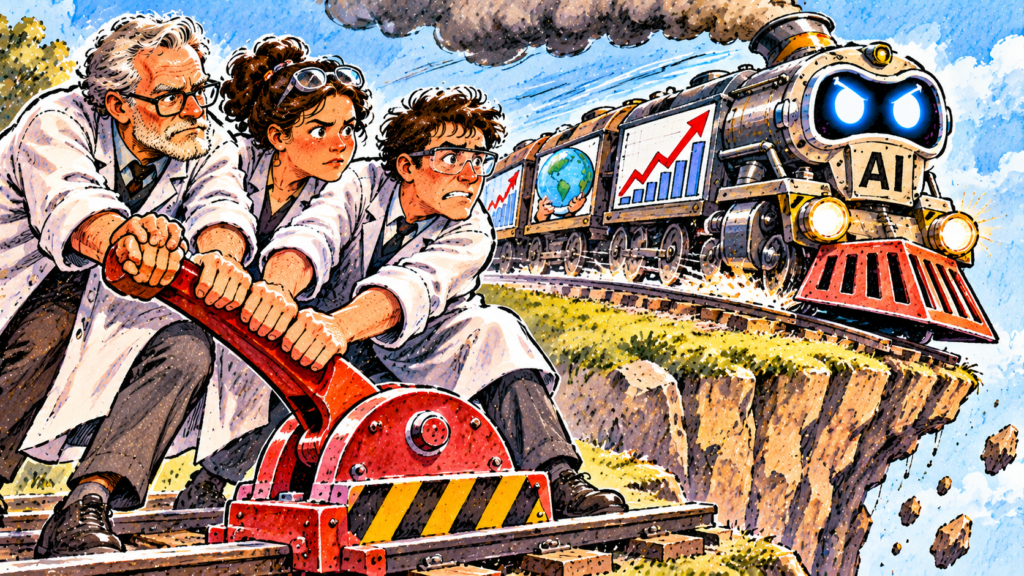
AI forecasting can become unreliable in a particularly dramatic way when a computer attempts to simulate a complicated physical system for a long period. Small errors can accumulate until its predictions describe behaviour that could not plausibly occur. Researchers at MIT have investigated a way of preventing that type of failure by building a physical constraint into the prediction process itself. In a conference paper published in 2026, Andrea Goertzen, Sunbochen Tang and Navid Azizan describe an approach that keeps predicted trajectories bounded under the mathematical conditions established by their model.
The research addresses chaotic dynamics, the kind of behaviour encountered in systems where very small differences in the initial conditions can lead to increasingly different outcomes. It is relevant to problems such as fluid movement and atmospheric simulation, but it is not a demonstration that the system can provide a perfectly accurate weather forecast months into the future. Keeping a simulated system physically plausible and predicting precisely what will happen are different achievements.
Why AI forecasting can fail without a physical boundary
Think about a computer attempting to predict the movement of a swirling liquid. It begins with a description of the liquid’s current state and produces an estimate of how that state will change. If the same model is applied repeatedly, its latest prediction becomes the starting point for the next one. A small error that appears unimportant at an early stage may influence subsequent calculations.
In a system whose behaviour is highly sensitive to initial conditions, that process creates a difficult problem. Even when the underlying physical laws are understood, an imperfect starting description can eventually produce a simulated trajectory that differs greatly from the real one. There may be a limit to how far ahead a precise prediction is useful.
Machine learning adds another consideration. A model may learn an excellent approximation of the relationships it encounters during training, without learning every physical restriction that governs the system. Once repeated predictions move it into unfamiliar circumstances, its responses may cease to respect those restrictions.
The result is more serious than simply predicting the wrong location of a particular feature. A simulation could generate values that become progressively larger or otherwise stray outside the plausible behaviour of the physical system. Even if the early predictions were convincing, such a failure can make the longer simulation unusable for understanding the system’s overall behaviour.
The researchers therefore examine a question distinct from the usual pursuit of forecast accuracy. Can a machine learning model be constructed so that its predictions remain within a bounded region, even when the precise course of a chaotic system cannot be predicted indefinitely?
The difference between chaos and unlimited behaviour
Chaos does not mean that a physical system can do anything whatsoever. A model of a chaotic system may describe highly complicated movements while remaining subject to restrictions. The state of the system can evolve in an unpredictable manner without every quantity increasing without limit.
One way to appreciate the distinction is to consider a small region of moving fluid. The path taken by a particular feature may be difficult to forecast precisely because of interactions within the flow. Nevertheless, the system is governed by physical relationships that limit the kinds of behaviour it can exhibit under the assumed conditions.
A simulation that reproduces the broad character of those movements may remain useful even after it can no longer tell us where a particular feature will appear. Scientists may want to examine how the system behaves over an extended period, how different states are distributed or how frequently it approaches certain conditions. For those purposes, a forecast that eventually produces wildly unrealistic values is especially problematic.
There is an important qualification. Some physical systems really can undergo a change in behaviour that takes them outside the range previously observed. A constraint must therefore reflect the particular system and assumptions being studied. It would be misleading to treat a restriction derived for one model as a universal law that applies to every physical situation.
How the model is prevented from running away
In a November explanation of the work from MIT, the researchers discuss learning an energy-like quantity and establishing a region within which the simulated dynamics should remain. Their method modifies proposed predictions to enforce a condition that reduces this quantity outside the relevant region. The conference paper calls the resulting approach the Energy-Constrained Operator, or ECO.
The term energy-like is significant. The method learns a mathematical function with properties that can be used to constrain the behaviour of the model. It should not be interpreted as a direct measurement of the physical energy of every possible system or as a complete recreation of all its physical laws.
Imagine drawing a boundary around the states that a simulated system can plausibly occupy. Inside that region, the model has room to represent complicated behaviour. Outside it, the prediction mechanism must satisfy conditions that prevent continued outward movement in the relevant mathematical sense. The researchers use a projection operation to adjust the model’s proposed evolution so that the constraint is respected.
Simply cutting off extreme numerical predictions would be a less informative approach. A fixed maximum chosen without regard to the system could remove behaviour that is legitimate. It might also conceal problems in the underlying model, making the simulation look stable without capturing the correct relationships between its variables.
The intention is to retain the flexibility of a learned model while ensuring that its predictions satisfy a meaningful structural restriction. The paper provides a mathematical guarantee of bounded predictions for the constructed model under its specified conditions, which is different from establishing that every value inside that boundary is correct.
Why long-term behaviour can matter more than a particular prediction
Forecasting the exact position of a feature at a distant point in time is not always the principal objective of a simulation. In research involving fluid flow, for example, a scientist may want to understand the pattern of behaviour produced over an extended period rather than reproduce a particular sequence indefinitely.
If a simulation produces sensible-looking results for a short interval and then becomes unstable, it may be poorly suited to that purpose. A mathematical guarantee that predictions stay bounded can make it possible to examine longer sequences, provided the model also reproduces the important statistical properties of the underlying system.
The ECO paper reports experiments on mathematical systems that include equations used to describe complex fluid behaviour. The authors report stable longer-horizon simulations that capture relevant statistical characteristics in their tests. This is evidence for the approach in the systems examined, not evidence that it has been independently established as a reliable operational forecasting tool for every application.
There is an analogy with the development of AI weather forecasting and physical modelling. A prediction system needs to be assessed against the quantities that matter to its users. A model that accurately reproduces an average may perform poorly on rare events. A system that provides plausible long-term behaviour may still be unable to predict the exact timing of an individual event.
For engineers and scientists, a useful evaluation needs to distinguish these objectives rather than compress them into a single score. Different decisions require different kinds of reliability.
Why a guarantee does not make a forecast true
One of the attractions of the MIT work is that the constraint is built into the model rather than being treated solely as something that should emerge from training. This offers a way of reasoning about a specific property of the system before using it to produce a long sequence of predictions.
However, a mathematical guarantee is only as relevant as the conditions and assumptions under which it is established. A model that cannot produce an unbounded trajectory could still produce the wrong pattern of behaviour. It might overlook an important feature, assign the wrong frequency to an event or react incorrectly to a change in the conditions of the real system.
The model could also be limited by the training material used to construct it. If the data do not represent a particular operating condition, maintaining bounded predictions under that condition does not necessarily establish that the model has learnt how the physical system actually responds.
The importance of these distinctions becomes clearer when considering applications outside the research demonstration. Someone relying on a forecast to make a decision about equipment, infrastructure or environmental conditions may care about how well the model represents an extreme event, rather than whether its values remain finite. Evidence from tests designed for the particular use would still be required.
Other approaches, such as machine learning for simulating different physical substances, address related but distinct challenges. A model’s ability to represent different kinds of material does not automatically establish that its long-running predictions satisfy a useful physical constraint. Conversely, a model designed to prevent unbounded behaviour need not be a general-purpose simulator of every material.
Combining learned relationships with established physical knowledge
The development points towards an approach in which scientific knowledge can provide more than the examples from which a machine learns. Known constraints can help determine which predictions the system is allowed to make. That may be especially valuable where experimental observations are difficult to obtain or where collecting examples of every possible condition would be impractical.
It also creates a responsibility for researchers to specify exactly what has been enforced. A restriction that works well for a system with particular dissipative properties may be unsuitable for a different system. The mathematical assumptions, the quality of the training data and the performance of the model under realistic conditions all need to be considered.
The wider context of weather forecasting accuracy over different time horizons provides a useful reminder that the value of a prediction depends on when it is made, what it is intended to represent and how its uncertainty is communicated. Improving one property of a model can be important without eliminating the limits of prediction itself.
The MIT research offers a precise example of how machine learning can be made more accountable to the physical behaviour it is supposed to represent. Instead of hoping that a model will learn every necessary restriction from examples, the researchers explicitly enforce a property that helps keep its predictions stable. It is a promising contribution to the design of scientific simulations, and a reminder that an artificial intelligence system can benefit from being told what it is not allowed to do.
About the Author
Stuart Kerr is Technology Correspondent at LiveAIWire, covering artificial intelligence, cybersecurity and the social impact of emerging technology. LiveAIWire is an independent, human-led technology publication using AI-assisted research, editorial production and original AI-assisted editorial illustrations under his direction.