
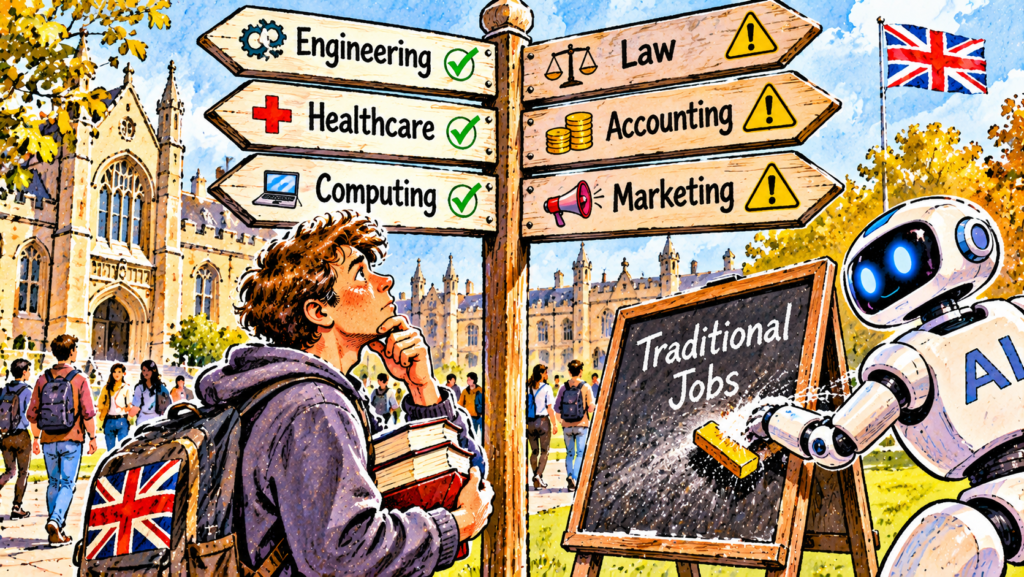
AI and university degrees have become linked in an uncomfortable decision facing British families. A teenager selecting a course may be considering a career whose everyday responsibilities will look different by the time they graduate. Research described by King’s College London economist Bouke Klein Teeselink in September 2026 suggests that UK applicants have been moving towards more AI-exposed degrees, rather than abandoning them, even as junior opportunities in the associated occupations have weakened.
The work, conducted with Aristotle Vossos, Andrei Andronic and Kartik Akileswaran, is presented as a working paper. Its analysis links degree choices to the AI exposure of occupations associated with previous graduates. It does not predict which individual students will find work after graduation. It also cannot establish from application patterns alone whether students are making an informed bet on technology or responding to incomplete information about the labour market.
What the research says about AI and university degrees
The researchers examined domestic applications to 1,090 higher education degrees between 2020 and 2025. As explained in King’s College London’s account of the findings, the team connected career histories drawn from LinkedIn with university admissions information. They used the types of jobs held by former students to estimate the exposure of different degrees to large language models, the technology behind systems such as ChatGPT.
Following ChatGPT’s public launch in November 2022, degrees that scored more highly on the researchers’ exposure measure experienced stronger relative growth in applications. For a difference of one standard deviation on that measure, the researchers reported relative growth of approximately six per cent. The corresponding occupations also showed a decline in the share of junior and entry-level positions.
A standard deviation is a statistical way of describing how far a value lies from the centre of a distribution. In this study, it is used to compare degrees according to their relative exposure. The finding does not mean that applications to every computing or engineering course rose by six per cent, or that students on those courses face a particular probability of unemployment.
It is a relationship across the degrees examined and the occupations associated with them. That distinction is essential when interpreting a study that could otherwise be turned into an unnecessarily alarming message for anyone considering a technical or analytical subject.
Exposure does not necessarily mean replacement
An occupation can be exposed to AI because a model is capable of performing some of its tasks. That says little by itself about whether the occupation will disappear. A graduate may perform a mixture of activities, some of which can be automated and others of which depend on professional judgement, relationships or an understanding of the organisation’s particular circumstances.
Consider a junior software developer. A coding assistant might make it easier to produce a routine component of an application, but the organisation still needs to understand what the software is supposed to achieve, whether it works correctly and how it fits into the systems already in use. The employer’s decision about hiring depends on how those responsibilities are organised and whether the technology creates opportunities to undertake additional work.
The effect on entry-level positions may also differ from the effect on experienced employees. Someone with extensive knowledge of a business might be able to combine that experience with an AI tool to handle tasks that previously required additional support. A new graduate who would once have learnt through those routine tasks may find fewer opportunities to acquire the same experience.
This relationship is explored in research on AI and hiring among young workers. It creates a question that is easily overlooked in discussions of automation: if a profession still needs experienced people, where will those people acquire their experience when the traditional starting roles change?
Why an applicant might still choose an exposed subject
It is entirely possible for a student to recognise that AI is changing a profession and still decide that the relevant degree offers attractive opportunities. If the technology expands the range of work a person can undertake, understanding the underlying subject may become more valuable. A computing student could see the development of artificial intelligence as a reason to study computing, rather than as a reason to avoid it.
Career choices also reflect interests that do not disappear when a market changes. A person who enjoys mathematics may prefer a mathematically demanding degree even if the associated occupations become more competitive. Another applicant may be attracted to the intellectual content of a course without intending to pursue the most obvious career associated with it.
There is a less optimistic possibility. A student may be relying on accounts of graduate opportunities that describe conditions from several years earlier. If a degree has historically been associated with high salaries and plentiful junior jobs, that reputation may continue to attract applicants after the conditions begin to change.
The King’s research cannot determine which of these explanations dominates. Application data reveal decisions, but they do not reveal all the motivations behind those decisions. An apparent mismatch between current entry-level hiring and future graduate supply could eventually disappear if demand recovers, if new occupations emerge or if students use their qualifications in unexpected ways.
This uncertainty is important for parents. Telling a young person to abandon a subject because its associated work is changing could be just as misguided as insisting that past career outcomes will automatically continue. The question should be how well the course prepares the student to adapt when the tasks performed within a profession evolve.
Finding better information before submitting an application
Students choosing courses can examine more than the advertised graduate salary. The UCAS undergraduate data resources for the 2025 cycle offer an official starting point for understanding application and acceptance patterns. UCAS also identifies limitations to its coverage, particularly for provision in Scotland that falls outside its system. Application data should not be confused with direct evidence of demand from employers.
An applicant investigating a particular course would benefit from asking what graduates actually do, how recently the outcomes were measured and how many of the relevant opportunities are accessible to newcomers. A headline employment figure may include people working in occupations that are only loosely connected to the subject. An average salary may not explain the range of possible outcomes or the circumstances of the people included.
It is also worth examining the course itself. Programmes with similar names can place different emphasis on fundamental concepts, practical work and independent projects. A student who understands why a process works may be better placed to evaluate an automated system than someone who has learnt only to reproduce a procedure using a particular application.
The availability of practical experience can be especially valuable when the conventional routes into a profession are changing. Work placements, supervised projects and opportunities to collaborate with people in industry can help students see how a theoretical subject is applied. They can also reveal skills that are rarely visible in a description of a job vacancy.
None of these considerations guarantees a position after graduation. They are ways of improving a decision made under uncertainty, rather than attempting to predict the exact state of a labour market years in advance.
Universities need room for students to change direction
A degree is a substantial commitment of time, and it is difficult for an applicant to know how a subject will suit them before beginning it. Changes in technology create an additional source of uncertainty. The course chosen by a student may remain intellectually relevant even when the most obvious occupation associated with it changes.
Universities could respond by making it easier to combine disciplines and change pathways where that is academically practical. A student interested in computing might discover a strong interest in a particular application of technology, while someone studying a non-technical subject may want to gain a deeper understanding of data or automated decision-making.
The debate about redesigning university degrees for a world of AI illustrates a related challenge. Updating a curriculum should involve more than adding training in whichever chatbot is currently popular. The longer-term value of a qualification lies partly in the understanding and methods that can be applied when individual tools are replaced.
There is also a case for helping graduates adjust after they enter the workforce. Someone who discovers that the opportunities associated with their original field have changed may need an accessible way to develop complementary skills. The availability of practical AI skills training for workers is one element of a broader approach, although different professional transitions require different types of training.
The decision is a bet on adaptability, not a forecast of certainty
The King’s research identifies a tension between stronger relative interest in exposed degrees and weaker indicators for junior hiring in the occupations associated with them. It does not establish that applicants should choose less exposed subjects. There are uncertainties on both sides of that choice, including the possibility that technology will change work in ways that current measures do not capture.
For a family discussing university options, the more useful approach is to examine a student’s interests, the quality and flexibility of the course, the skills it develops and the pathways it offers. Evidence about entry-level opportunities belongs in that discussion alongside other considerations, rather than being treated as an infallible instruction about what to study.
Graduates will need to navigate the relationship between their own expertise and tools whose capabilities may change repeatedly during their working lives. The value of a degree may increasingly depend on whether it gives them a strong enough foundation to understand unfamiliar developments, question the results of automated work and learn new methods without having to start again from the beginning.
About the Author
Stuart Kerr is Technology Correspondent at LiveAIWire, covering artificial intelligence, cybersecurity and the social impact of emerging technology. LiveAIWire is an independent, human-led technology publication using AI-assisted research, editorial production and original AI-assisted editorial illustrations under his direction.