
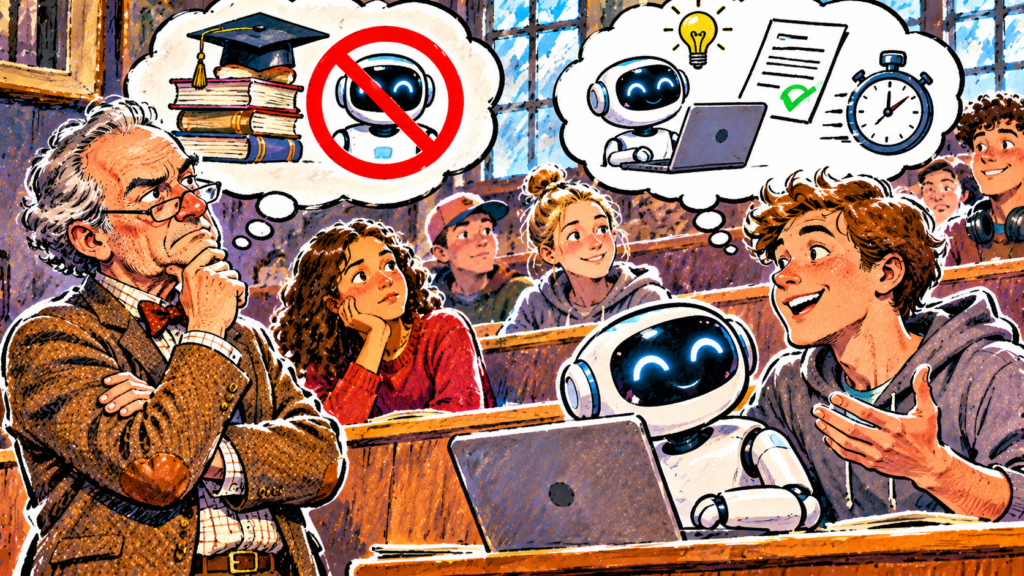
AI at university is often discussed as if students and lecturers agree on how artificial intelligence is being used and differ only about whether it should be allowed. Research involving the University of Manchester and Spain’s University of the Basque Country suggests that even the underlying picture of student behaviour may be contested. In a paper published in Frontiers in Education, the researchers examined perceptions among academic staff and students in a British university setting. Lecturers tended to perceive more extensive student use than students reported themselves.
The distinction is important. The study did not observe every student’s use of AI or independently establish how many assignments had been completed with a chatbot. It compared what people said about their experiences and what they believed about other people’s behaviour. The findings point towards a gap in perception, which universities need to understand before deciding how to respond to the technology.
The difficult conversation about AI at university
The researchers surveyed 45 members of academic staff and 86 students in a school covering social science subjects. According to the University of Manchester’s account of the study, the questionnaires were completed between April and June 2024. Students were generally more positive than staff about the potential for generative AI to assist academic work. The university published its account in November 2026, making the time between data collection and publication a particularly important consideration.
A student starting an assignment in 2024 encountered a different landscape of tools from someone beginning one today. The cost of access, the capabilities of individual models and the rules communicated by universities can change. A study of one school at one point in time cannot provide a current estimate of how students across the country are using artificial intelligence.
It can, however, reveal a difficulty that is likely to remain relevant as tools change. Someone responsible for assessing students may not have the same understanding of the software as someone experimenting with it in their own time. Conversely, students may not appreciate what an academic considers an essential part of the learning process, even when they understand the instruction to submit their own work.
This creates an opportunity for misunderstanding on both sides. A lecturer may perceive a polished assignment as evidence of substantial automation, while a student may regard limited language assistance as unremarkable. The two people may also interpret the word assistance differently, leading to disagreement before any discussion of academic integrity has properly begun.
A well-written paragraph does not tell its own history
Consider a student who reads the assigned texts, develops an argument and writes a draft. They might subsequently use a chatbot to identify awkward phrasing or suggest a clearer transition between paragraphs. Another student might enter the assignment question into a generator and submit a revised version of the answer it produces. Both could truthfully say they used AI, but the contribution of the tool to their intellectual work is very different.
The difficulty for an assessor is that the final piece of writing does not necessarily disclose the process that produced it. Fluent prose may reflect a student’s own writing, feedback from another person, traditional spelling and grammar tools or more extensive generative assistance. An unusual error is not reliable evidence that a human wrote the passage, just as polished prose is not reliable evidence that a machine did.
That is why the debate cannot be resolved simply by asking students whether they used artificial intelligence. A meaningful answer requires a definition of the kinds of use being discussed. Was the system asked to explain an unfamiliar concept? Did it produce a structure for an argument? Did it draft the text that was submitted? The consequences for learning and assessment differ in each case.
An institution that treats all of these activities as a single category may struggle to communicate its expectations. It risks discouraging legitimate assistance while giving students too little information about where the important boundaries lie. Conversely, a policy that describes AI use as entirely acceptable without specifying what students must demonstrate independently leaves assessors with an equally difficult problem.
The wider discussion of university guidance on AI and learning is therefore as much about language and expectations as it is about selecting approved software.
When learning is the work that the software removes
A generative assistant can produce a coherent explanation of a difficult text in a form that is easier for a student to understand. This could provide a useful starting point, particularly when the student has struggled with unfamiliar terminology. The educational value depends on what happens next.
If the student returns to the original text, compares the explanation with the evidence and works through areas of disagreement, the assistant may have supported a demanding intellectual activity. If the generated explanation replaces the original reading entirely, the student may never discover the nuances, uncertainty or reasoning that the assignment was intended to develop.
A similar distinction applies to writing. Revising a draft can help a student discover how to communicate an argument more clearly. Automatically rewriting the entire passage may produce a better-looking result without developing that ability. The difference is especially important where the intended learning outcome is the skill that the software is being asked to perform.
Research into how AI can improve student work without necessarily improving thinking provides a related area of inquiry. The central question is not merely whether the output looks better, but whether the learner becomes more capable of producing, explaining or evaluating such work in the future.
Lecturers who understand this distinction may find it easier to explain why some uses are appropriate and others are problematic. Students may also be more willing to accept a restriction when they understand its relationship to the skill being assessed, rather than encountering a prohibition that appears arbitrary.
What students may not want to tell their lecturers
A survey relies on participants’ willingness and ability to describe their behaviour accurately. Students might understate use that they believe an institution regards as unacceptable. They may also fail to count tools embedded in ordinary software as artificial intelligence, particularly when the software does not make its underlying technology obvious.
Academic staff face a different information problem. They encounter the results of student work and hear accounts of new technology, but they are not necessarily present when a student decides to use a tool. Their impressions can be shaped by particularly noticeable cases, which may not reflect typical behaviour across a course.
Neither perspective provides an objective measurement of every use. The difference between the groups should not be presented as proof that students are concealing widespread misconduct or that lecturers are imagining a problem that does not exist. The research establishes that their stated perceptions differed. Determining why requires additional evidence.
Institutions can reduce some of that uncertainty by providing opportunities for students and staff to discuss realistic examples without automatically making the conversation an accusation. An academic could explain how different forms of assistance relate to the assessment criteria, while students could describe the kinds of tools they encounter during ordinary study.
The goal would be to make an acceptable process easier to understand, not to invite students to disclose confidential personal material or expose themselves to unfair disciplinary treatment. A transparent description of the policy and the consequences of breaching it would be essential to such a discussion.
Assessing what the student actually understands
An assignment can be redesigned to make evidence of learning more visible. A student might be asked to explain why they selected particular evidence, discuss the weaknesses of their own argument or respond to questions about a decision made during the work. These approaches can provide additional information that is not available from the final written submission alone.
That does not mean every course should abandon essays or impose oral examinations on every student. Different subjects have different learning objectives, and some assessment methods may present accessibility or practical difficulties. The important principle is to identify what students need to demonstrate and select evidence that reflects that ability.
There is also a cost to requiring elaborate documentation of every interaction with a tool. A student who spends excessive time recording routine edits may have less time to concentrate on the subject itself. Requirements need to be proportionate, clear and applied consistently. The related debate about student trust, empowerment and dependence on AI illustrates why an educational response needs to consider more than academic misconduct.
Better policies start with a shared understanding
The Manchester research offers a useful reminder that perceptions of AI use are not the same as verified behaviour. A department that wants to understand its students’ practices would benefit from gathering current evidence, explaining its expectations clearly and examining how its own assessments encourage or discourage particular uses.
For students, the practical lesson is to check the rules for the particular course and assessment, rather than assume that a tool permitted for revision is necessarily allowed in a submitted assignment. Asking for clarification before using a tool in a disputed way is generally more useful than attempting to explain the decision after a problem arises.
The enduring challenge for universities is to maintain confidence in what a qualification represents while recognising that students are encountering increasingly capable software. A constructive response begins by identifying what students need to learn and by ensuring that both sides understand how artificial intelligence is being used in that process. Without that shared understanding, an institution can spend considerable effort solving a problem that its staff and students have not even defined in the same way.
About the Author
Stuart Kerr is Technology Correspondent at LiveAIWire, covering artificial intelligence, cybersecurity and the social impact of emerging technology. LiveAIWire is an independent, human-led technology publication using AI-assisted research, editorial production and original AI-assisted editorial illustrations under his direction.