
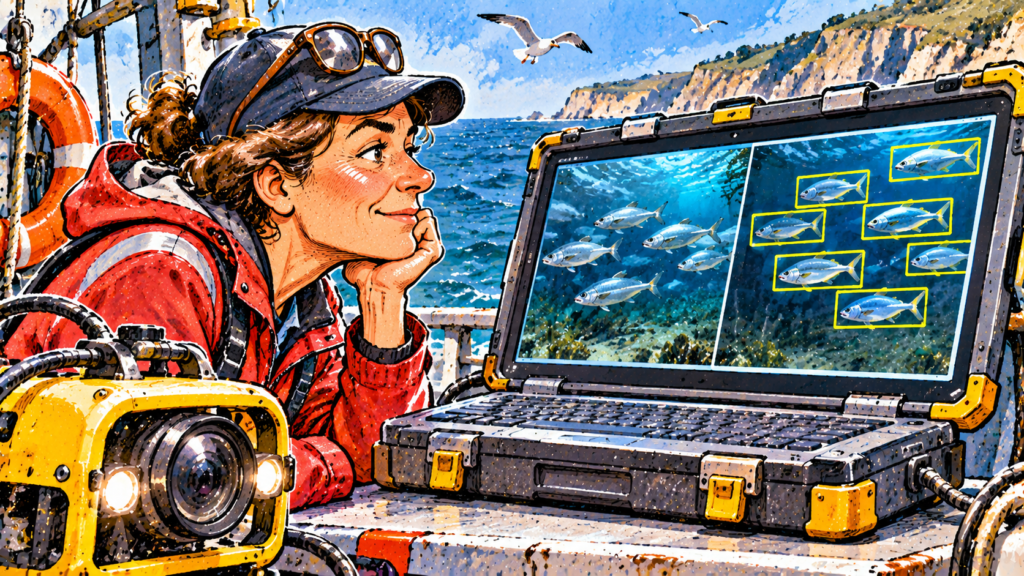
Ocean Detect tackles a problem that begins when a scientific camera comes back from the sea. Researchers may have recorded extraordinary animals in their natural surroundings, but someone still has to identify what appears in the footage and convert those observations into usable data. At the University of Rhode Island, biological oceanography researcher Christine de Silva and colleagues have developed an artificial intelligence platform to help with that painstaking work. A university report on the project, published on 24 November 2026, describes both its promise and the continuing need to check the machine’s output.
The project received the Guy Harvey Foundation Collegiate Award at Ocean Exchange’s 2026 competition. The competition organiser’s winners list independently confirms the award. Recognition of the innovation does not establish that its automated identifications are always correct. The value of the work lies in addressing a genuine bottleneck in marine research: the difficulty of examining large collections of underwater images in sufficient detail.
Why Ocean Detect starts with a camera rather than a robot
Much of the appeal of underwater research comes from the machinery used to reach difficult places. Yet a camera on a stationary platform can be a particularly useful scientific instrument. Instead of following an individual animal, researchers can record what arrives in a particular area over a period of time. A consistent arrangement makes it possible to compare footage collected at different sites, provided the conditions and limitations are properly documented.
The university’s description of baited remote underwater video introduces one way of collecting such observations. Cameras are placed near bait to record animals that approach. Lighting enables recording in surroundings where natural light may be limited. The equipment can capture behaviour that would be difficult to study through brief human observation alone.
Baited footage does not represent every creature in the surrounding ocean. Animals that are attracted to the bait are more likely to appear than those that avoid it, and the camera only observes a limited field of view. The type of bait, water conditions, depth and length of the recording can all influence the resulting observations. The computer cannot remove those sampling limitations simply by identifying the animals more quickly.
That distinction matters because a successful video analysis system is a component of scientific measurement, not the measurement strategy itself. Researchers still have to decide where to place cameras, how to compare the observations and whether the evidence supports a conclusion about a population or habitat.
Turning moving pictures into research data
Imagine a video that begins with an empty patch of seabed. A fish swims into view, disappears behind another animal and returns from a different direction. Later, something of a similar shape passes the camera in poor lighting. A scientist might want to know which species appeared, when they arrived, how long they remained visible and whether repeated sightings represent the same individual.
Watching the video is only part of the job. Each observation has to be recorded in a form that can be compared with other footage. A researcher may draw a boundary around an animal in an image, assign it a name and record the frame or time at which it was observed. Such labels make the original footage searchable and provide material from which a machine learning system can learn.
De Silva’s team initially needed to prepare labelled images before the computer could recognise creatures for itself. The project subsequently brought labelling and model use together, so previously trained models can suggest regions of interest before someone examines them. This changes the nature of the human task from searching every frame to checking a proposed interpretation of it.
The difference can be substantial when the footage contains long periods without an animal of interest. A system that highlights likely events can direct attention to those parts of the recording that deserve closer examination. It must also be capable of finding unusual events, rather than simply drawing attention to the things its training has already taught it to expect.
A dramatic speed claim needs a careful denominator
The University of Rhode Island report attributes a striking performance figure to the research team: automated annotation of a half-hour recording on its computing infrastructure was approximately 133 times as fast as manual annotation. It also describes the continuing development of methods to verify and correct those annotations. These are reported project results, not an independently established end-to-end productivity figure for marine research in general.
That qualification makes the claim more useful rather than less impressive. The time required for a computer to produce a proposed set of labels is measurable. The time required for a marine biologist to turn those labels into a reliable dataset is another quantity. Combining them without distinguishing their roles would obscure the real benefit.
A system might quickly flag a common fish that is well represented in its training material. An unfamiliar creature captured in a murky frame could take much longer to resolve, even after the machine has done its work. The amount of human checking needed depends on the quality of the predictions, the purpose of the study and the consequences of an error.
For a broad survey, a researcher may be able to tolerate a degree of uncertainty in some preliminary labels. A record used to establish the presence of a rare species or support an environmental decision may need a much higher level of scrutiny. The technology should make that distinction possible, rather than requiring scientists to treat every generated identification as equally reliable.
The animals a computer is least likely to recognise
Marine ecosystems present difficult conditions for image recognition. Animals can be partially hidden, appear at unfamiliar angles or have markings that are difficult to distinguish under artificial lighting. A camera positioned in one environment may produce very different images from a camera positioned elsewhere.
These problems also arise in other approaches to marine observation, including AI-assisted coral reef mapping and whale detection using aerial imagery. The underlying challenge is to establish whether the model is identifying a biological feature or merely responding to a pattern that happened to correlate with that feature in its training material.
An underwater detection system should be able to preserve uncertainty. If an animal cannot be identified beyond a broad group, that may be the scientifically responsible conclusion. Insisting on the most specific possible name could create apparently precise records that are actually less trustworthy.
A further issue is that common species are likely to offer more opportunities for obtaining training examples than rare ones. A model that performs well on frequently encountered animals may still miss the very observation that makes an expedition valuable. Researchers need a way to examine failures and to recognise footage where automated screening may be particularly unreliable.
The benefit of retaining original images is that a future expert can revisit a disputed result. This creates a route to correction when a classification changes or new knowledge about a species becomes available. Without the original evidence, it is much harder to separate a mistake made by the computer from a mistake made by the person who reviewed it.
Could coastal communities use a system like this?
One attraction of making video analysis easier is that scientific observation could become more accessible to organisations without large specialist teams. A coastal community interested in the condition of its local waters might be able to collect recordings and obtain an initial account of the creatures visible in them. A marine business might use a related approach to organise footage collected for environmental monitoring.
These are possible applications rather than established deployments of Ocean Detect. Community projects would still need suitable equipment, appropriate permissions, a credible sampling method and access to people who understand the local ecosystem. An attractive interface cannot substitute for that expertise.
There are also questions about computing costs and data ownership. Video can require substantial storage, and a project that depends on central computing infrastructure needs a dependable way to transfer and process it. Organisations must decide who can access footage and associated location information, particularly when the recordings concern sensitive habitats or species.
The wider promise of artificial intelligence in deep-sea exploration is not confined to collecting more observations. It also involves making better use of the observations already collected. If footage remains inaccessible because nobody has the resources to examine it, an additional expedition may add to the backlog without resolving the original problem.
What a useful scientific result would look like
The strongest future evaluation of Ocean Detect would examine the complete journey from original video to a checked dataset. It would compare human and machine-assisted workflows, record which types of animal are missed or wrongly identified, and establish how much expert time is actually saved after corrections are made.
It would also assess footage collected outside the environments used for training. A detector that works in familiar surroundings may be useful, but researchers need to understand whether and how it can be adapted to other locations. Reporting the performance separately for different species and recording conditions would be more informative than a single headline accuracy figure.
For marine scientists, the purpose of the exercise is to understand the ocean rather than demonstrate that an algorithm can outperform a person at a narrowly defined task. If the platform makes it practical to revisit old recordings, investigate unusual observations and spend more expert time interpreting results, it could make a meaningful contribution to that objective.
A camera may spend hours recording animals that people rarely see. The achievement of a successful analysis system would be to make those observations easier to discover without allowing the speed of automated labelling to become a substitute for the care required to understand them.
About the Author
Stuart Kerr is Technology Correspondent at LiveAIWire, covering artificial intelligence, cybersecurity and the social impact of emerging technology. LiveAIWire is an independent, human-led technology publication using AI-assisted research, editorial production and original AI-assisted editorial illustrations under his direction.