ai aviation flight safety history 2026
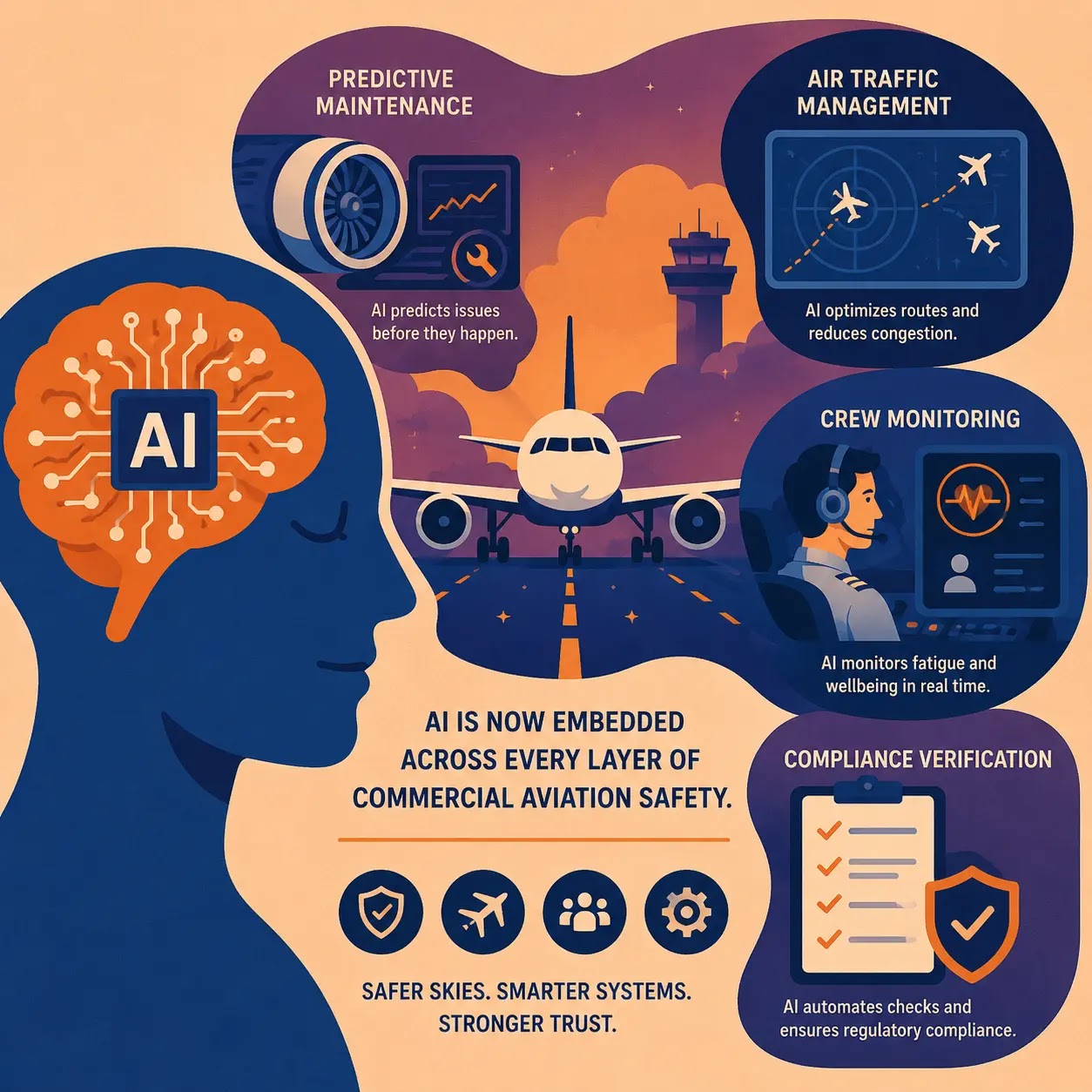
AI is now embedded across every layer of commercial aviation safety, from predictive maintenance and air traffic management to crew monitoring and compliance verification.
By Stuart Kerr, Technology Correspondent, LiveAIWire
Flying Is Already the Safest Form of Mass Transportation Ever Devised. AI Is About to Make It Safer Still.
Commercial aviation is statistically the safest way to travel that humanity has ever created. The probability of dying on a commercial flight is approximately one in eleven million. In a good year, more people are killed by lightning strikes than in commercial airline accidents. That extraordinary safety record was built over a century of engineering rigour, regulatory discipline, and the hard-won lessons of every accident ever investigated. Now, artificial intelligence is being applied to that same record with the goal of pushing safety further, not incrementally but structurally, by finding the failure patterns that human oversight alone cannot catch, predicting mechanical problems before they manifest, and managing airspace complexity that is growing faster than the human systems designed to control it. The result, already visible in verified deployments across the global aviation industry, is a system that is learning to prevent accidents rather than simply responding to them.
Predictive Maintenance: Fixing the Problem Before the Plane Knows It Has One
The single most impactful application of AI in aviation safety right now is predictive maintenance, and its logic is straightforward. Every modern commercial aircraft is equipped with thousands of sensors continuously measuring engine performance, hydraulic pressure, vibration signatures, temperature gradients, and dozens of other parameters throughout every flight. That data, historically analysed retrospectively during scheduled maintenance checks, is now being processed by AI systems in real time, comparing current readings against baseline models built from millions of hours of operational data.
The outcome is the ability to flag components that are trending toward failure before any mechanical symptom is detectable by conventional inspection. Airlines using AI predictive maintenance systems report measurable reductions in unscheduled maintenance events, which are among the most disruptive and costly occurrences in airline operations. An unexpected engine fault that grounds an aircraft requires not just a repair but a cascade of crew reassignments, passenger rebooking, and slot management interventions that ripple through a network for hours. Predicting and addressing that fault during a scheduled overnight check eliminates the cascade entirely.
ICAO, the International Civil Aviation Organisation, has formally recognised AI’s potential to provide crew assistance, reduce time spent on non-value-added tasks, and bring efficiency and effectiveness to flight operations, and is working toward publication of recognised compliance standards for AI in aviation safety systems in 2026. The European Union Aviation Safety Agency’s European Plan for Aviation Safety 2026 contains 129 active safety actions with new rulemaking tasks specifically addressing new technologies and concepts including AI integration.
Air Traffic Control: Managing a Sky That Is Getting More Crowded
Global air traffic is projected to grow significantly over the coming decades, creating denser airspace and higher operational complexity than any previous generation of air traffic control systems was designed to manage. The Newark air traffic control outages of 2025, which drew significant public attention to the age of US ATC infrastructure, highlighted the urgency of modernisation. In response, the US Department of Transportation announced plans to replace the entire aging American air traffic control system, including 618 aging radars, 25,000 new radios, and a transition to full internet protocol networking, with AI at the centre of the rebuilt architecture.
AI is already being deployed in air traffic management to optimise flight routing around emerging weather patterns, reduce fuel burn by calculating more efficient flight paths, and manage airspace capacity dynamically as demand fluctuates. Airport Collaborative Decision Making, or A-CDM, uses real-time data sharing between airlines, airports, and air traffic controllers to coordinate movements at major hubs with AI assisting in sequencing decisions that previously required significant manual coordination. Early deployments at European airports have demonstrated meaningful reductions in taxi times, fuel consumption, and the knock-on delays that propagate through airline networks from a single poorly-managed departure.
A systematic review of 175 studies on AI and aviation safety published in Advanced Engineering Informatics in January 2026 found that large language models are increasingly being used in accident analysis and virtual co-pilot applications, with the emergence of hybrid intelligence design, combining AI capability with human oversight, identified as the most promising framework for the near-term future of cockpit safety systems.
The Human Factor: AI Watching the Crew
The majority of aviation accidents that occur have a human factors component. Pilot fatigue, cognitive overload, distraction, and communication errors between crew members and between cockpit and air traffic control are recurring themes in accident investigation reports. AI is beginning to be deployed to monitor precisely these variables, not to override human judgment but to provide an independent alert layer when the data suggests that a crew is operating under conditions that historically precede errors.
AI systems monitoring biometric data can flag fatigue indicators. Voice recognition systems can detect communication patterns associated with elevated stress or confusion. Attention monitoring technology, already deployed in some training simulators, can identify when a pilot’s focus has shifted away from the primary flight task. None of these systems replace the pilot. They provide the pilot with information about their own state that the human brain is frequently unreliable at self-assessing, particularly under the precise conditions, high workload, accumulated fatigue, time pressure, where errors are most likely to occur.
In early 2026, the US Congress passed an aviation safety bill requiring at least two qualified pilots on the flight deck of all commercial airline flights, explicitly reinforcing the principle that AI enhancement of human oversight is the direction of travel, not AI replacement of human judgment. That policy position reflects a consensus across aviation regulators globally: the future of flying safety is hybrid intelligence, where AI and human expertise each do what they do best.
The Compliance Revolution: AI Catching the Flights That Should Not Fly
A less visible but critically important application of AI in aviation safety is compliance monitoring. Illegal charter operations, where aircraft and crews operate outside their certified parameters, represent a genuine safety risk and an industry-wide problem of what industry experts describe as epic proportion. CoachAir Aviation Intelligence is developing an AI platform that validates each flight in real time by cross-checking FAA and DOT data, insurer databases, maintenance logs, and operator records before a booking can be confirmed. If information is missing, inconsistent, or outside permitted parameters, the system flags the transaction automatically. Every decision produces a regulator-ready audit trail.
The principle extends beyond charter to scheduled aviation. AI systems monitoring the full data ecosystem of an airline operation, crew rest records, maintenance logs, weather briefings, fuel loads, and weight and balance calculations, can identify situations where multiple factors that individually fall within permitted limits are combining to create a risk profile that no individual check would flag. That kind of systemic pattern recognition is precisely what AI does best and precisely what human oversight, managing individual data streams sequentially, finds most difficult.
What This Means for Anyone Who Flies
The improvements AI is delivering to aviation safety are not theoretical projections. They are active deployments producing verified results. The aircraft you fly on today is maintained by AI predictive systems, managed by AI routing and spacing tools, and operated by crews whose workload is being progressively reduced by AI automation of the tasks that historically competed most damagingly with the primary task of flying the aircraft.
The next time flying feels routine, that feeling is itself a measure of how well the safety architecture is working. The 11 million to one odds against a fatal accident are the product of a century of relentless improvement. AI is not replacing that tradition. It is accelerating it, with tools that can see patterns in data at scales and speeds that no human team could match, and with the institutional rigour and regulatory oversight that aviation safety has always demanded. As explored in Beyond Hallucinations: Why Training AI to Reason Harder Is Making It Less Reliable, the quality of AI validation matters enormously in high-stakes contexts. Aviation’s regulatory framework, among the most demanding in the world, ensures that the AI being deployed in safety-critical applications meets standards that consumer AI tools are not yet required to match. That distinction is what makes the aviation application of AI genuinely different from most others. And it is what makes the safety gains it is delivering genuinely trustworthy.
About the Author
Stuart Kerr is Technology Correspondent at LiveAIWire. He writes about artificial intelligence, ethics, and how technology is reshaping everyday life. Follow @LiveAIWire on X.