Elon Musk a Million Satellites and a Data Centre in the Sky The Most Ambitious Plan in Tech History
By Stuart Kerr, Technology Correspondent
Published: 9 May 2026
Author Bio: https://liveaiwire.com/p/to-liveaiwire-where-artificial.html
The Man at the Centre of Everything
No figure in technology, business, or politics occupies more space in the global conversation right now than Elon Musk. He is simultaneously the chief executive of the world’s leading electric vehicle company, the founder of the most active commercial rocket company in history, the owner of one of the world’s most influential social media platforms, the driving force behind a frontier AI company that recently merged with SpaceX, and a named defendant in more than a dozen active federal lawsuits arising from his role as the unofficial head of the Department of Government Efficiency. He is also, as of January 2026, the man who asked the United States government for permission to put up to one million satellites in orbit and turn them into the largest solar-powered data centre ever conceived.
This article does not take a position on Musk’s political activities or the ongoing legal proceedings against him. Courts will determine those outcomes. What it does is examine the satellite plan on its own terms, because whatever you think of the man, the idea is genuinely extraordinary and the questions it raises about AI, energy, and the future of computing deserve a clear, honest examination.
The Plan: A Data Centre the Size of an Orbital Constellation
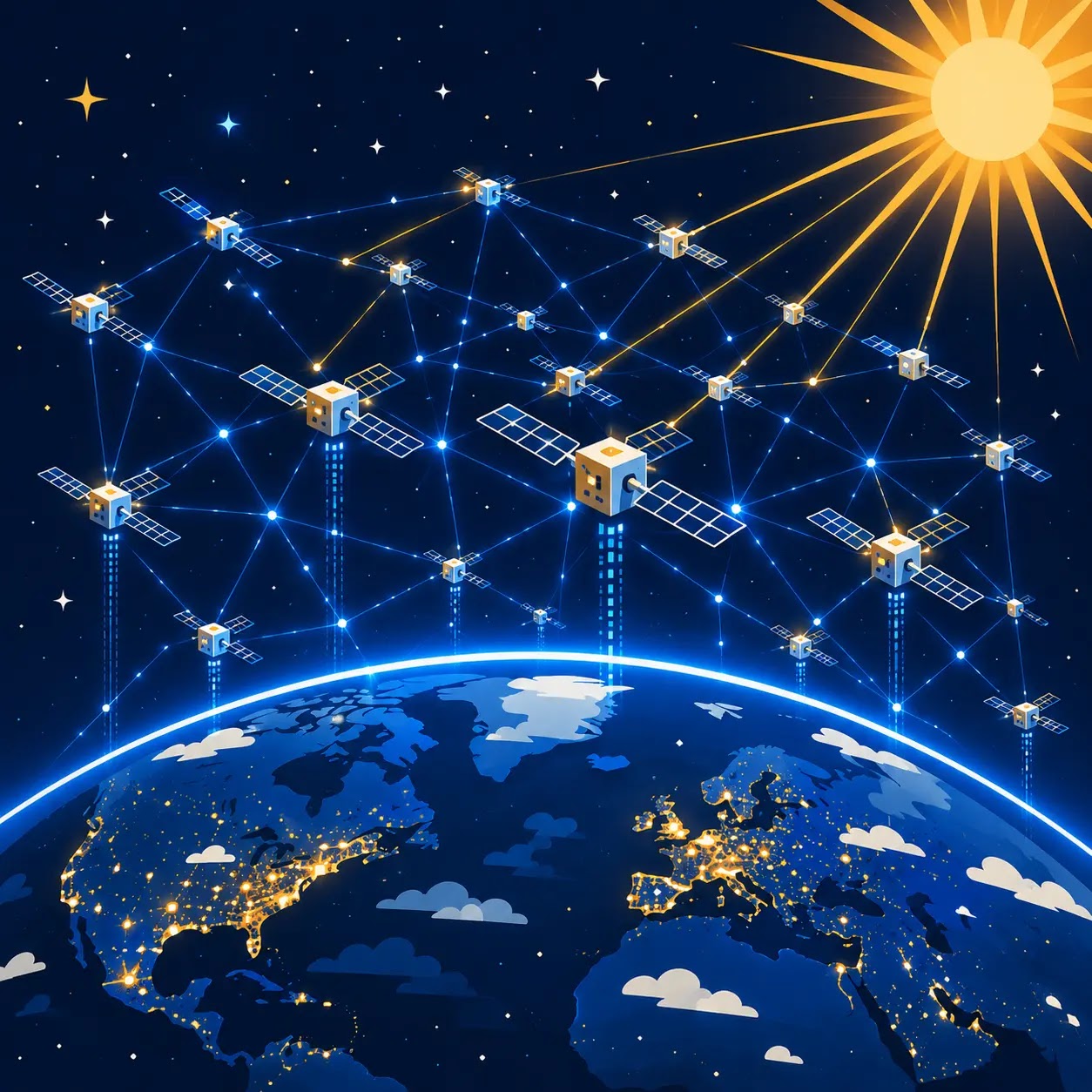
On 30 January 2026, SpaceX filed an application with the Federal Communications Commission requesting approval to launch a constellation of up to one million satellites into low Earth orbit, operating at altitudes between 500 and 2,000 kilometres. The stated purpose is not internet connectivity, which Starlink already provides. It is AI computing.
In SpaceX’s own words from the FCC filing: “By directly harnessing near-constant solar power with little operating or maintenance costs, these satellites will achieve transformative cost and energy efficiency while significantly reducing the environmental impact associated with terrestrial data centers.” The satellites would be linked by high-speed laser communications, processing AI workloads in orbit and relaying results to the ground through the existing Starlink network.
The physics behind the proposal are genuinely compelling. A satellite in the correct orbit receives sunlight for the overwhelming majority of its orbital period, effectively giving it access to near-continuous solar power in a way that no ground-based facility can match. Earth’s rotation means terrestrial solar farms experience night. A constellation of satellites distributed across different orbital positions does not. The sun is always shining somewhere in the network. Musk summarised the vision on X: “Starship could deliver 100GW per year to high Earth orbit within four to five years if we can solve the other parts of the equation.”
The merger of SpaceX with xAI, which took place in February 2026, makes the strategic logic explicit. xAI is the company behind Grok, one of the leading AI assistants currently available. Moving AI compute into orbit, powered by the sun, would give xAI access to effectively unlimited clean energy for training and running models, freeing the company from the land, water, and grid constraints that are increasingly limiting the expansion of terrestrial AI infrastructure.
Why This Idea Makes Sense on Paper
The energy problem facing AI is real and growing rapidly. The International Energy Agency estimated that data centres consumed approximately 415 terawatt-hours of electricity in 2024, roughly 1.5 percent of all global electricity use, growing at around 12 percent annually. In a worst-case scenario, that demand could exceed 1,000 terawatt-hours by the end of 2026. Water consumption for cooling is equally significant and increasingly contested in drought-prone regions where many data centres are located.
Space offers a theoretically elegant solution to both problems. Solar panels in orbit receive sunlight without atmospheric interference and without the day-night cycle that limits ground-based generation. The vacuum of space eliminates the need for water-based cooling systems. Once deployed, the marginal cost of operation is dramatically lower than ground-based equivalents. SpaceX argues that within a few years, the lowest cost to generate AI compute will be in space. The orbital data centre market, currently at a very early stage, is projected by analysts to grow from approximately $1.77 billion in 2029 to $39.1 billion by 2035, a compound annual growth rate of around 67 percent.
SpaceX is not alone in this thinking. Starcloud has already launched a satellite carrying an NVIDIA GPU to test high-performance computing in orbit. Axiom Space plans to send orbital data centre modules to the International Space Station by 2027. Google’s Project Suncatcher aims to power AI workloads via solar satellites. China’s ADA Space is developing its own constellation of AI-enabled satellites. Jeff Bezos has publicly stated that a gigawatt-scale data centre will be built in space within the next ten to twenty years.
The Very Serious Problems That Need Solving
The proposal has attracted significant scepticism from scientists, astronomers, and space policy experts, and their concerns are well founded.
The cooling problem is the most fundamental engineering challenge. Earth-based servers are cooled by air or water. Space is a vacuum. Without a medium to carry heat away, the waste heat from a large computing payload has nowhere to go except outward via radiators. The radiators required to dissipate the heat generated by a meaningful orbital data centre would need to be substantially larger than anything ever built in space. This is not an insurmountable physics problem, but it is a significant engineering one that SpaceX’s FCC filing does not address in detail.
The orbital congestion problem is equally pressing. There are currently over 15,000 satellites in orbit. SpaceX’s existing Starlink constellation already contains several thousand. Adding a million more satellites, even in carefully managed orbits, dramatically increases the risk of collisions and the generation of debris. A cascading collision event, known as Kessler syndrome, in which debris from one collision creates more collisions in a self-sustaining chain reaction, is a risk that the global space community takes seriously. A recent report in the journal Nature found that the proliferation of megaconstellations could contaminate up to 96 percent of images from NASA’s SPHEREx mission and affect a significant proportion of Hubble Space Telescope observations.
The communication latency issue is also real. AI training workloads require the movement of enormous quantities of data between processing nodes. Doing this at the speeds required for efficient large-scale training, across laser links between satellites in different orbits, is a substantially different engineering challenge from providing internet connectivity through Starlink.
The FCC filing itself requests a waiver of standard milestone requirements that would normally require half of the constellation to be deployed within six years of authorisation and the full system within nine years. SpaceX has not provided a deployment schedule or cost estimate in the filing. The scale of the proposal, its technical novelty, and the absence of specific commitments make it difficult to assess as a near-term business plan rather than a long-term vision.
The Legal and Political Context
It would be incomplete to discuss Musk’s orbital ambitions without acknowledging the broader context in which they are being pursued. As of May 2026, Musk is a named party or central figure in at least a dozen separate federal legal actions. The most significant of these concern his role as the de facto head of the Department of Government Efficiency, which was created by executive order in January 2025 and has been the subject of constitutional challenges from state attorneys general, federal employee unions, and civil rights organisations.
Courts have issued injunctions blocking specific DOGE actions and federal judges have flagged concerns about whether Musk’s role required Senate confirmation under the Appointments Clause of the US Constitution. In March 2026, a federal appeals court temporarily blocked his deposition in one of the DOGE-related cases. A ruling from the DC Circuit Court of Appeals on the core constitutional questions is expected in mid-2026. It is important to note that none of these proceedings have resulted in any finding of personal wrongdoing against Musk. The cases are primarily constitutional and administrative law disputes about the structure and authority of DOGE as an entity. Courts have not ruled on the merits of the core constitutional claims.
The legal proceedings are relevant to the satellite plan because they affect the regulatory environment in which SpaceX is seeking approval. The FCC is a federal agency. The relationship between an applicant and a federal regulator inevitably exists within a political and legal context, and that context is currently unusually complex for SpaceX and its founder.
What This Means for the Future of AI
Setting aside the politics and the legal proceedings entirely, the orbital data centre concept points toward a genuine inflection point in how humanity will power artificial intelligence. The energy constraints facing terrestrial AI infrastructure are real and growing. The search for solutions, whether orbital solar, nuclear, geothermal, or new forms of grid management, is one of the defining challenges of the AI era.
As explored in MoR and the Race Beyond Transformers, the architectural race in AI is partly driven by the need to achieve more with less energy. Orbital solar-powered computing, if the engineering challenges can be solved, would effectively remove the energy constraint from AI development entirely, with significant implications for the pace of progress.
Whether SpaceX’s specific proposal becomes reality on any particular timeline is uncertain. The technical challenges are formidable, the regulatory path is complex, and the cost of deploying a million satellites, even using Starship, is extraordinary even by the standards of the current AI investment boom. But the direction of travel it represents, moving AI infrastructure off-planet and tapping the effectively unlimited solar energy of space, is one that multiple serious organisations are now pursuing in parallel.
The most ambitious plan in the history of computing may or may not belong to the most controversial figure in global business. What it undeniably belongs to is the most consequential decade in the history of artificial intelligence.
About the Author
Stuart Kerr is Technology Correspondent at LiveAIWire. He writes about artificial intelligence, ethics, and how technology is reshaping everyday life. Follow @LiveAIWire on X.