
By Stuart Kerr, Technology Correspondent, LiveAIWire
In March 2026, independent benchmarks on consumer smartphones confirmed that AI inference — the process of running a trained AI model to generate a result — had crossed a threshold that engineers had been working toward for years: sub-20ms latency for production computer vision models on devices costing under 400 dollars. Image classification completes in 4 to 8 milliseconds. Object detection runs in 12 to 20 milliseconds. Real-time text recognition finishes in 10 to 18 milliseconds. These are not laboratory results from specially prepared hardware. They are production numbers from the Qualcomm Snapdragon 8 Elite powering the Samsung Galaxy S25, from Apple’s A18 Pro in the iPhone 16 series, and from Google’s Tensor G4 in the Pixel 9 — devices that tens of millions of people are carrying in their pockets today.
The global on-device AI market, valued at approximately 10.7 billion dollars in 2025, is projected to reach 75.5 billion dollars by 2033 at a compound annual growth rate of 27.8 percent, according to Grand View Research. Smartphones account for 47.2 percent of that market in 2026. What is driving this growth is not incremental hardware improvement. It is a structural shift in how AI is deployed — away from models that process data in distant cloud servers and toward models that run entirely on the device in your hand, with your data never leaving your possession and with response times measured not in seconds but in fractions of a millisecond.
What On-Device AI Actually Means
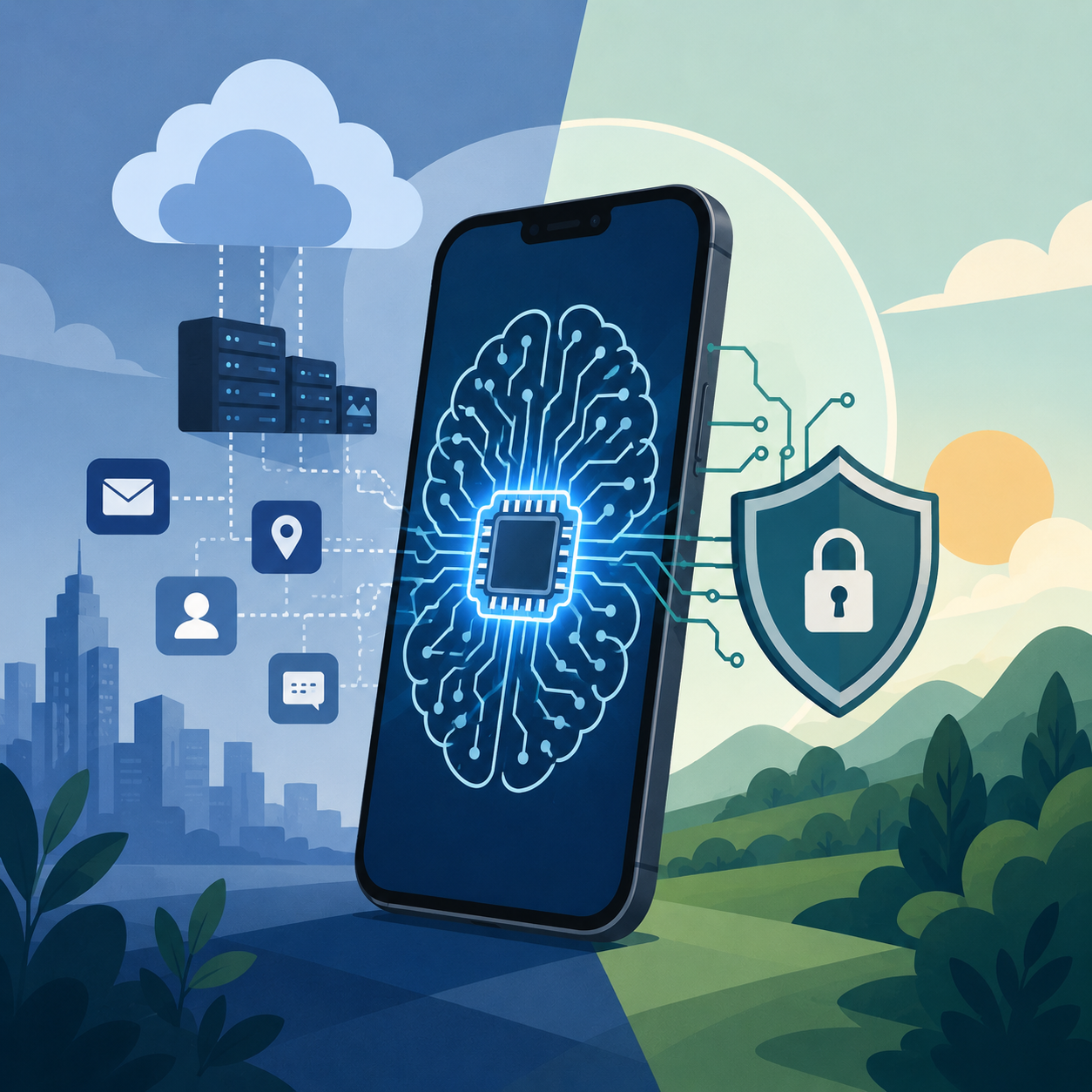
The distinction between cloud AI and on-device AI is architectural rather than cosmetic. When you ask a cloud-based AI assistant a question, your request travels as data from your device to a server, is processed by a model running on that server’s hardware, and the result travels back to your device. That round trip introduces latency measured in hundreds of milliseconds in good network conditions, and becomes impossible when your network connection is poor or absent. The processing happens in a facility owned and operated by a technology company, which means the data you submit — your words, your photographs, your documents — is transmitted to and processed in infrastructure that is not yours.
On-device AI eliminates that chain. The AI model runs on a neural processing unit embedded in your device’s chip. Your data never leaves your device. The response is generated by hardware in your own hands, in the time it takes the electrons to traverse a few millimetres of silicon. For applications that require genuine privacy, genuine real-time performance, or genuine reliability regardless of network conditions, this is not a preference. It is a prerequisite.
Apple Intelligence, announced in 2024 and significantly expanded in 2025 and 2026, is the highest-profile consumer deployment of this architecture. Apple’s chips — the A17 Pro, A18 Pro, and M4 series — include dedicated neural engine components specifically designed for AI workloads. Most Apple Intelligence tasks run entirely on-device. Complex tasks that exceed on-device capability are routed to Private Cloud Compute, Apple’s server infrastructure designed so that Apple cannot access user data — an architecture that independent security researchers were invited to audit in 2024. Samsung’s Galaxy AI on the S25 series uses Qualcomm’s Snapdragon 8 Elite to process Live Translate during voice calls entirely on-device, providing real-time translation without transmitting audio to any external server. Google’s Tensor chips on Pixel devices include tensor processing unit blocks that power on-device speech processing, computational photography, and language features across the Android system.
Why 2026 Is the Inflection Point
Three developments converged in 2025 and 2026 to make on-device AI viable at consumer scale. The first is neural processing unit maturity. Every premium smartphone chipset now includes a dedicated NPU — a hardware accelerator specifically designed for the matrix multiplication operations that AI inference requires. Qualcomm’s Snapdragon 8 Gen 3 supports generative AI models with up to 10 billion parameters on-device without compromising battery life. Apple’s Neural Engine processes AI workloads at efficiency levels that allow complex on-device tasks to run without noticeable battery drain. These are not incremental improvements to general-purpose processors. They are purpose-built AI hardware that reduces the energy cost of AI inference by orders of magnitude compared to running the same operations on a CPU or GPU.
The second development is model optimisation. The AI models that run on cloud infrastructure are enormous — hundreds of billions of parameters requiring thousands of watts of GPU compute to generate a single response. The models that run on-device are fundamentally different: compressed through quantisation (reducing precision from 32-bit to 4-bit or 8-bit representations), pruned to remove parameters that contribute minimally to output quality, and distilled from larger teacher models into smaller student models that approximate the capability at a fraction of the size. A quantised 4-bit model running on an NPU with INT8 computation produces results with negligible accuracy loss compared to the full-precision equivalent, according to AlephZero Labs’ March 2026 production benchmarks — enabling models that would require a data centre at full precision to run on a mobile chip consuming a few watts.
The third development is framework maturity. Meta’s ExecuTorch has emerged as the leading framework for deploying PyTorch models to mobile and edge devices. Apple’s CoreML, Qualcomm’s QNN SDK, and MediaTek’s NeuroPilot are converging on a common capability set that was fragmented and unreliable in 2023 and 2024. The tooling that allows developers to take a model trained in a research environment and deploy it efficiently on diverse mobile hardware has become accessible and reliable in ways that were not available at the start of this technology wave.
The Privacy Case That Has Been Validated
The privacy argument for on-device AI is not new. It has been made consistently since early AI assistant features began requiring cloud connections to process voice commands. What has changed is that the argument can now be accompanied by genuine capability: on-device AI in 2026 is not a privacy-preserving compromise that sacrifices capability. For a growing range of applications, it is the highest-performing option available.
The implications are significant in regulated sectors. Healthcare applications that process sensitive patient data on-device — analysing voice patterns for early dementia detection, processing images for skin lesion classification, monitoring continuous physiological data from wearables — can provide AI capability without requiring that clinical data be transmitted to cloud infrastructure. Legal and financial applications that process confidential documents can use on-device AI for analysis without those documents ever leaving the user’s device. Enterprise applications that process proprietary data can leverage AI without creating data sovereignty risks that cloud processing introduces.
The privacy protection on-device AI provides is not primarily about trust in technology companies. It is about the architecture of data exposure. Data that never leaves a device cannot be subpoenaed from a cloud provider, cannot be exposed in a data breach of a central server, cannot be used to train AI models without the user’s knowledge, and cannot be accessed by the intelligence agencies of the jurisdiction where the server is located. For users whose threat model includes any of those risks, on-device AI is not merely preferable — it is necessary.
The Applications Being Enabled
The specific applications that on-device AI makes possible or substantially improves fall into categories determined by the requirements of privacy, real-time performance, and offline operation. Computational photography — the AI-enhanced image processing that produces the quality of photographs modern smartphones are capable of — has been predominantly on-device since the introduction of dedicated NPUs. The AI that enhances low-light images, recognises faces for portrait mode, and stabilises video in real time must operate at camera frame rates that cloud processing cannot match and must work regardless of network connectivity.
Real-time translation has been a flagship demonstration of on-device AI since Samsung introduced Live Translate in 2024. The ability to translate a phone call in both directions, in real time, without transmitting the audio content to any external service, represents a genuine new capability that cloud-based translation required either latency penalties or privacy trade-offs to provide. On-device translation in multiple languages is now standard on premium Android and iOS devices.
The automotive sector is where on-device AI’s latency advantages are most consequential. A car navigating a rural highway cannot wait 200 milliseconds for a cloud response before deciding whether to brake. NVIDIA Drive and Qualcomm Snapdragon Ride process sensor fusion, object detection, and path planning entirely on chips inside the vehicle, achieving the sub-10 millisecond response times that safety-critical systems require. Factory AI inspection systems run inference on local embedded hardware — cameras and processors installed on production lines — because shipping images to the cloud for quality inspection introduces latency and security risk that manufacturing environments cannot accept.
The Accessibility Dimension
On-device AI has a dimension that is rarely discussed in the technology media but that may prove the most consequential over the next decade: it is accessible in environments where cloud AI is not. India and Southeast Asia are markets where mobile internet is fast in cities but intermittent in rural and semi-urban areas. Sub-Saharan Africa has mobile coverage but data costs that make continuous cloud AI consumption economically prohibitive for most users. The on-device AI market in Asia Pacific holds 34.6 percent of the global market in 2026 and is projected to exhibit the fastest growth, driven partly by the fact that on-device AI serves populations who cannot rely on cloud connectivity.
The federated learning dimension of on-device AI extends this further: models can improve using local data without sending that data to a server, allowing AI systems to learn from the experiences of users in low-connectivity environments without requiring those users to maintain persistent connections. On-device fine-tuning — adapting a model to a specific user’s behaviour and preferences without transmitting that behavioural data — is still experimental in 2026 but is approaching feasibility on flagship hardware and represents the next phase of on-device AI capability.
For readers following how AI infrastructure is evolving, LiveAIWire’s coverage of how long-context AI models like Gemini 1.5 Pro handle large-scale processing and our analysis of how AI training and evaluation economics actually work provides the context for understanding where on-device AI fits in the broader AI architecture landscape. The question of what AI knows about you and how that data is exposed is where the privacy case for on-device processing is most directly relevant.
The Thermal and Battery Challenge
The technical limitations of on-device AI in 2026 are real and worth acknowledging alongside the achievements. The LLM inference benchmarks published in March 2026 revealed a significant constraint on mobile platforms: thermal management supersedes peak compute as the primary limitation for sustained inference. The iPhone 16 Pro loses nearly half its throughput within two inference iterations as the chip’s thermal protection kicks in. The Samsung Galaxy S24 Ultra suffers a hard OS-enforced frequency reduction that terminates inference entirely under sustained load. The performance numbers that make on-device AI look competitive with cloud inference are achieved under short-burst conditions. Sustained use cases — always-on personal AI agents, continuous speech processing, extended document analysis — expose thermal constraints that current mobile form factors cannot fully overcome without architectural solutions that are still in development.
The battery dimension is related but distinct. Running a neural processing unit at capacity consumes meaningful power even in power-optimised architectures. The trade-off between AI capability and battery life is being managed through intelligent routing — sending simple tasks to on-device models and complex or extended tasks to cloud processing — but this hybrid approach reintroduces the cloud dependency that on-device AI was supposed to eliminate. Apple’s Private Cloud Compute architecture represents the most sophisticated current approach to this trade-off: on-device for privacy-sensitive tasks, purpose-built cloud for tasks that exceed on-device capability, with explicit guarantees about server-side data access. Whether that architecture becomes an industry standard depends on competitive dynamics that are still playing out among the major platform operators.
What Comes Next
The on-device AI trajectory points toward several developments that researchers and engineers in the field identify as near-term milestones. On-device fine-tuning — the ability to adapt a base model to an individual user’s behaviour, preferences, and specific data without sending that data to a server — is described by AlephZero’s 2026 analysis as still experimental but approaching feasibility on flagship hardware. Production-ready on-device text-to-speech with natural prosody and low latency is expected to become standard by late 2026. Real-time vision-camera pipelines with zero-copy buffer sharing between camera hardware and inference engine are in active development, targeting total pipeline latency below 10 milliseconds for camera-based applications. The direction is clear: on-device AI capability is expanding faster than mobile hardware is improving, which means the practical gap between what is possible on-device and what requires cloud processing will continue to narrow even as the applications that can leverage that capability expand in scope and ambition.
About the Author
Stuart Kerr is Technology Correspondent at LiveAIWire, covering artificial intelligence, emerging technology, and their impact on business, society, and everyday life. LiveAIWire publishes original AI journalism every weekday at liveaiwire.com.