
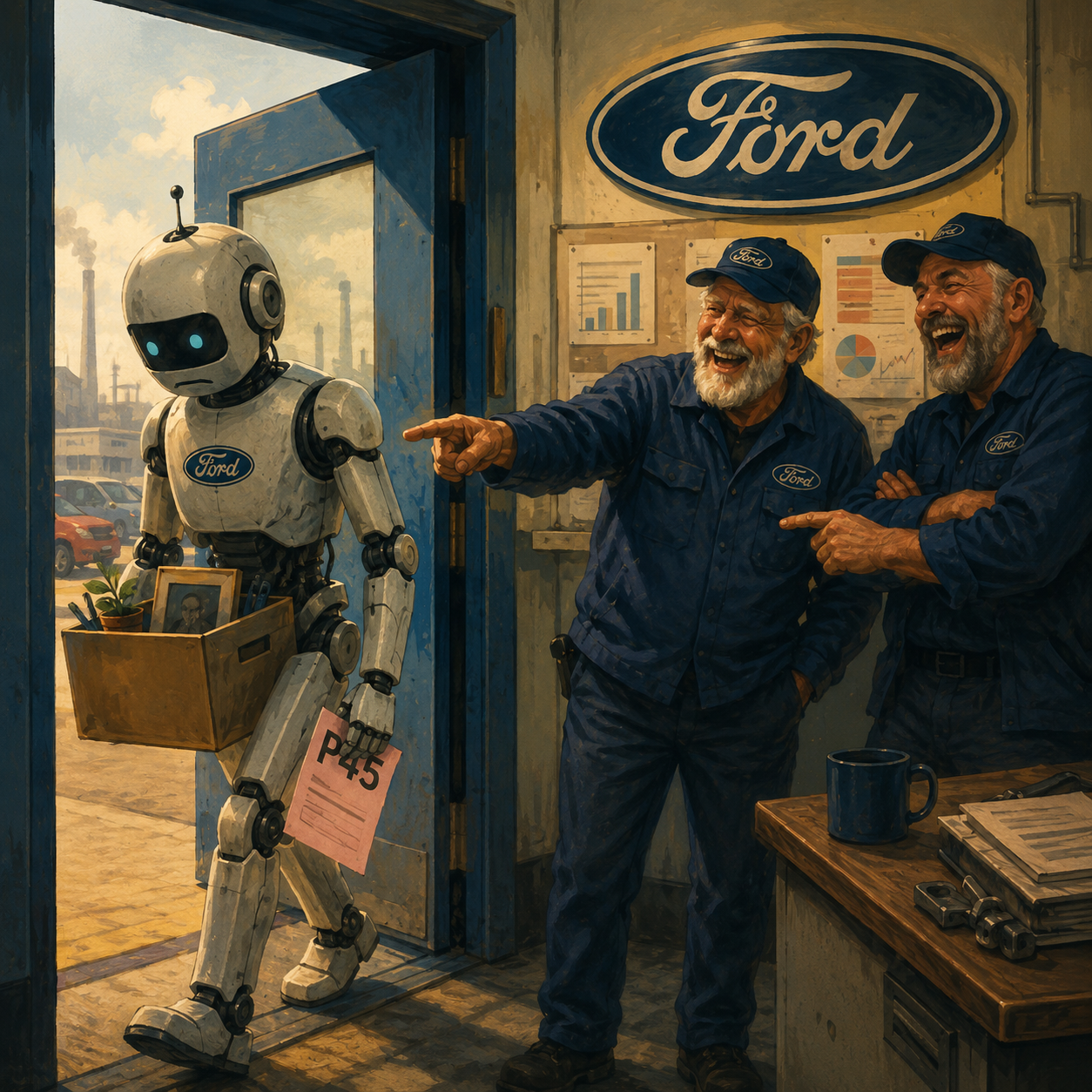
The Ford AI engineers rehiring is the result: more than 300 veteran engineers brought back after the company concluded that artificial intelligence alone could not replicate the quality judgement of the experienced staff it had let go.
The admission, made by company executives this week, lands days after Ford topped the JD Power 2026 U.S. Initial Quality Study for the first time since 2010, a turnaround the automaker now attributes directly to bringing back the human expertise its AI systems were supposed to replace.
Artificial intelligence is a fantastic tool, but it is only as good as the information you use to train it, Charles Poon, Ford’s vice president of vehicle hardware engineering, told reporters this week. Over prior years, Ford did not pay as much attention as it should have to the experience of its most knowledgeable engineers, the people who had been with the company through many product cycles, Poon said.
What this means for you: the Ford AI engineers story is not an argument against artificial intelligence in manufacturing. It is a specific, on-the-record account of what happens when a company assumes AI can absorb institutional knowledge it was never actually given. Ford’s quality tools did not fail because the underlying technology was broken. They failed because the engineers whose judgement the systems needed to learn from had already left before that knowledge could be captured.
Where the Ford AI Engineers Story Actually Started
Before the Ford AI engineers were brought back, Ford had expanded its use of AI across quality control in recent years, including rolling out roughly 900 AI-powered cameras across its plants to catch defects and supply chain issues at the source. Chief operating officer Kumar Galhotra has said the company had been relying more and more on automated quality systems, with disappointing results. The expectation inside Ford was that ingesting the company’s existing design requirements into AI systems would be sufficient on its own to maintain product quality.
That assumption did not hold. Poon told reporters the company had mistakenly believed that introducing artificial intelligence and feeding it existing design requirements would automatically produce a high-quality product. The problem was not that the AI was fundamentally broken. It was that many of Ford’s most experienced engineers, the people whose decades of accumulated judgement the AI systems needed to learn from, had already left the company before that knowledge could be captured and used to train the tools meant to replace them.
This is the specific failure mode that Ford AI engineers now exist to correct. A machine learning system trained on formal design requirements can enforce documented rules consistently. It cannot recognise the undocumented pattern that an experienced technician spots instinctively, the specific vibration that signals a supplier defect three steps upstream, or the subtle inconsistency that only shows up after years of handling similar parts. That kind of judgement was walking out the door faster than Ford was capturing it.
The Rehiring and What It Reveals About AI in Manufacturing
Ford has spent the past three years bringing back what insiders refer to as gray beard engineers, the Ford AI engineers doing the retraining work directly, technicians with decades of design and manufacturing experience who are now used for two purposes simultaneously. They catch the quality issues that automated systems were missing, and they mentor younger staff while helping rebuild and retrain the AI tools that fell short the first time.
We recognised that for us to enhance some of our automation and machine learning and artificial intelligence tools we needed to ensure that they were trained by the most experienced individuals, Poon said. The company’s own materials marking its JD Power result were direct about the cause, describing the achievement as requiring a significant talent refresh. That refresh involved not only the roughly 300 rehired Ford AI engineers but also a turnover of senior leadership across engineering, supply chain, and manufacturing.
This pattern, in which returning human experts are used specifically to train and correct AI systems rather than simply reversing a decision to automate, is becoming a recognisable case study for other manufacturers weighing similar bets. According to reporting from TechCrunch, Ford anticipates the rehiring will contribute to roughly a billion dollars in reduced costs this year alone, a figure that reframes the returning engineers as a direct financial asset rather than a retreat from automation.
The Quality Numbers Behind the Ford AI Engineers Turnaround
The results the Ford AI engineers have delivered are measurable and independently verified. According to JD Power’s own 2026 U.S. Initial Quality Study, Ford scored 152 problems per 100 vehicles, the best result among mainstream brands and an improvement of 41 problems per 100 vehicles compared with the prior year, the largest year-over-year gain of any mainstream automaker. The Ford F-150, Mustang, and Super Duty each ranked highest in their respective segments for the second consecutive year, giving Ford seven of its ten tested models a top-three finish, the highest share of any manufacturer in the study.
Ford CEO Jim Farley has said falling warranty and recall costs are delivering hundreds of millions of dollars in savings for the company. The turnaround does carry a significant qualifier. Ford remains one of the most recalled automakers in the United States, and Galhotra has described current recall figures as a trailing measure of quality rather than a current one, arguing that as vehicles built under the revised engineering approach make up a larger share of the fleet, the recall numbers should improve correspondingly. Whether that prediction holds will not be clear for some time, since recalls by nature reflect defects in vehicles built one or more years earlier.
Why the Ford AI Engineers Case Matters Beyond One Automaker
Ford’s experience adds a concrete, named, on-the-record data point to a pattern that has been showing up across multiple industries. AI systems deployed to replace experienced human judgement frequently underperform unless that human judgement is actively used to train and supervise them, and removing experienced workers before their knowledge is captured creates a gap that AI cannot independently fill. LiveAIWire’s earlier reporting on what the IMF’s AI job exposure figures actually mean for workers found a closely related dynamic, in which the roles most exposed to automation are often the ones where institutional judgement, not documented process, was doing the real work.
The same tension is visible in LiveAIWire’s coverage of agentic AI running large parts of Jaguar Land Rover’s own weld inspection process, where the manufacturers seeing genuine gains from automation are consistently the ones treating AI as a tool that augments experienced staff rather than one that replaces the need for them. And it connects directly to the broader pattern documented in LiveAIWire’s analysis of why businesses that adopted AI fastest are now pulling back, where premature automation without a plan for retaining the expertise that trains it has produced costly corrections across sectors well beyond car manufacturing.
This is distinct from saying AI does not work. Ford is not abandoning its AI investment. It is restructuring how human expertise and AI tools work together, with veteran staff training and correcting the systems rather than being replaced by them outright. For workers in roles where employers are weighing AI-driven automation, Ford’s public admission offers a concrete data point: the value of accumulated, specific, hard-to-codify professional judgement does not disappear simply because an AI system has been trained on the available documentation.
For organisations making similar bets, the lesson Ford is now telling reporters is one of timing and sequencing. Capturing institutional knowledge before veteran staff leave, rather than after, determines whether an AI quality system actually works or simply automates the absence of judgement at scale. The Ford AI engineers now working on the factory floor are, in that sense, not a nostalgia exercise. They are the missing training data Ford’s automated systems needed all along.
About the Author
Stuart Kerr is Technology Correspondent at LiveAIWire, covering artificial intelligence, emerging technology, and their impact on business, society, and everyday life. LiveAIWire publishes original AI journalism every weekday at liveaiwire.com.