
By Stuart Kerr, Technology Correspondent, LiveAIWire
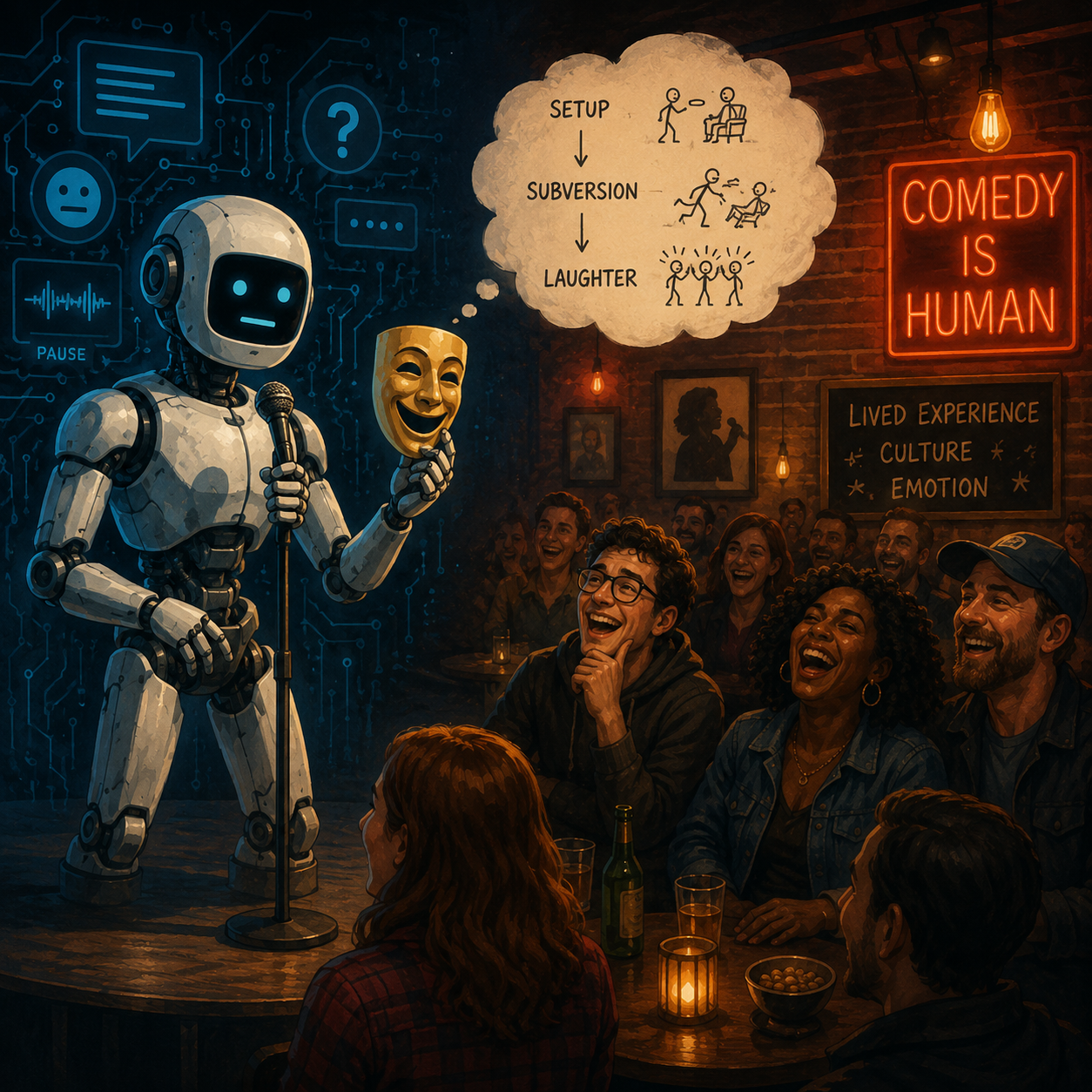
At the CHI 2026 conference in Barcelona, researchers from the University of Edinburgh and Carnegie Mellon presented findings from an experiment in which AI-generated stand-up comedy was performed to paying theatre audiences. The audiences knew they were watching AI-assisted performance. They laughed anyway. The research, part of a body of work studying real-time comedy generation for live performance, found that AI-generated material, when performed by skilled comedians who could adapt timing and delivery to audience response, produced genuine laughter at rates comparable to human-written material in the same performance context. A separate 2024 Stanford study found that AI-composed jokes scored higher in unpredictability — a key metric in computational humour research — than human-written equivalents. In a 2025 masked evaluation, participants struggled to differentiate between human- and AI-generated jokes.
These findings sound like evidence that AI has cracked comedy. They are not. They are evidence that AI can produce output that activates the cognitive mechanisms of humour detection in specific, controlled conditions. The gap between generating text that humans rate as funny in a survey and understanding what makes things funny — and why, and for whom, and in what context — is the gap between performing a function and comprehending its nature. That gap matters enormously for understanding what AI comedy actually is and what it cannot become.
What Humour Actually Requires
The cognitive science of humour identifies several interacting components that any humour system — human or artificial — must handle. The incongruity-resolution theory, most thoroughly developed by Suls and elaborated in subsequent research, proposes that humour involves detecting an incongruity between an expectation and a reality, and then resolving that incongruity in a way that is both surprising and makes a particular kind of sense. The pun works because it violates a linguistic expectation and resolves the violation by revealing a double meaning. The political joke works because it reframes a familiar situation as absurd, and the reframing reveals something true that convention had obscured. The personal anecdote works because it connects a specific experience with a universally recognisable emotional truth.
AI can pattern-match on these structures. A language model trained on millions of jokes, comedy scripts, and humorous writing has encountered every major comedic form many times over. It can produce outputs that have the surface structure of incongruity and resolution. What it cannot do is generate incongruity that is genuinely surprising rather than statistically surprising — that departs from expected patterns in ways that reveal rather than merely deviate. The distinction is between humour that emerges from genuine insight into the human condition and humour that emerges from rearranging words in patterns that have historically preceded laughter.
The Timing Problem
Professional comedians consistently identify timing as the most unteachable component of comedy — the sense of when a beat should fall, how long a silence should extend before the punchline, when an audience needs to breathe before the next escalation. Stand-up timing is not merely a matter of rhythm, though rhythm is part of it. It is a continuous reading of audience state: the energy in the room, the degree to which the crowd is with the performer, the moments when they are ready to be surprised and the moments when they need a recovery beat before the next challenge.
The CHI 2026 research on AI stand-up comedy found that core comedic elements like timing and audience interaction are transferable to AI comedians — but the qualification is important. They are transferable when the AI’s outputs are delivered by human performers who provide the real-time audience reading, the physical presence, and the moment-to-moment adjustment that timing actually requires. The AI generates material. The human provides the intelligence that makes it land. That is a meaningful collaboration, but it is not AI comedy. It is human comedy with AI-generated material — a distinction that matters for understanding what AI can and cannot contribute to live performance.
The Identity and Experience Problem
The CHI 2026 research paper on AI stand-up comedy identifies a finding that cuts to the heart of comedy’s relationship to experience: humour-based performances are affected by the comedian’s personal identity in ways that elicit laughter and resonance. Cultural background, community affiliations, lived experiences, and the specific vantage point from which a comedian observes the world are not incidental to their comedy. They are constitutive of it. The material that generates the deepest laughter in stand-up is almost always the material that is most specifically rooted in a particular life — the family dynamic that is both embarrassing and universally recognisable, the cultural experience that is simultaneously specific and illuminating of something broader, the professional or personal failure that is funny precisely because it is real.
AI has no lived experience. It has processed descriptions of experience, at extraordinary scale, in every genre and register of language. But the difference between having processed a million descriptions of romantic rejection and having been romantically rejected — between knowing about heartbreak and having had your heart broken — is not a difference of degree. It is a difference of kind. The comedy that emerges from heartbreak is not comedy about heartbreak in the way that AI can generate. It is comedy in which the specific texture of a specific experience is transformed into something universally funny, because the comedian found the angle at which their private pain becomes public recognition.
What AI Can Actually Contribute to Comedy
The most productive use of AI in comedy appears to be the one the CHI 2026 research documented: collaboration, in which AI generates material rapidly across a wide range of angles and formats, and human comedians select, adapt, and perform the material that resonates with their own experience and voice. The 2025 research on Human-AI comedy collaborations found that these were rated as most creative and widely shareable — combining the volume and variation that AI can produce with the selection and contextual intelligence that human comedians bring.
AI is also being used in comedy writing rooms to generate joke variations, to explore angles that a writing team might not have considered, and to quickly test different framings of the same setup before committing to a direction. These are uses where AI functions as a generative tool that expands the space of options available to human comedians, rather than as a replacement for the human judgment, timing, and personal experience that comedy ultimately depends on.
The AI comedy experiments that have attracted the most attention — the Edinburgh Fringe performances of AI-generated stand-up, the comedy club showcases of material generated by language models — are interesting precisely because they reveal both what AI can do and where its limits lie. The audiences who laugh at AI-generated material are often laughing at the incongruity of a machine attempting something so human. That meta-humour — the comedy of AI’s own limitations in understanding comedy — is produced by the audience, not the AI. It is, perhaps appropriately, the funniest thing about AI comedy.
For readers following AI in creative industries, LiveAIWire’s coverage of the copyright crisis reshaping AI art and our analysis of the legal battle over AI training data addresses how AI is reshaping other creative domains, sharing the core tension between AI’s technical capability and the human experience that creative work requires.
The Subversion Problem
Stand-up comedy at its most effective is not primarily about producing laughter. It is about producing a specific kind of laughter — the laughter of recognition at something you had not previously been able to articulate, the laughter of relief at seeing a socially enforced fiction punctured, the laughter that briefly dissolves the distance between a performer’s specific experience and an audience’s aggregate recognition. The comedians who have most durably transformed their fields — Lenny Bruce, Richard Pryor, Hannah Gadsby, Dave Chappelle — have done so by using comedy to say something about power, about experience, about society, that could not be said any other way. The comedy is not a vehicle for a message. The comedy is how the message becomes thinkable.
AI cannot subvert power structures it is not embedded in. It cannot speak from a vantage point of marginalisation it has not experienced. It cannot puncture a social fiction it does not have a stake in maintaining or dismantling. When AI generates what pattern-matches as subversive comedy — transgressive language, taboo subject matter, challenges to social convention — it is doing so through statistical association with human material that was itself subversive in context. The context is absent from the AI’s output even when the surface features of subversion are present. This is why the funniest AI comedy often turns out to be the meta-comedy of AI’s own limitations — the comedy that audiences provide by laughing at the gap between what AI is doing and what a human comedian would be doing. That laughter is genuinely funny. But it is the audience’s contribution, not the AI’s.
Where Human-AI Comedy Collaboration Is Going
The most productive development in AI comedy is the emergence of genuine human-AI collaboration as a distinct creative form. Comedy writers working with AI as a generative tool — using it to explore angles rapidly, to test phrasing variations, to identify the logical extensions of a comedic premise — report that AI is most useful not for generating finished jokes but for expanding the space of possibilities from which human judgment selects and refines. The human comedian brings the identity, the experience, the timing instinct, and the judgment about what is genuinely funny versus merely transgressive or merely clever. The AI brings speed, volume, and the ability to pursue logical chains further than a human mind tires of doing. The combination, when the human remains in creative control, can produce material that neither would generate alone. That collaborative model is the one the research identifies as most creative and most widely resonant — and it is the model that keeps humans genuinely in the loop rather than reducing comedy to an algorithmic output that happens to produce laughter.
The AI Comedy Live Performance Experiment
The most useful test of AI comedy capability is not a survey asking whether AI-generated jokes are funny. It is watching what happens when AI-generated material meets a live audience in real time. The Edinburgh Fringe Festival has hosted AI comedy performances since 2023, with comedians performing material generated entirely or substantially by AI systems. The results have been illuminating about both what AI can do and where the performance reveals its limits. Audiences engaging with the meta-premise — AI performing comedy — laugh readily at the novelty and at the moments when the AI’s limitations are themselves comedic. The intrinsic quality of the AI-generated material, when stripped of the meta-framing, is harder to assess because audiences come knowing they are watching AI comedy, which creates a charitable interpretive frame that the same material without that framing might not receive.
The CHI 2026 research paper explicitly frames the theatre stage as a laboratory, identifying paid comedy audiences who expect genuine entertainment as a more realistic and demanding testbed than crowd-sourced survey evaluations. Its finding that AI-generated material can achieve comparable laugh rates to human-written material when performed by skilled comedians represents a genuine result — but the qualification about skilled human delivery is doing significant work in that finding. The AI generates words. The human comedian provides the understanding of what is actually funny, the physical presence that creates the relationship between performer and audience, and the moment-to-moment adjustment that comedy requires. That collaboration produces results. But the results belong as much to the human as to the AI, and attributing them primarily to AI capability misunderstands where the creative contribution is actually concentrated.
About the Author
Stuart Kerr is Technology Correspondent at LiveAIWire, covering artificial intelligence, emerging technology, and their impact on business, society, and everyday life. LiveAIWire publishes original AI journalism every weekday at liveaiwire.com.