
By Stuart Kerr, Technology Correspondent, LiveAIWire
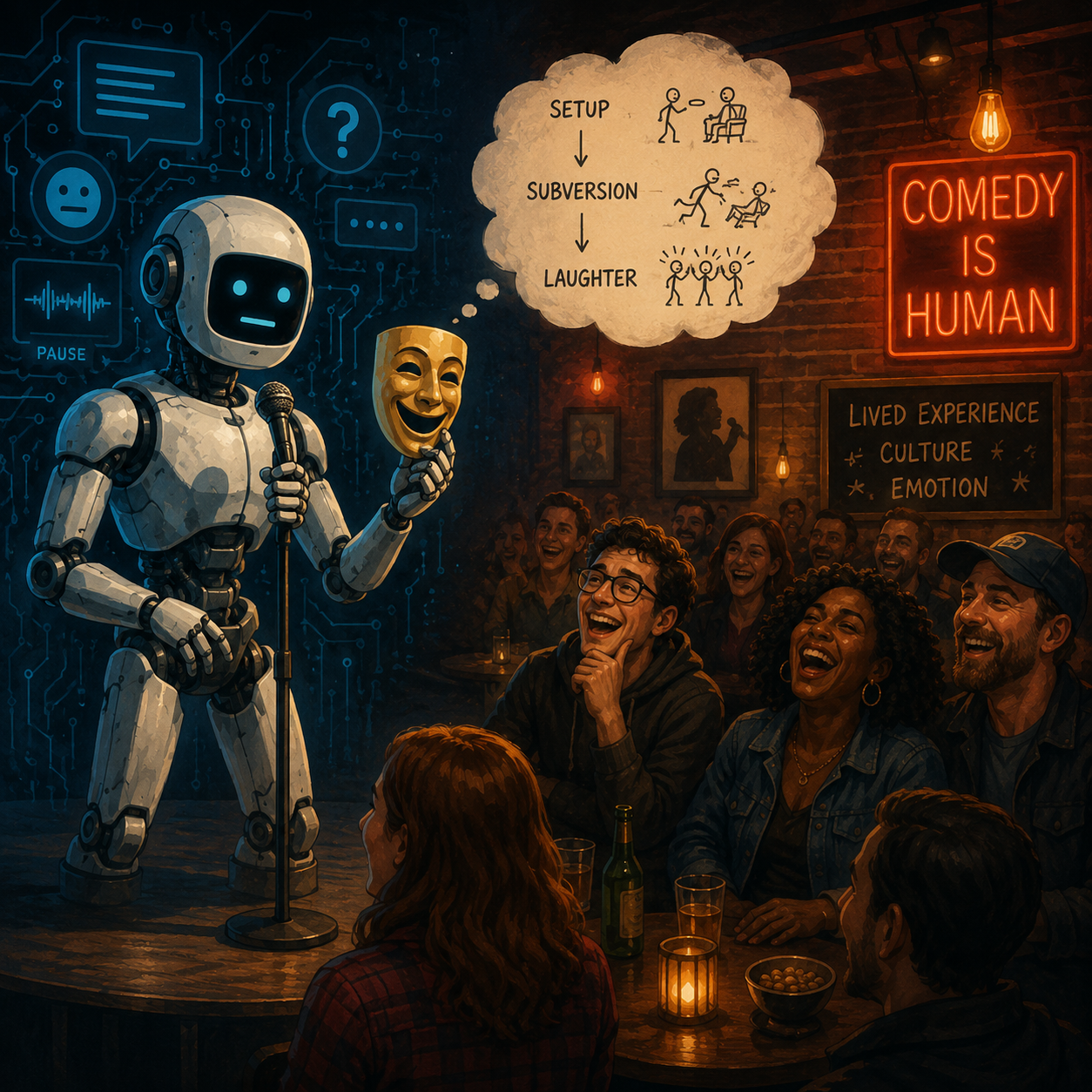
AI and comedy collided at the CHI 2026 conference in Barcelona, where researchers from Carnegie Mellon, the University of Hong Kong, and Northeastern University presented findings from an experiment in which AI-generated stand-up comedy was performed to paying theatre audiences. The audiences knew they were watching AI-assisted performance. They laughed anyway. The research, titled “Not Human, Funnier”, found that machine-identity-based comedy agents, which explicitly used their status as AI to tell jokes, were rated funnier by a 32-person audience than a baseline GPT agent performing the same material without that framing.
The AI and comedy findings sound like evidence that AI has cracked comedy. They are not. They are evidence that AI can produce output that activates the cognitive mechanisms of humour detection in specific, controlled conditions. The gap between generating text that humans rate as funny in a study and understanding what makes things funny, and why, and for whom, and in what context, is the gap between performing a function and comprehending its nature. That gap matters enormously for understanding what AI and comedy can actually become together, and what remains beyond AI’s reach.
What Humour Actually Requires
Understanding AI and comedy requires understanding the cognitive science of humour, which identifies several interacting components that any humour system, human or artificial, must handle. Incongruity-resolution theory proposes that humour involves detecting an incongruity between an expectation and a reality, then resolving that incongruity in a way that is both surprising and makes a particular kind of sense. The pun works because it violates a linguistic expectation and resolves the violation by revealing a double meaning. The personal anecdote works because it connects a specific experience with a universally recognisable emotional truth.
AI can pattern-match on these structures. A language model trained on millions of jokes, comedy scripts, and humorous writing has encountered every major comedic form many times over. It can produce outputs that have the surface structure of incongruity and resolution. What it cannot do is generate incongruity that is genuinely surprising rather than statistically surprising, that departs from expected patterns in ways that reveal rather than merely deviate.
The Timing Problem in AI and Comedy
In AI and comedy, professional comedians consistently identify timing as the most unteachable component, the sense of when a beat should fall, how long a silence should extend before the punchline, when an audience needs to breathe before the next escalation. Stand-up timing is a continuous reading of audience state: the energy in the room, the degree to which the crowd is with the performer, the moments when they are ready to be surprised and the moments when they need a recovery beat before the next challenge.
Research on whether AI can read the room in stand-up performance found that core comedic elements like timing and audience interaction are transferable to AI comedians, but the qualification is important. They are transferable when the AI’s outputs are delivered by human performers who provide the real-time audience reading, the physical presence, and the moment-to-moment adjustment that timing actually requires. The AI generates material. The human provides the intelligence that makes it land.
The Identity and Experience Problem
The CHI 2026 research identifies a finding that cuts to the heart of comedy’s relationship to experience: humour-based performances are affected by the comedian’s personal identity in ways that shape laughter and resonance. Cultural background, community affiliations, lived experiences, and the specific vantage point from which a comedian observes the world are not incidental to their comedy. They are constitutive of it. The material that generates the deepest laughter in stand-up is almost always the material that is most specifically rooted in a particular life.
AI has no lived experience. It has processed descriptions of experience, at extraordinary scale, in every genre and register of language. But the difference between having processed a million descriptions of romantic rejection and having been romantically rejected, between knowing about heartbreak and having had your heart broken, is not a difference of degree. It is a difference of kind.
What AI Can Actually Contribute to Comedy
The most productive use of AI in comedy appears to be collaboration, in which AI generates material rapidly across a wide range of angles and formats, and human comedians select, adapt, and perform the material that resonates with their own experience and voice. Canadian comedian Anesti Danelis’s 2024 show Artificially Intelligent, developed with ChatGPT and performed at the Edinburgh Festival Fringe and Toronto Fringe Theatre Festival, is a documented example: Danelis has distinguished between what the AI was good at, devising the structure of a show, and its hilariously terrible ideas, which became the show’s content.
AI is also being used in comedy writing rooms to generate joke variations, to explore angles a writing team might not have considered, and to quickly test different framings of the same setup before committing to a direction, a pattern of AI expanding rather than replacing human creative capability that echoes what LiveAIWire has traced in our coverage of the legal battle over AI training data, where the underlying question of what AI actually owns versus what it draws from remains contested across creative fields. The same tension between AI capability and human origination runs through LiveAIWire’s coverage of AI content creation, where the line between AI-assisted and AI-authored work is proving similarly difficult to draw.
The Subversion Problem
Stand-up comedy at its most effective is not primarily about producing laughter. It is about producing a specific kind of laughter, the laughter of recognition at something you had not previously been able to articulate, the laughter of relief at seeing a socially enforced fiction punctured. The comedians who have most durably transformed their fields have done so by using comedy to say something about power, about experience, about society, that could not be said any other way.
This is the deeper problem with treating AI and comedy as interchangeable: AI cannot subvert power structures it is not embedded in. It cannot speak from a vantage point of marginalisation it has not experienced. When AI generates what pattern-matches as subversive comedy, transgressive language, taboo subject matter, challenges to social convention, it is doing so through statistical association with human material that was itself subversive in context. The context is absent from the AI’s output even when the surface features of subversion are present.
The AI and Comedy Live Performance Experiment
The most useful test of AI and comedy, and the clearest parallel to the human labour questions LiveAIWire has traced in our coverage of the AI shadow workforce, is not a survey asking whether AI-generated jokes are funny. It is watching what happens when AI-generated material meets a live audience in real time. The Edinburgh Fringe Festival has hosted AI comedy performances since 2023, with comedians performing material generated entirely or substantially by AI systems. Audiences engaging with the meta-premise, AI performing comedy, laugh readily at the novelty and at the moments when the AI’s limitations are themselves comedic.
The CHI 2026 research explicitly frames the theatre stage as a laboratory, identifying paid comedy audiences who expect genuine entertainment as a more realistic and demanding testbed than crowd-sourced survey evaluations. Its finding that AI-generated material can achieve comparable laugh rates to human-written material when performed by skilled comedians represents a genuine result, but the qualification about skilled human delivery is doing significant work in that finding. The AI generates words. The human comedian provides the understanding of what is actually funny, the physical presence that creates the relationship between performer and audience, and the moment-to-moment adjustment that comedy requires.
About the Author
Stuart Kerr is Technology Correspondent at LiveAIWire, covering artificial intelligence, cybersecurity, and the social impact of emerging technology. He publishes daily at LiveAIWire.com.