
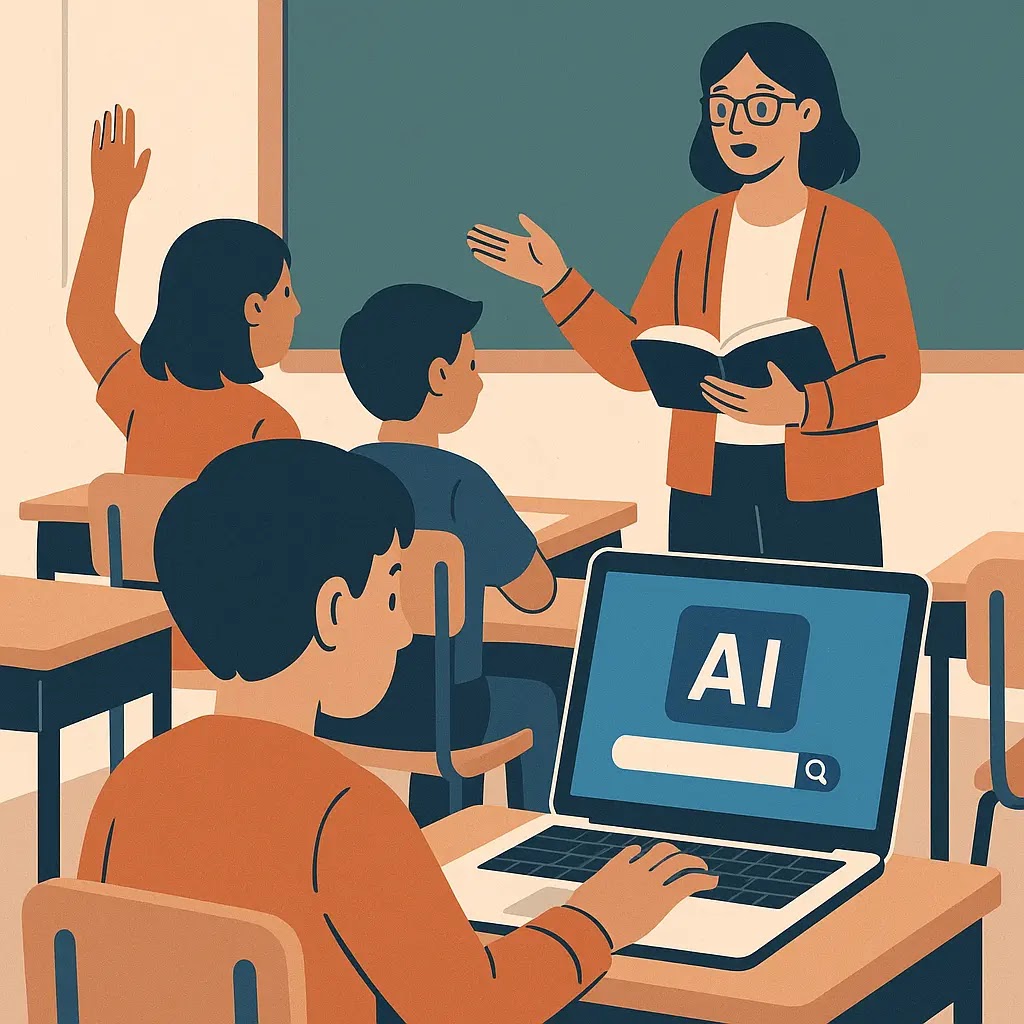
In
the time it takes a student to open a browser, type a query into Google, and
begin evaluating the first page of results, a classmate using a generative AI
tool has already received a structured, personalised answer to the same
question, asked two follow-up queries to deepen their understanding, and
started drafting the next section of their essay. This speed differential is
not the most important change that generative AI is introducing to student
research, but it is the most visible one, and it is driving a shift in
behaviour that has moved faster than most educational institutions have been
able to respond to.
A survey of Harvard undergraduates, published as a working paper
and widely cited in educational technology research, found that approximately
one in three students already turn to AI tools instead of Google or Wikipedia
as their first information source. The Harvard survey
data captures a transition at one of the world’s best-resourced
universities, but the pattern it documents is not confined there. The Higher
Education Policy Institute’s 2025 student AI survey, drawing on a
large UK undergraduate sample, found that 92 per cent of students had used AI
tools in their academic work, with the most common applications being concept
explanation, research summarisation, and study guide generation. Within a
period of approximately two years, a technology that was barely present in
most educational institutions has become mainstream.
What Has Changed and Why
The shift from search to AI is not simply about speed or
convenience. It reflects a genuine difference in the nature of the tool. A
search engine presents a ranked list of sources and requires the user to
evaluate which are authoritative, navigate to them, read them, synthesise the
relevant content, and form their own understanding. A generative AI system
presents a synthesised answer that has already completed several of those
steps. For a student who is clear on what they need to know and wants the
most direct path to understanding it, the AI interface is genuinely more
useful than the search interface for a large class of
queries.
The pedagogical question is whether the most direct path is always
the most educational one. The London School of Economics has published
commentary on AI in higher education that raises this concern explicitly: the
cognitive work of searching, evaluating, and synthesising information from
multiple sources is not merely a means to an end. It is itself part of what
education is trying to develop. A student who receives a well-structured
summary from an AI has learned the content of the summary. The question of
whether they have developed the critical faculties that the
search-and-synthesis process was intended to build is harder to
answer.
What Universities Are Actually Doing
Educational institutions have responded to the AI transition in
ways that range from blanket prohibition to active integration, with the
majority occupying an uncertain middle ground. A SAGE Journal study on
student attitudes toward AI in education found that students are navigating
genuine uncertainty about what is permitted, expected, and appropriate, often
without clear institutional guidance. Many students reported wanting to use
AI for legitimate support, such as understanding difficult concepts or
improving their writing, while being unsure where the line between
appropriate assistance and academic misconduct fell in their institution’s
framework.
The US Department of Education’s position, articulated in its 2023
guidance on AI in education and reaffirmed in subsequent publications,
emphasises a “human-in-the-loop” model: AI should enhance teaching
and learning without substituting for the human relationships, critical
development, and pedagogical judgment that define education. This framework
is sound in principle but requires translation into assessment design,
curriculum structure, and institutional policy in ways that most universities
are still working through.
What This Means for Learning and Knowledge
The question of what students are learning when they learn with AI
is not settled. For the acquisition of factual content and conceptual
understanding, there is reasonable evidence that well-designed AI tutoring
can be effective, sometimes more so than traditional instruction for students
who need personalised pacing and immediate feedback. For the development of
research skills, source evaluation, and the capacity to navigate contested or
ambiguous information, the picture is more complicated. As our analysis of
the
limits of what AI can actually understand found, AI tools that
present confident, fluent answers can actively obscure the uncertainty and
contestation that characterise most real knowledge domains. A student who
learns to expect confident synthesis may be less prepared for the genuine
complexity they will encounter in professional and civic
life.
The Publisher Dimension
The implications of students replacing Google with AI extend
beyond individual learning outcomes. Publishers of educational materials,
specialist journals, and the news organisations that produce the current
affairs content students are expected to engage with are already facing the
traffic declines that AI search is driving across the broader media
ecosystem. As we examined in our coverage of how
AI Overviews are restructuring the economics of online publishing,
the reduction in traffic to source materials has implications for the
sustainability of the organisations producing those materials. In educational
contexts, this matters because the quality of AI synthesis depends on the
quality of the underlying human-created content it draws from. The ecosystem
that produces that content requires readers and the revenue they generate,
and students who never visit the original sources are not generating that
revenue.
The Calibration That Is Still Being Found
The most productive framing for educators and students navigating
the AI transition may be to think about which elements of the learning
process benefit from AI assistance and which are undermined by it. Using AI
to explain a concept you could not understand from a textbook is different
from using AI to draft an argument you could have developed yourself. Using
AI to identify relevant sources is different from using AI to summarise those
sources in place of reading them. The skills most at risk from over-reliance
on AI, critical reading, tolerance for ambiguity, independent judgment, and
the capacity to engage with sources rather than summaries, are also the
skills most valued by the employers, professions, and institutions that
students will enter after their education.
As AI’s creative and generative capabilities continue to expand,
as our coverage of the
tipping point generative AI has reached in creative industries
documented, the question of what humans need to do and know that AI cannot do
will become the organising question for curriculum design. Education that
helps students find a productive relationship with these tools, rather than
either avoiding or uncritically depending on them, is likely to be the
education that serves them best in the environment they are preparing to
enter.
The HEPI survey also found that students are developing strong
opinions about which uses of AI are educationally legitimate and which
represent shortcuts that undermine their own learning. This student
perspective matters because the norms around AI use in education will
ultimately be shaped by the people who are doing the learning, not only by
the institutions setting the rules. A generation of students who have grown
up with AI as a natural part of their cognitive environment may develop
nuanced practices around when to use it and when not to, practices that are
more sophisticated than blanket prohibition or unrestricted use — if they are
given the frameworks and guidance to make those distinctions
well.
About the Author
Stuart Kerr is the Technology Correspondent for LiveAIWire. He
writes about artificial intelligence, emerging technology, and the forces
reshaping work, business, and society.