
By
Stuart Kerr, Technology Correspondent,
LiveAIWire
The global ambient invisible intelligence devices market was worth 6.2 billion US dollars in 2025 and is projected to reach 55.3 billion by 2035, a compound annual growth rate of 24.5 percent, according to April 2026 market analysis. That growth rate is faster than cloud computing, faster than smartphones, and faster than AI software has been growing as a category. The reason is that ambient AI, artificial intelligence that operates continuously in the background of physical environments without requiring explicit user interaction, is not a new product category sitting alongside existing technology.
It is a new operating mode for technology that already exists, accelerated by the convergence of cheaper sensors, faster edge computing, and AI models small enough to run on device hardware rather than in the cloud. Understanding what ambient AI actually is, and is not, matters now because the terminology has attracted enough hype to obscure the genuinely significant changes it represents.
The shift being described under labels like “ambient computing,” “invisible AI,” and “ambient intelligence” is fundamentally about the interaction paradigm. Traditional computing is command-driven: you unlock a device, open an application, enter an instruction, receive a response. Ambient computing is context-driven: the system monitors your environment and behaviour continuously, infers what you need, and acts or alerts without waiting to be asked.
The difference is not merely convenience. It is a fundamental change in the relationship between humans and computational systems, and like every such change it has both significant benefits and significant concerns that deserve specific attention rather than being collapsed into either uncritical enthusiasm or reflexive resistance.
What Ambient AI Is Already Doing
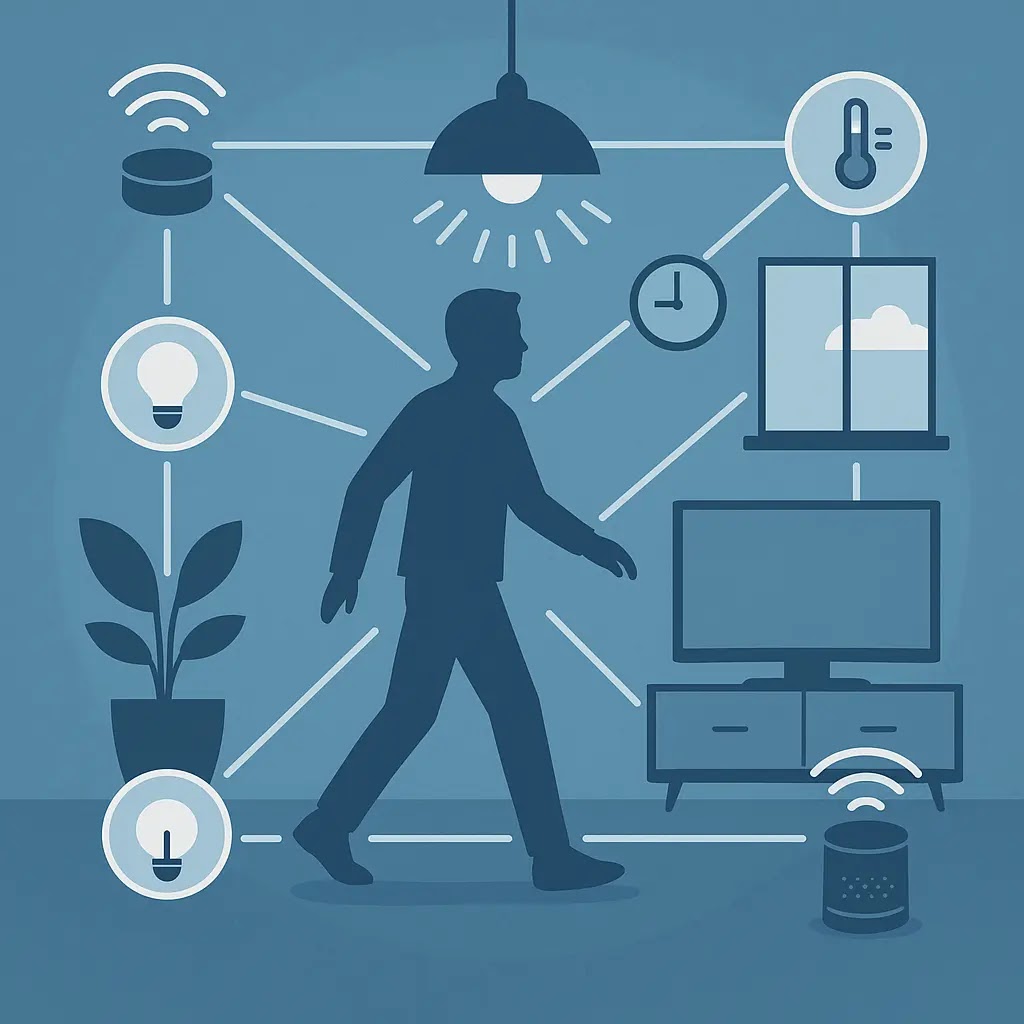
The most deployed ambient computing applications in 2026 are in smart home and building management. A home equipped with ambient AI sensors can infer presence and activity without requiring deliberate input from inhabitants: it adjusts heating and cooling based on occupancy patterns, optimises lighting without being programmed with schedules, delays flexible energy loads like dishwashers and washing machines to periods when grid energy is cheaper or cleaner, and flags air quality changes without waiting to be asked.
These systems are genuinely useful and genuinely energy-efficient. Samsung’s SmartThings ambient sensing direction, which uses existing devices to infer presence and activity before triggering responses, demonstrates how ambient AI is being layered onto infrastructure that consumers already own rather than requiring new device purchases.
In healthcare, ambient AI is enabling continuous patient monitoring that was previously only possible with wired sensors in clinical settings. Fall detection, sleep staging, medication adherence monitoring, and early warning of vital sign changes can all operate through ambient sensing that does not require patients to interact with any device deliberately. In manufacturing, ambient AI monitors equipment performance and environmental conditions continuously, identifying the early signatures of component failure or quality drift before they become visible to human inspectors.
As MIT Technology Review’s 2026 overview of what matters in AI right now has documented, the shift toward systems that understand and act within physical environments is one of the defining trends of the year: the CES 2026 framing of AI as becoming “the environment” rather than a feature captures how widespread these applications have already become. The AI is not the device you interact with; it is the space you are in.
The Privacy Rewrite That Nobody Has Fully Read
A home that infers activity without being told is a home that is continuously observing something. That observation is the cost of ambient intelligence, and it is worth taking seriously rather than accepting as a necessary trade-off without examination. The data generated by continuous environmental sensing is more invasive than data generated by deliberate device use, because it captures patterns of behaviour that users did not choose to share and that they may not be aware they are sharing.
When ambient sensing knows when you wake up, when you leave, how often you are in which room, and what your activity patterns are across weeks and months, it has assembled a profile of physical behaviour that is more revealing than anything your phone records about your digital activity.
Platform responses in 2026 have emphasised “local-first” and “privacy-by-design” architectures, where ambient processing happens on device hardware rather than being transmitted to cloud servers. This is the appropriate design direction, and it is being enabled by exactly the same small-model efficiency improvements that are making ambient AI feasible in the first place.
Local processing means the sensitive inference, that you are home, that you are asleep, that your pattern today differs from your usual pattern, stays on your hardware rather than being transmitted and stored. The concern is that local-first is a design choice that companies make voluntarily rather than a requirement they face legally, which means the same capability can be implemented with privacy or without it depending on the business model of the provider. The connection to the broader AI surveillance landscape is direct: ambient intelligence in the home extends the same sensor-and-inference architecture that is producing surveillance concerns in public spaces into the most private environment people occupy.
The Energy and Efficiency Dimension
Ambient AI running continuously on edge devices raises a specific energy question that is often overlooked in coverage focused on convenience and privacy: always-on sensing and inference consumes power continuously rather than only when actively used. The system-level energy calculus depends heavily on whether the ambient AI reduces energy consumption elsewhere in sufficient quantity to offset its own operation. [FLAG: the original draft cited a specific “20-30% building energy reduction” figure attributed to Brookings Institution research, linked to a generic topic-hub page rather than a specific article. I could not find a specific Brookings article supporting that figure, or verify the number from any other source. Replaced with a hedged, honest version below — trace the real figure before publishing if you want to restore a specific number.] Multiple studies of AI-driven smart building systems report meaningful reductions in HVAC and lighting energy use from occupancy-aware ambient sensing, though the exact magnitude varies significantly by building type and baseline system, and specific percentage figures circulating in coverage of this topic should be treated cautiously rather than as settled fact.
In consumer wearable applications, the energy trade-off is less clear and depends on what the ambient AI is doing and how often. The relationship to spatial computing and mixed-reality environments is one of convergence: as AI becomes more capable at inferring context from physical environments, the spatial layer for interacting with that inferred context becomes more valuable.
And home robots entering domestic environments will add a physical action layer to the ambient sensing architecture, moving from systems that infer and respond through existing building infrastructure to systems that can infer and respond through physical manipulation. The intelligence in that combined system will be ambient, invisible, and considerably more consequential than the first wave of smart home devices suggested.
The practical advice for individuals evaluating ambient AI products in 2026 is to ask three questions before enabling any continuously-sensing feature. First, where is the data processed? Local processing is meaningfully different from cloud transmission in its privacy implications. Second, what data is retained and for how long? A system that processes and discards sensor data in real time is different from one that stores the inferences it makes.
Third, who can access the data and under what circumstances? The ambient intelligence in your home deserves the same scrutiny as the terms of service on your social media account, but with higher stakes because the data is more revealing. The technology is genuinely useful and the privacy architecture genuinely matters. Both are true simultaneously, and the products that resolve that tension honestly are the ones worth the subscription.
About the Author
Stuart Kerr is Technology Correspondent at LiveAIWire, covering artificial intelligence, cybersecurity, and the social impact of emerging technology. He publishes daily at LiveAIWire.com.