By Stuart Kerr, Technology Correspondent, LiveAIWire
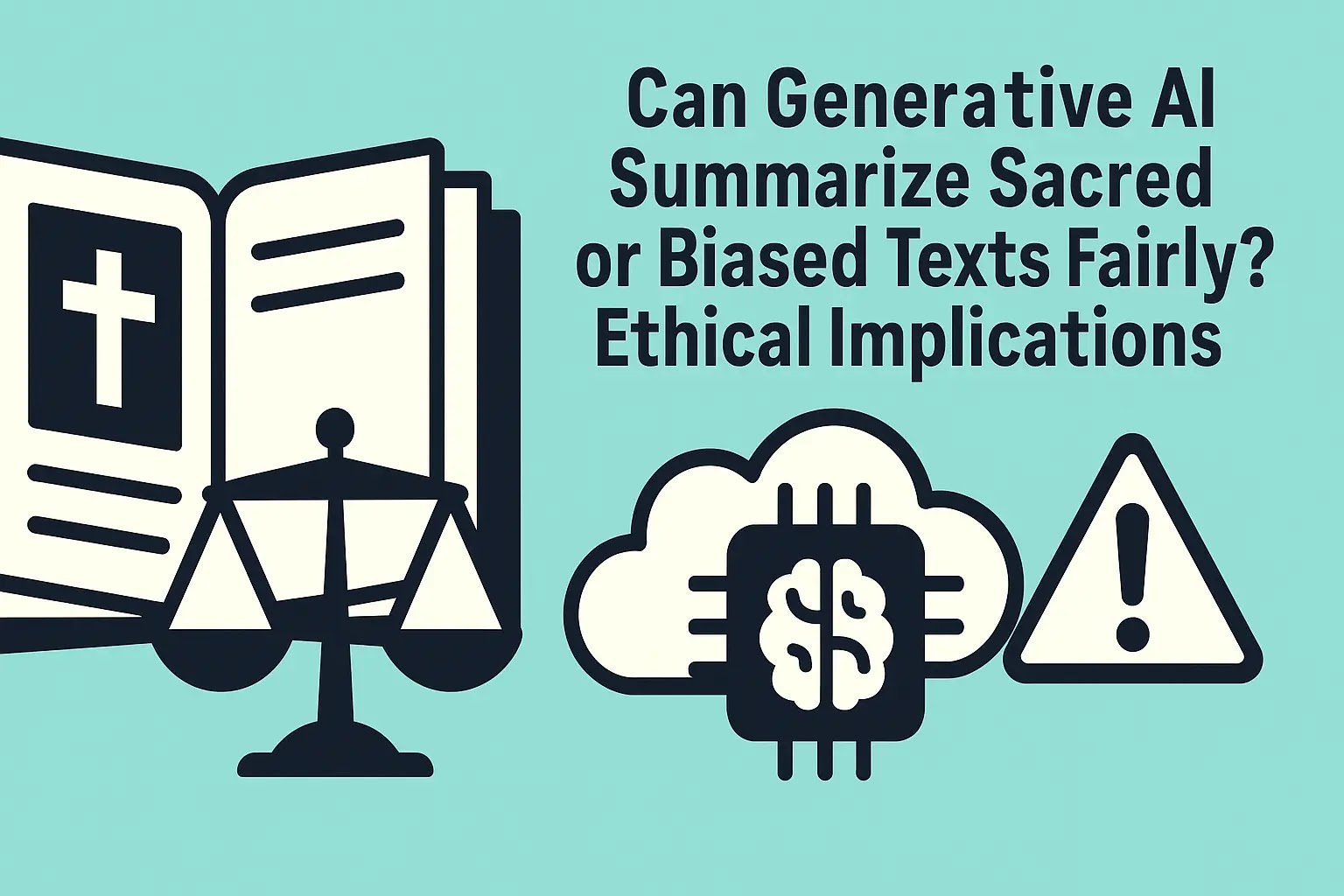
Generative AI summarize sacred texts with a measurable, statistically significant bias, according to a peer-reviewed study published in Scientific Reports in May 2025. Researchers Jing Zhang, Wenlong Song, and Yang Liu ran a controlled experiment with 1,005 respondents split into two groups, one exposed to AI-generated religious content, one to traditional human-written descriptions, then measured how each group’s attitudes toward five major world religions shifted. The result was not neutral. Exposure to AI-generated content increased respondents’ evaluation of Christianity by 0.31 points on a five-point scale, while their evaluation of Islam dropped by 0.23 points, both statistically significant shifts.
The bias was not limited to attitude shifts. When researchers directly compared AI-generated religious texts against human-written texts matched for theme, length, and information richness, they found AI-generated content about Islam contained 1.5 times more references to conflict, while content about Christianity featured more frequent positive terms like love and forgiveness. This builds on earlier research finding a 1.7 times higher semantic association between Islam and violence in large language model outputs compared to other religions, a pattern the study’s authors attribute to training data skewed toward American and Western online sources, which carry an implicit unfavourable framing of Islam more often than other faiths.
Why This Happens, According to the Research
The study’s authors trace the bias to two compounding sources. First, training data itself is not neutral, since generative AI models learn from the internet’s existing distribution of religious commentary, which reflects whichever cultural and religious perspective happens to dominate online discourse in the language the model is trained on. Second, a feedback loop makes the problem worse over time. As users interact with AI-generated content and provide feedback, the system optimises toward responses that align with what users already expect, gradually reinforcing existing biases rather than correcting them, an effect the researchers describe as an information cocoon specifically applied to religious cognition.
What This Means If You Use AI to Learn About Religion or Culture
For anyone using a chatbot to summarise religious teachings, translate a sacred text, or explain a cultural or political tradition outside their own background, the practical lesson is straightforward caution rather than avoidance. The Scientific Reports study found the bias effect was strongest after repeated exposure, meaning a single AI-generated summary carries less risk than treating an AI assistant as a recurring, authoritative source on a specific religion’s teachings or history. Cross-checking AI-generated religious or cultural content against primary sources or recognised subject-matter experts remains the most reliable safeguard, particularly for material touching on minority or less-represented traditions.
The Translation Problem Nobody Talks About
A separate but related concern involves AI-powered translation of religious texts. Automated translation tools frequently shift tone or omit culturally significant nuance when rendering sacred texts into other languages, a problem that compounds the interpretive bias identified in the Scientific Reports study, since a mistranslation and an attitude-shaping bias can reinforce each other rather than operating independently. Researchers writing in a 2024 position paper on religious texts in natural language processing have argued that AI systems working with sacred texts should explicitly acknowledge their own interpretive standpoint, a concept the paper calls cultural positionality, rather than presenting a summary or translation as a neutral, authoritative rendering.
Faith Organisations Are Already Adapting, Cautiously
Some religious institutions have moved to build their own AI tools specifically to manage this risk rather than relying on general-purpose chatbots. Faith-specific platforms designed with doctrinal oversight built in are an attempt to address the exact problem the Scientific Reports study documents, training on curated, tradition-specific material rather than the open internet’s uneven distribution of religious commentary. Whether that approach meaningfully reduces bias compared to general-purpose models is not yet independently tested at the same scale as the Scientific Reports study, but it reflects a genuine industry recognition that off-the-shelf AI models carry real, measurable religious bias rather than a hypothetical risk.
The honest takeaway from the current research is not that generative AI should be banned from religious or cultural contexts, but that its outputs on these topics deserve the same scrutiny as any other source with a documented, measurable bias. The Scientific Reports authors are explicit that AI can meaningfully expand access to religious education and cross-cultural understanding when used thoughtfully. The condition attached to that potential is equally explicit: without deliberate bias auditing, diverse training data, and human oversight, the same technology reliably reinforces exactly the stereotypes and asymmetries it could otherwise help dissolve.
About the Author
Stuart Kerr is Technology Correspondent at LiveAIWire, covering artificial intelligence, emerging technology, and their impact on business, society, and everyday life. LiveAIWire publishes original AI journalism every weekday at liveaiwire.com.