
By Stuart Kerr, Technology Correspondent, LiveAIWire
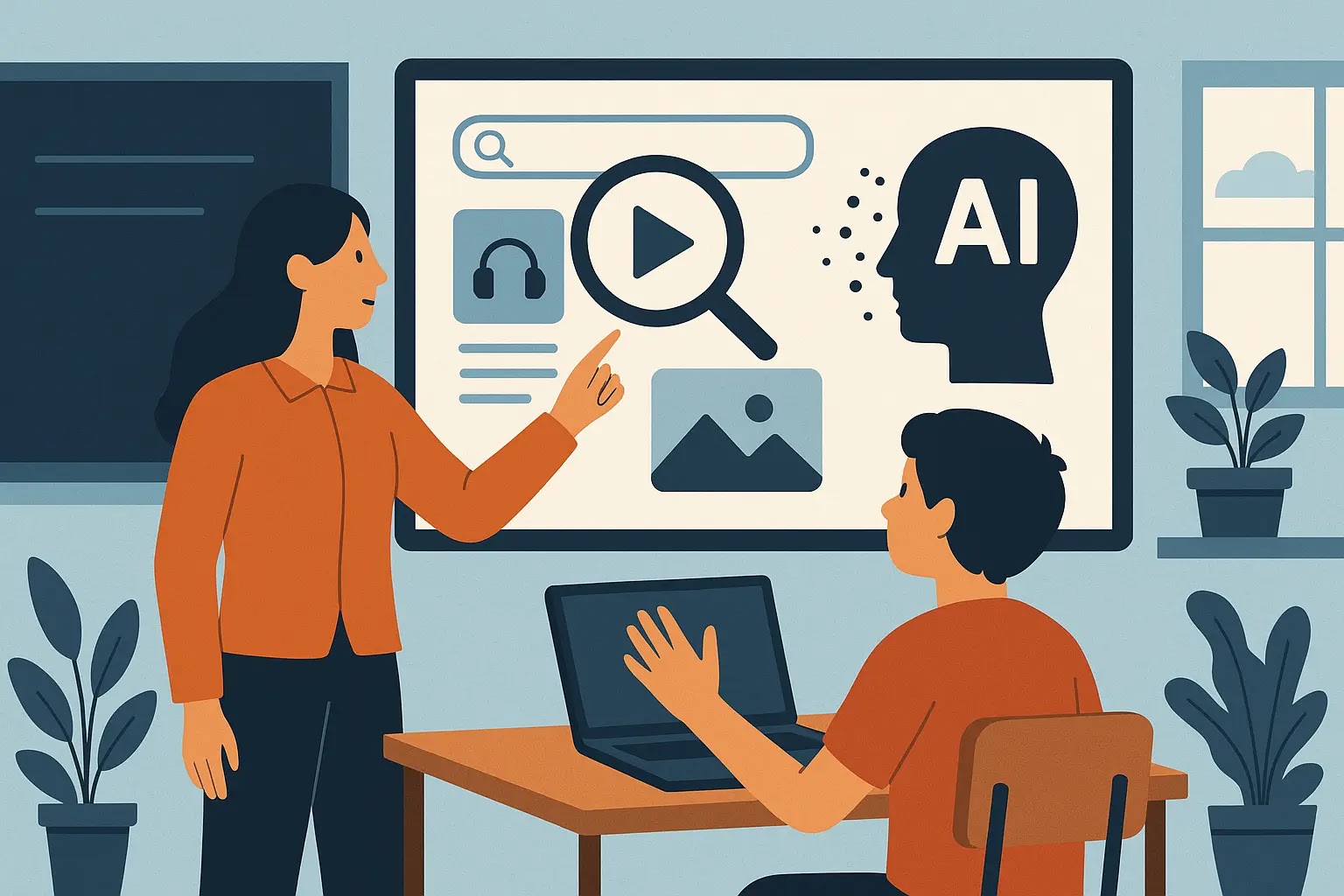
AI Mode in education is moving from search feature to genuine study tool faster than most classrooms have had time to adjust. Google’s rollout of AI Mode in Search, announced at Google I/O in May 2025, extended the company’s AI Overviews feature into a fuller, more conversational search experience, one that increasingly resembles a study companion rather than a results page.
Under the hood, AI Mode uses what Google calls a query fan-out technique, breaking a single question into several subtopics and issuing multiple searches simultaneously to assemble a more complete answer than a single query would return. For students, that shift matters because it changes what a search actually returns: not a list of links to sift through, but a synthesised, multimodal response that can incorporate text, images, and increasingly live camera input through Search Live, Google’s extension of its Project Astra visual reasoning technology into Search itself.
The classroom implications of that shift are still being worked out, but the direction is clear. Google reports that people are already coming to Search with longer, more complex, and more multimodal questions than before, and that usage of AI Overviews drives a measurable increase in return visits for the types of queries where it appears.
A search experience that can accept a photograph of a diagram or a handwritten equation, reason about it, and respond with an explanation tailored to the question is a materially different tool for homework help than a conventional keyword search, and students appear to be adopting it accordingly.
From Search Feature to AI Mode in Education Study Tool
The multimodal capability driving AI Mode in education is only part of what has changed. Alongside AI Mode, Google has been building a parallel set of education-specific tools under the LearnLM banner, its family of models fine-tuned specifically for pedagogy rather than general-purpose reasoning. LearnLM is now integrated directly into Gemini 2.5, and its influence is most visible in two features aimed squarely at students: Guided Learning, a Socratic-style tutoring mode that prompts students toward understanding through questions rather than handing over direct answers, and Learn Your Way, a research experiment that transforms static textbook material into a set of interactive, multimodal formats a student can choose between.
The evidence that this approach actually improves learning outcomes, rather than simply making study feel more engaging, comes from a randomised controlled study Google conducted with 60 students aged 15 to 18 in the Chicago area. Students were given up to 40 minutes to study a textbook chapter on adolescent brain development, split between a group using Learn Your Way and a group using a standard digital PDF reader.
The results, published by Google Research in September 2025, showed the Learn Your Way group scored 9 percent higher on an assessment taken immediately after the study session, and 11 percent higher on a retention test taken three to five days later, 78 percent average versus 67 percent for the control group.
Student sentiment tracked the outcomes: all of the students who used Learn Your Way reported feeling more comfortable going into the assessment, compared with 70 percent of the control group, and 93 percent said they would want to use the tool again for future learning.
What Multimodality Actually Adds to Studying
The theoretical basis for combining multiple formats, text, audio, slides, mind maps, quizzes, rather than relying on a single mode of presentation, rests on dual coding theory, the long-standing finding in cognitive psychology that forging connections between different representations of the same material strengthens the underlying mental model a learner builds. Google’s implementation breaks source material into digestible sections augmented with generated images and embedded questions, offers narrated slide presentations spanning the full material, generates simulated audio conversations between an AI tutor and a student modelling common misconceptions, and produces hierarchical mind maps that let a student zoom between the big picture and the specific detail.
None of these individual formats is new to educational technology, but AI Mode in education changes how cheaply they can be produced. Generating a narrated slide deck, a set of section quizzes, and a mind map from a single textbook chapter previously required substantial teacher time or dedicated instructional design resources.
Automating that generation, while personalising the content to a specific student’s stated grade level and interests, is what allows the approach to scale to individual students rather than remaining a resource only well-funded schools could provide, a pattern LiveAIWire has also traced in our coverage of AI and autism, where neural networks aid neurodiverse communication through similarly personalised, adaptive formats.
The Adoption Numbers
Google reports that in 2025, more than a million educators and students received AI training through Google for Education, with more than 100,000 earning Gemini certifications through the platform’s Learning Centre. Gemini in Classroom, which lets teachers generate quizzes, lesson materials, and differentiated activities grounded in their own class content, is now available free of charge to Google Workspace for Education users.
That combination, free access bundled into an education suite many schools already use, is likely a more significant driver of classroom adoption than the underlying model capability itself, since it removes the procurement and cost barriers that have slowed adoption of other education technology. This mirrors the pattern LiveAIWire documented in our reporting on why students are quietly replacing Google search with generative AI more broadly.
The competitive context around AI Mode in education matters here too. Google’s Guided Learning launched within roughly a week of OpenAI’s Study Mode and follows Anthropic’s Claude for Education, launched earlier in 2025. All three approaches share the same basic pedagogical premise, that an AI tutor should guide a student toward an answer rather than simply supplying one, but Google’s specific advantage lies in the breadth of its existing content ecosystem. Search, YouTube, Classroom, and NotebookLM together give Google’s tools access to a volume and diversity of educational content, and in Classroom’s case, direct visibility into what a specific class is actually studying, that a standalone chatbot cannot easily replicate.
What Remains Unresolved
The efficacy data behind AI Mode in education so far comes from a single study, a single subject area, and a single age range, and Google itself has acknowledged that population diversity, subject-domain coverage, and replication across different contexts are the open questions that will determine whether the early results generalise. A nine-to-eleven-point improvement over a standard digital reader in one Chicago classroom is a promising signal for AI Mode in education, not a settled finding, and the honest reading of the evidence is that multimodal AI Mode in education tools look genuinely useful rather than definitively transformative at this stage.
The concerns that apply to AI in education generally apply here too. Over-scaffolding, where a tool provides so much structured support that students practise recognising the right answer rather than recalling it unaided, is a real risk that Google’s own researchers have flagged.
Personalisation built on assumptions about learning styles or cultural context that do not hold for every student remains a design risk rather than a solved problem, and opacity, where a student or teacher cannot easily tell why a tool generated a particular explanation or changed its approach, is a legitimate transparency concern for any adaptive system used in a classroom setting. This is a version of the same trust problem LiveAIWire examined in our coverage of the quality risks of AI-generated content at scale.
Multimodal AI Mode in education tools are moving from laboratory demonstration into everyday classroom use faster than the evidence base evaluating their long-term effects is accumulating, and that gap is worth watching as adoption scales.
About the Author
Stuart Kerr is Technology Correspondent at LiveAIWire, covering artificial intelligence, cybersecurity, and the social impact of emerging technology. He publishes daily at LiveAIWire.com.