
By Stuart Kerr, Technology Correspondent, LiveAIWire
The Rise of Synthetic Testimony
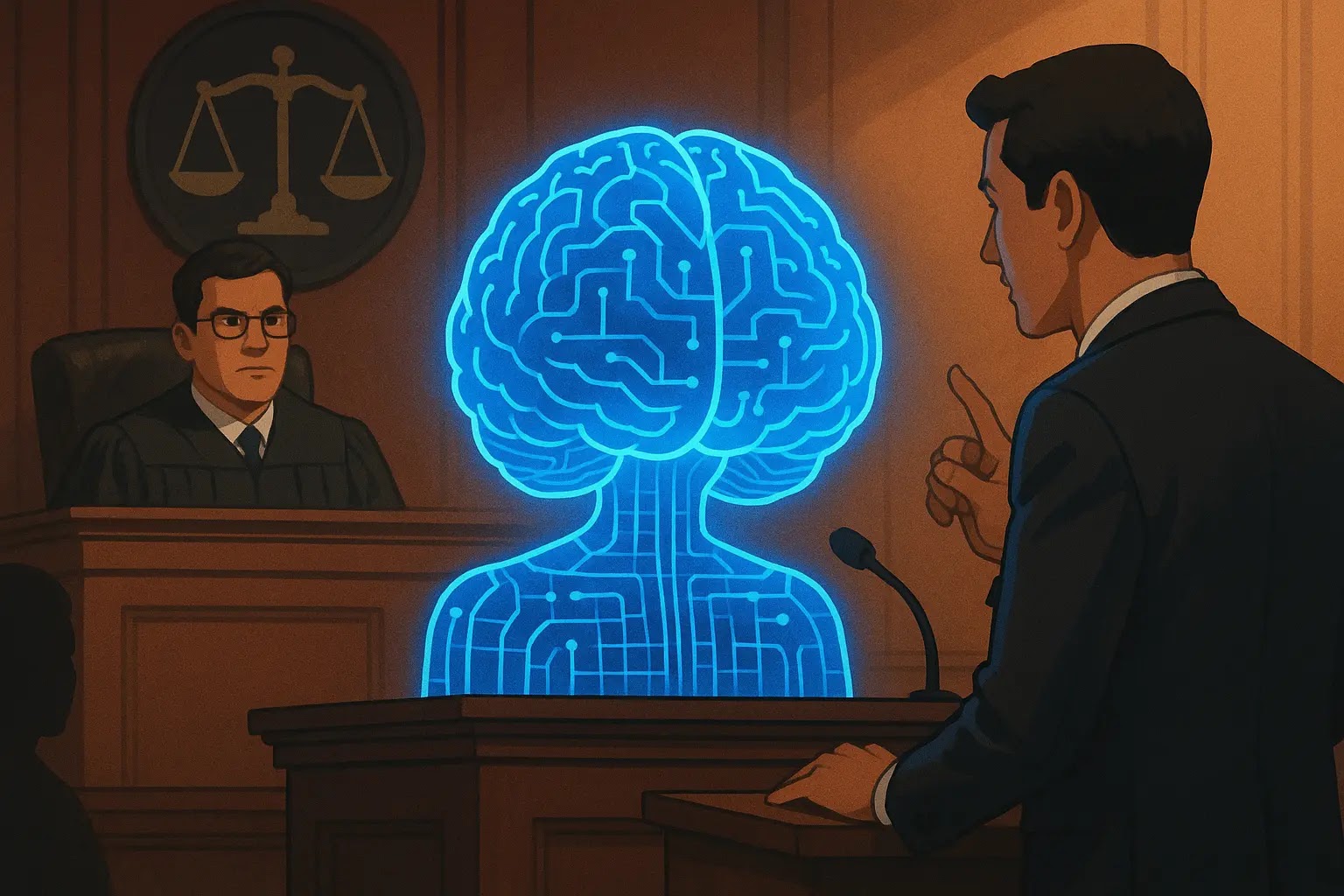
AI evidence in court is no longer a hypothetical, and the legal system is only beginning to work out how to handle it. Courtrooms have always been stages for human memory, interpretation, and persuasion. Witnesses take an oath, recount what they observed, and submit to questioning by lawyers who probe for truth or contradiction. The process depends on credibility, accountability, and the capacity for challenge. It is built on the assumption that the source of testimony is a human being with a mind, a memory, and a stake in the outcome.
That assumption is now being tested as AI evidence in court becomes more common. Artificial intelligence tools are already being used in criminal investigations to generate reconstructions of crime scenes, analyse digital evidence, and cross-reference vast databases at speeds far beyond human capability. If a system can produce a detailed, data-driven reconstruction of events, some legal scholars are asking whether that reconstruction might one day be introduced not merely as supporting evidence, but as testimony in its own right. The question sounds speculative. The debate it has opened is not.
What the Law Currently Allows
At present, the position of courts on AI evidence in court is clear. AI cannot testify. Legal systems in the United States and across most of the world require witnesses to be human beings capable of swearing an oath and submitting to cross-examination. AI can legitimately support the testimony of a qualified human expert, helping that expert analyse data or prepare visual reconstructions, but the AI itself cannot occupy the witness box or face questioning from opposing counsel.
This distinction matters for reasons that go deeper than procedure. The courtroom process relies on witnesses being subjects of scrutiny, not just sources of information. Their biases, memory gaps, prior statements, and motivations are all legitimate targets for cross-examination. Human fallibility is built into the system as a feature, not a bug, because it forces both sides to test the reliability of the account being offered. An AI system, however sophisticated, cannot be cross-examined in this sense. It does not have motivations, does not have a stake in the outcome, and cannot be caught in a contradiction between what it said yesterday and what it is saying today.
The Problem of Hallucinated Citations
Even before courts consider whether AI should ever testify, they are grappling with the consequences of AI evidence in court being used irresponsibly. A database maintained by legal researcher Damien Charlotin tracks well over a thousand cases worldwide where courts have addressed AI-generated hallucinations in filings, including citations to cases that simply do not exist. The citations often look plausible, reference real areas of law, and are formatted correctly. They are also entirely invented, and the lawyers filing them frequently fail to verify the output before submission.
These incidents illuminate the central danger of treating AI outputs as reliable without independent verification. Generative AI systems do not know what they do not know. They produce outputs that are statistically plausible given their training data, which is not the same as producing outputs that are factually accurate. In a legal context, where decisions about liberty, liability, and compensation rest on the precision of factual claims, the difference between plausible and accurate is not a technical footnote. It is the entire point.
The same hallucination problem would attach to any AI system introduced as a witness. Juries, who are not required to have any technical background, might be particularly susceptible to treating algorithmically generated reconstructions as authoritative simply because they appear precise and data-driven. A system that presents a detailed three-dimensional reconstruction of a crime scene carries an aura of objectivity that human witnesses never could. That aura could be deeply misleading.
Regulating AI Evidence in Court
Lawmakers and judicial panels are not waiting for problems with AI evidence in court to resolve themselves. Reuters reported that a US judicial panel advanced a proposal, now known as Rule 707, to bring AI-generated evidence under new rules that would align its admissibility with standards already applied to human expert testimony. The proposal would require any AI-generated reconstruction to pass reliability tests and demonstrate methodological soundness before it could be introduced in court. Rather than treating AI outputs as neutral data, the framework would subject them to the same adversarial scrutiny as any other expert opinion.
If adopted, this would represent a significant step toward treating AI as a technical tool subject to challenge, rather than as an oracle beyond question. It would also raise immediate practical questions about how you cross-examine a system. Opposing counsel would need to be able to probe the training data used, the architectural choices made, and the specific outputs produced for the case at hand. That requires both technical expertise from lawyers and a degree of transparency from AI developers that the industry has not historically provided.
What Legal Scholars Are Proposing
On AI evidence in court, the academic conversation is ahead of the regulatory one, and considerably more ambitious. A Stanford Law Review article titled Meaningful Machine Confrontation argues that the constitutional right to confront witnesses under the Confrontation Clause may need to be substantially rethought for the AI era. The proposals range from requiring source code disclosure and extensive documentation of training data to granting opposing counsel the right to retain independent technical experts who can probe the processes behind AI conclusions.
These arguments echo concerns LiveAIWire has raised elsewhere about opacity in algorithmic decision-making, from AI sentencing bias in predictive risk tools to AI insurance premiums calculated by systems that resist outside scrutiny. In each case, the same structural problem recurs: an algorithm makes a consequential decision, and the people affected by it have no meaningful way to challenge how it reached that conclusion.
Witnesses or Tools: A Critical Distinction
Underlying all of these debates about AI evidence in court is a question about categories. Is AI a witness, or is it a tool? The distinction matters because the legal system has very different mechanisms for handling each. Tools are subject to relevance and reliability tests. They can be challenged technically, and their limitations can be explained to a jury. Witnesses are subjected to something more extensive: a full adversarial examination of their credibility, their relationship to the parties, and the basis of their knowledge.
When it comes to AI evidence in court, AI fits neither category cleanly. It is more than a measuring instrument, because it generates interpretations and reconstructions, not merely raw data. But it is less than a witness, because it has no subjective experience, no stake in the outcome, and no personal accountability for the conclusions it produces. The legal system will need to develop a third category, or substantially modify the existing two, to accommodate what AI can do and what it cannot be held responsible for.
Those accountability questions have parallels in other domains where AI is being deployed to make judgements once reserved for people, including the courtroom-adjacent debate over facial recognition in law enforcement, where the same tension between algorithmic confidence and verifiable accuracy is already playing out. A wrongful conviction or an unjust acquittal attributable to AI evidence that was not properly scrutinised would set back both public trust in the justice system and public confidence in AI at precisely the moment when both are most fragile.
About the Author
Stuart Kerr is Technology Correspondent at LiveAIWire, covering artificial intelligence, cybersecurity, and the social impact of emerging technology. He publishes daily at LiveAIWire.com.