
By Stuart Kerr, Technology Correspondent, LiveAIWire
Walk into most corporate AI training sessions in 2026 and the room tells a story that the agenda does not. The facilitators are usually in their late twenties or thirties. The case studies feature Gen Z interns automating spreadsheets and millennial managers prompting their way through client decks. The employees quietly taking notes in the back, the ones in their late forties and fifties who have spent two decades building the institutional knowledge the company actually runs on, rarely see a single example built around how they work.
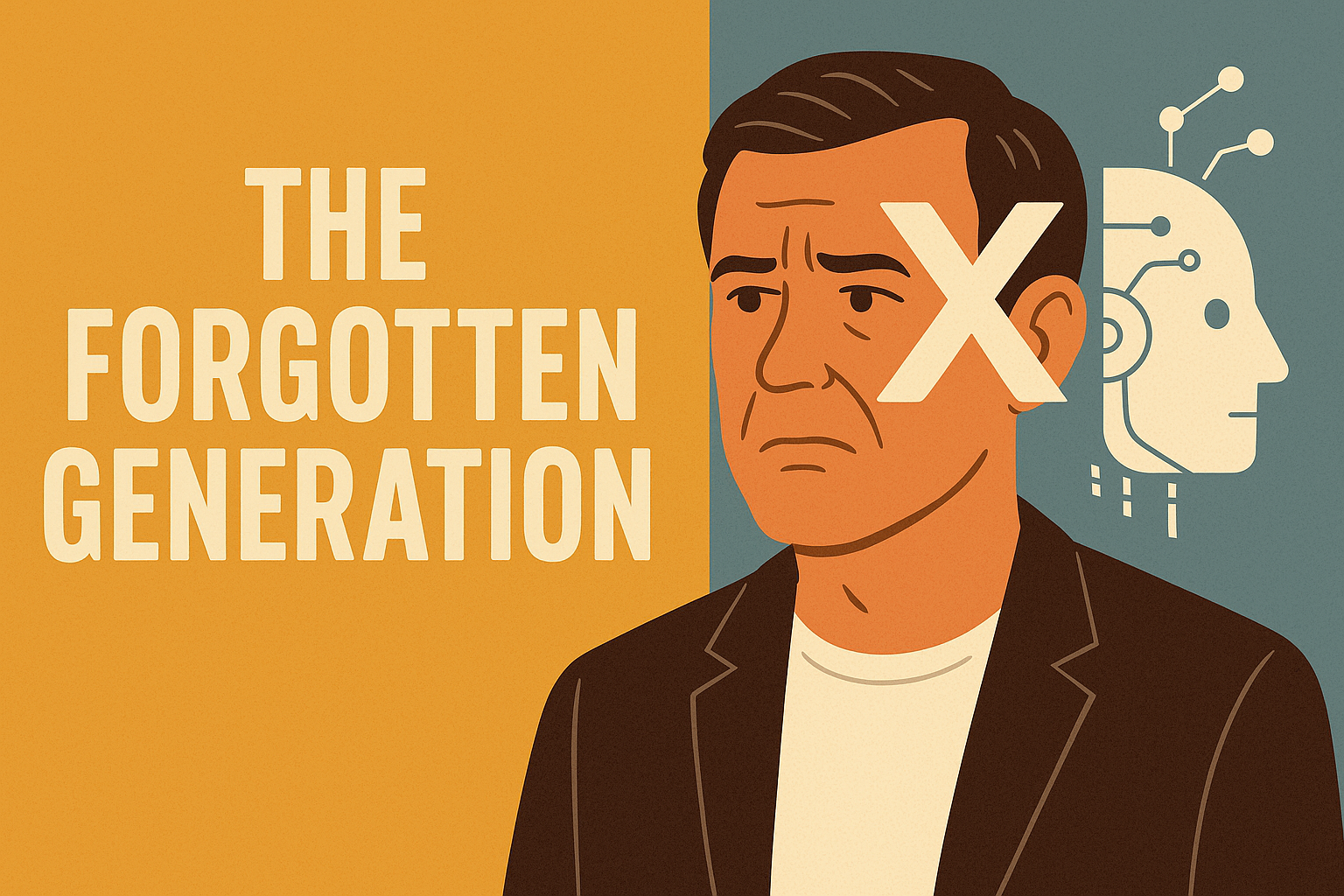
The gap between Gen X and AI adoption in the modern workplace is not a story about reluctance. It is a story about design choices nobody made on purpose, and about a generation that keeps getting left out of the conversation building the tools it is now expected to use.
The scale of that gap is no longer a matter of anecdote. A 2025 survey from the London School of Economics found AI usage far more common among Gen Z employees, at 83 percent, and millennials, at 73 percent, than among Gen Xers at 60 percent and baby boomers at 52 percent.
Separate research from the OECD’s study of how people experience new technologies and generative AI identified age as the single largest divide in AI use of any measured factor, larger than income or education, a gap wider than the ones separating people by income or education level.
Table of Contents
Where Gen X and AI Adoption Actually Stands
The picture is more nuanced than a simple story of older workers falling behind. Mather Institute’s 2026 Gen Xperience Study, a survey of roughly four thousand employed adults across four generations, found that Gen Xers, defined as those aged forty-five to sixty, reported using AI at work less than millennials but more than baby boomers. The same study found Gen X trusted AI-generated content more than boomers did, but less than younger colleagues, positioning the generation squarely in the middle of the adoption curve rather than at its trailing edge.
Researchers behind the study argued this middle position could make Gen X a useful bridge between AI-skeptical older colleagues and AI-fluent younger ones, provided employers actually invest in that role rather than assuming it will happen on its own.
That caveat matters because the same research found real friction underneath the more optimistic framing. While 77 percent of millennials and 69 percent of Gen Xers said adapting to new technology felt easy, employers were cautioned against assuming technological proficiency based on generation alone, since the variation within each age group was often larger than the variation between them. Training access appears to be doing a lot of the explanatory work: employees who received structured guidance on using AI tools were consistently more likely to adopt them, regardless of age, and Gen Z workers were significantly more likely than Gen X or boomer colleagues to have received that training in the past month.
The Hiring Algorithm Problem Gen X Cannot See
Adoption at work is only half of the story. The other half is what happens before a Gen X worker even gets in the door. Employment researchers have increasingly flagged how automated hiring systems, the resume-screening tools and video-interview analysis platforms now standard at large employers, can penalize candidates for the exact markers of a long, stable Gen X career. Years of experience, graduation dates, and employment gaps function as hidden proxies for age inside these systems, even when age itself is never an explicit input.
AARP’s ongoing tracking of age discrimination in hiring has documented that a majority of workers over fifty report having experienced or witnessed age bias in hiring, a pattern AARP argues is being reinforced rather than corrected by algorithmic screening.
The mechanism is subtle enough that most Gen X applicants never learn why a qualified application went nowhere. A resume-parsing tool trained on data skewed toward younger hires can learn to associate longer tenure with higher salary expectations, and quietly deprioritize applicants who would, on paper, be the strongest fit for a senior role. Because the discrimination happens inside a scoring algorithm rather than a hiring manager’s stated reasoning, it is also far harder to challenge through the ordinary channels that have historically surfaced age bias complaints.
Caught in the Middle: Gen X and AI in Today’s Workplace
Our own reporting on the wider workplace has tracked a related dynamic: AI is splitting workers by skill type rather than by sector or seniority, rewarding judgment, synthesis, and contextual reasoning over routine information processing. Gen X workers, many of whom hold exactly the kind of institutional and relational knowledge that judgment-based work depends on, should in theory be well positioned in that divide. Whether they actually benefit depends heavily on whether employers give them the same structured onramps to AI tools that younger hires receive as a matter of course during onboarding.
That is not always happening. Workplace platforms for scheduling, performance management, and customer relationship tracking are increasingly built with AI features baked in by default, but few of them offer meaningful onboarding for employees who did not grow up using generative tools recreationally. The result is a generation expected to adapt seamlessly to systems it had no voice in designing, a pattern that shows up repeatedly in how augmentation and replacement effects diverge depending on who has access to training and tools, not simply who is willing to use them.
The stakes of getting this wrong extend beyond any one worker’s career trajectory. Gen X currently occupies a disproportionate share of middle and senior management roles, meaning decisions about which AI tools to roll out, and how to train staff to use them, are frequently being made by the same generation that surveys show receives the least structured AI training itself. Our analysis of what the 2026 employment data actually shows about AI and job displacement found that the workers most at risk are not always the ones in the most AI-exposed occupations, but the ones least equipped, through no fault of their own, to redirect their skills as their roles change shape.
What Employers Keep Getting Wrong
The pattern researchers keep returning to is that AI training budgets and product design decisions default to the assumption that younger employees need the least help and older employees need the least attention. Both assumptions are wrong often enough to matter. A worker in their twenties who uses AI chatbots socially is not automatically equipped to use AI tools responsibly and effectively inside a regulated workplace context, and a worker in their fifties who has spent thirty years adapting to new enterprise software is not automatically resistant to a new interface, provided someone actually shows them how it works and why it matters to their job.
Employers that have had more success closing this gap tend to share a few practices: they build AI training tracks that are generation-agnostic rather than assuming fluency by age, they involve experienced staff in testing new AI tools before wide rollout rather than after, and they treat algorithmic hiring systems as something to audit for age-proxy bias rather than something to trust by default. None of this requires abandoning AI adoption. It requires treating Gen X, and the specific gaps in access and design that keep showing up around this generation, as a design constraint worth solving rather than a demographic footnote.
The conversation about AI and generational divides has largely been framed around Gen Z’s fluency and boomers’ hesitation, with Gen X treated as a rounding error between the two. The data tells a more precise story: a generation adopting AI at a measurable but real pace, trusted with less training than it needs, and increasingly exposed to hiring systems that penalize the exact experience that should make its members more employable, not less. Closing that gap is not a matter of waiting for Gen X to catch up. It is a matter of employers building the onramps that have been missing all along.
About the Author
Stuart Kerr is Technology Correspondent at LiveAIWire, covering artificial intelligence, emerging technology, and their impact on business, society, and everyday life. LiveAIWire publishes original AI journalism every weekday at liveaiwire.com.