
By Stuart Kerr, Technology Correspondent, LiveAIWire
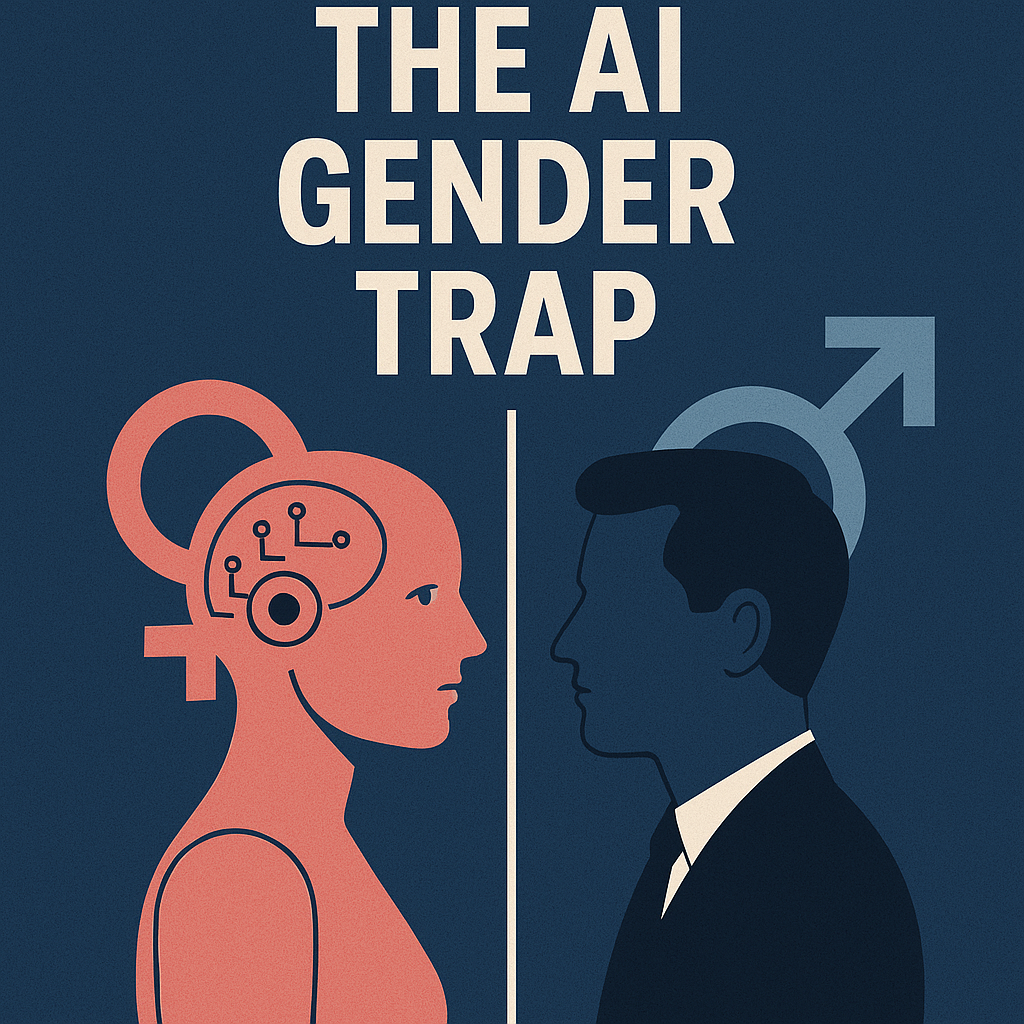
AI gender bias is not a fringe technical glitch, it is a structural feature of how today’s most widely used systems were built. When Apple launched Siri in 2011, the assistant defaulted to a female voice. Amazon’s Alexa followed the same design choice. Google offered options but most users accepted the defaults.
A UNESCO report, I’d Blush If I Could, documented the consequences of these decisions in 2019: AI assistants designed to be helpful, obedient, and endlessly patient were predominantly gendered female, and users treated female-voiced assistants with less respect than male-voiced equivalents while simultaneously expecting more compliance from them. The design choices were not individually malicious, but they reflected assumptions so deeply embedded in the people making them that they were not legible as choices.
AI gender bias is one manifestation of a broader pattern documented across AI systems in multiple domains. Language models trained on large text corpora inherit the associations between gender and occupation, capability, and social role present in those corpora, which encode historical distributions rather than current norms or aspirational ones. Systems trained primarily on internet text associate nursing with women and engineering with men not because the designers intended this but because the training data reflects decades of documented occupational segregation.
Where AI Gender Bias Shows Up in Practice
The practical consequences of AI gender bias are documented across multiple domains. Hiring algorithms trained on historical employment data consistently rate male candidates higher for technical roles and female candidates higher for administrative ones, even when qualifications are equivalent, because historical hiring patterns in the training data produce these associations. Image generation systems produce outputs that conform to gender stereotypes in occupational imagery: a prompt for a surgeon generates a male figure; a prompt for a nurse generates a female one.
In each case, the system is doing what it was optimised to do: producing outputs statistically consistent with its training data. What it is not doing is evaluating whether those statistical patterns reflect norms that should be perpetuated. A hiring algorithm that systemically disadvantages women in technical role evaluation is not describing a neutral reality. It is actively reproducing a historical pattern of discrimination in a context where the scale of deployment makes the cumulative effect larger than any individual hiring manager’s bias could produce, a dynamic that echoes what LiveAIWire has documented in our reporting on AI sentencing bias in predictive risk tools and on AI insurance premiums calculated by systems that inherit similar structural biases.
What This Means for You
If you use AI tools in professional contexts, including hiring, performance assessment, content generation, or customer service, you are likely deploying systems with gender bias embedded in their outputs whether or not that bias is visible. Understanding this is the first step toward managing it.
Addressing AI gender bias in practice requires mitigation approaches that vary by application. For hiring tools, bias auditing against demographic outcomes rather than input fairness is the more reliable test, since algorithms can treat inputs identically while producing discriminatory outcomes through the patterns in their training data. For generative AI in content creation, explicit prompting for demographic diversity in generated imagery and text, combined with human review of outputs before deployment, reduces but does not eliminate bias.
The Voice Assistant Problem at Scale
The UNESCO report that documented AI gender bias in voice assistants in 2019 prompted some changes in the industry. Amazon added male and non-binary voice options to Alexa. Apple made Siri’s default voice vary by region. Google expanded voice options across Assistant. These changes are meaningful as signals of intent but limited as solutions. The problem is not only which voice a user hears. It is the interaction pattern that the design encodes: an assistant that apologises frequently, accepts abuse without pushback, and maintains compliance regardless of how it is treated teaches users something about how service relationships should work that extends beyond their relationship with the AI.
Research on user behaviour toward female-voiced assistants documents patterns of abusive interaction that users do not engage in with equivalent male-voiced systems. These are not trivial edge cases. They are widespread behaviours at the scale of billions of daily interactions with systems designed to be maximally agreeable.
Regulatory and Industry Responses
The EU AI Act’s provisions on non-discrimination and fairness in high-risk AI systems create legal obligations for bias auditing in applications including hiring, credit assessment, and educational evaluation. These provisions apply to AI systems deployed in EU contexts regardless of where they are developed, which means international AI companies face regulatory obligations in the EU market that they do not face in their home jurisdictions. This is a meaningful lever for reducing AI gender bias in high-stakes applications, though it does not address the consumer AI contexts where gender bias in voice design and language generation operates at the largest scale.
Industry self-regulation has produced voluntary commitments to bias testing and diverse training data, but the mechanisms for holding those commitments to account are limited. This same pattern of uneven exposure runs through the labour market more broadly, as our coverage of whether AI is helping or hurting workers found, where women represent a disproportionate share of the highest-exposure occupational category identified by the ILO.
What Fair AI Actually Requires
Building AI systems that do not systematically reproduce AI gender bias requires more than diverse training data, though that is a necessary starting point. It requires evaluation frameworks that test for discriminatory outcomes rather than for input fairness, ongoing monitoring of deployed systems rather than one-time audits at the point of development, and accountability mechanisms that apply consequences when bias is identified rather than treating bias discovery as a technical finding to be addressed in the next model update.
Progress is happening, and it is worth acknowledging. The voice design choices that UNESCO documented in 2019 have been partially addressed. Hiring algorithm bias has received regulatory attention in multiple jurisdictions. Stanford HAI’s 2026 AI Index on responsible AI documents progress on bias reduction across major model families, though the picture is uneven. The progress is not linear or fast enough, but the direction is the right one, and the mechanisms producing it, regulatory pressure, civil society documentation, practitioner advocacy, are the appropriate mechanisms for a problem that is social as much as technical.
About the Author
Stuart Kerr is Technology Correspondent at LiveAIWire, covering artificial intelligence, cybersecurity, and the social impact of emerging technology. He publishes daily at LiveAIWire.com.