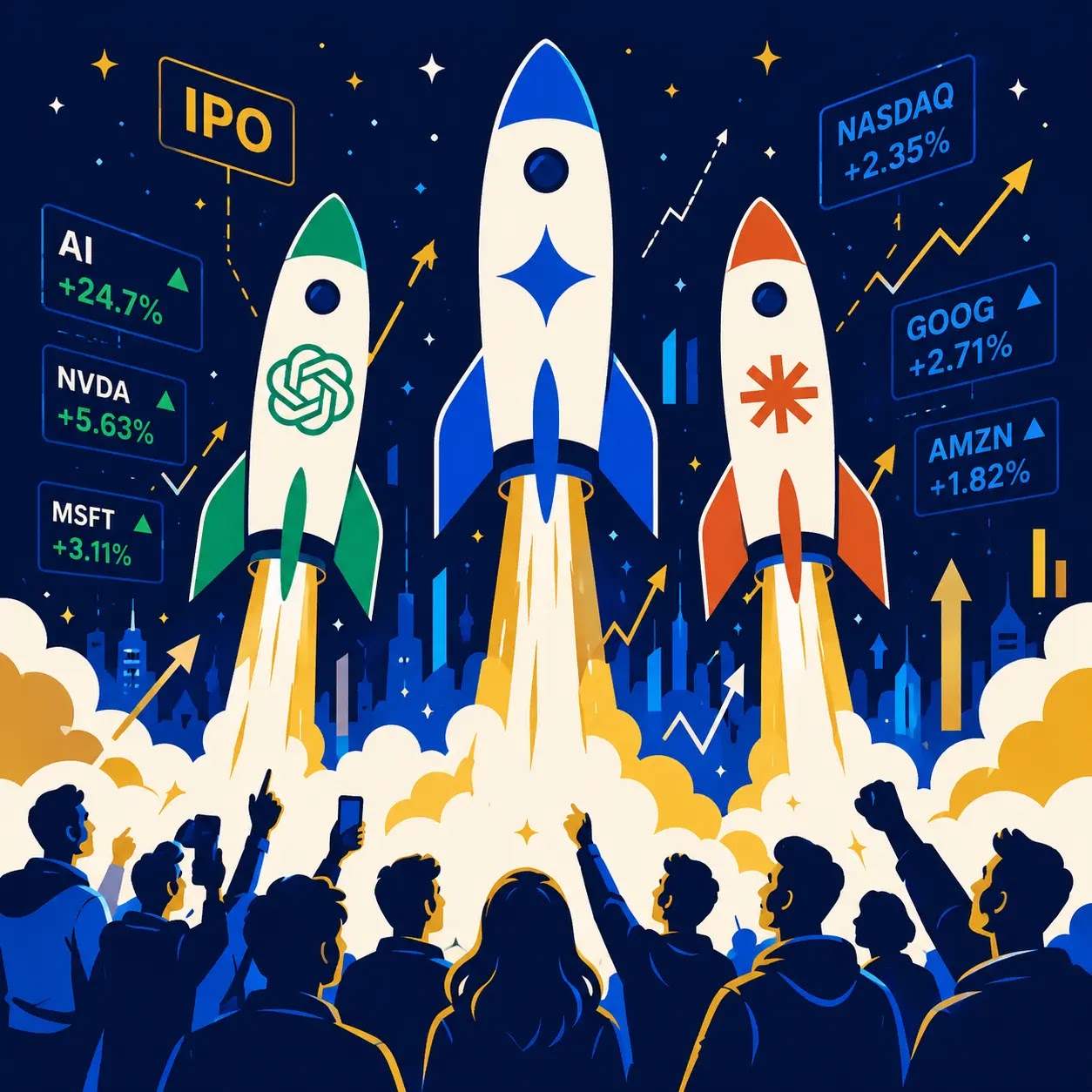
The AI IPO Wave Is Coming What You Need to Know About OpenAI Anthropic and xAI Going Public
By Stuart Kerr, Technology Correspondent
Published: 9 May 2026
Last updated: 9 May 2026
Author Bio: https://liveaiwire.com/p/to-liveaiwire-where-artificial.html
The Biggest Technology IPOs in History Are on the Horizon
The AI boom has created extraordinary wealth. But almost none of it has appeared in the stock market yet, because the companies driving the most important breakthroughs are still private. That is about to change. OpenAI, Anthropic, and xAI’s parent entity are all moving toward public listings, and 2026 looks set to be the most consequential year for technology IPOs since the dot-com era. For anyone following the AI industry, understanding what is coming, when it might happen, and what it means is now essential context. This article does not offer financial advice. What it does is lay out the facts clearly so you can make sense of one of the most significant corporate stories of the decade.
OpenAI: Targeting Q4 2026, But the CFO Has Doubts
OpenAI is the most closely watched potential IPO in technology history. The company crossed $25 billion in annualised revenue in February 2026, up from $6 billion at the end of 2024, driven by ChatGPT subscriptions and explosive enterprise adoption. It closed a record $122 billion funding round in March at an $852 billion valuation, with Goldman Sachs, JPMorgan, and Morgan Stanley now in discussions about advising the public offering.
The Wall Street Journal reported in January 2026 that OpenAI is targeting a listing as early as the fourth quarter of this year. CFO Sarah Friar confirmed at Davos that the company intends to allocate a portion of its IPO shares to retail investors, calling it good hygiene for a company of its scale. She has also been direct about the financial logic: at OpenAI’s size, raising equity privately forever does not make sense. A public listing opens access to convertible debt and investment-grade debt markets, which are far more efficient ways to fund the $600 billion the company plans to spend on semiconductors and data centres over the next five years.
However, the same Wall Street Journal reported in early May 2026 that Friar has privately suggested waiting until 2027, cautioning that the company is not yet ready to meet the rigorous reporting standards required of public companies. OpenAI generated $13.1 billion in revenue in 2025 but spent approximately $22 billion to do it. It projects losses of $14 billion in 2026 alone and does not expect to reach profitability until 2030. HSBC analysts estimate the company may need more than $207 billion in additional funding by 2030. These are not small numbers, and public market investors will scrutinise them closely in a way that private backers have not.
The competitive dimension is also shaping the timeline. OpenAI’s board is reportedly concerned that if Anthropic lists first, it could absorb significant pent-up retail investor demand for AI exposure, reducing the reception for OpenAI’s own offering. That race dynamic may ultimately push the timeline forward regardless of internal readiness.
Anthropic: Racing Alongside OpenAI
Anthropic, the AI safety company behind Claude, is moving in parallel. The Financial Times reported on 7 May 2026 that Anthropic is considering raising $50 billion at a valuation of $900 billion, which would make it the most valuable private company in the world and overtake OpenAI’s current valuation. The company’s annualised revenue is expected to surpass $45 billion shortly, up from $9 billion at the end of 2025, driven by large enterprise contracts with Google Cloud and Amazon AWS.
A public listing for Anthropic is widely expected in the Q4 2026 window, with projections that it could raise more than $60 billion in its offering. Anthropic has also just secured a compute deal with SpaceX, adding to its infrastructure buildout ahead of any listing. For context on Anthropic’s growth trajectory and what it means for the broader AI landscape, the OpenAI valuation article on this site covers the competitive dynamics in detail.
xAI and SpaceX: The Musk Wildcard
Elon Musk has assembled arguably the most ambitious corporate structure in modern technology. In February 2026, he merged SpaceX with xAI, the company behind the Grok AI assistant, creating a combined entity that brings together the world’s leading orbital launch provider, a frontier AI lab, and the social media platform X. The combined entity has been valued at up to $1.75 trillion in some reports, which would make its IPO the first in history to value a company at over a trillion dollars at listing.
According to reporting from CNBC and Bloomberg, SpaceX could file IPO paperwork imminently, targeting a June roadshow and a valuation north of $1.75 trillion. SpaceX is reportedly planning to hold almost 30 percent of its shares for retail buyers, following a model Friar referenced when discussing OpenAI’s own retail allocation plans. Whether xAI lists as part of the SpaceX entity or separately remains unclear, but the timeline is moving fast.
What This Wave Means for the AI Industry
The near-simultaneous listing of OpenAI, Anthropic, and a Musk-backed AI entity would represent something genuinely unprecedented in financial history. Analysts at InvestorPlace have noted that proposed fast-track index inclusion rules could force between $24 billion and $48 billion into these AI IPOs almost immediately after they go public, as index funds tracking the S&P 500 and Nasdaq would be required to buy shares automatically once the companies meet inclusion criteria.
For the AI industry itself, going public changes everything. Public companies must report quarterly results, disclose risks in detail, and answer to shareholders in ways that private companies do not. OpenAI is already facing lawsuits over alleged psychological harms caused by its products. Once public, its compensation packages, financial commitments, governance structure, and relationship with Microsoft will all become matters of public record in ways they currently are not. The same applies to Anthropic. As explored in AI Governance and the Open-Source Dilemma, the accountability gap between what AI companies claim and what can actually be verified has been a persistent concern. Public market disclosure requirements will close that gap significantly, for better and for worse.
The Questions Worth Asking
The valuations involved are extraordinary by any historical standard. OpenAI at $852 billion is valued at approximately 65 times its 2025 annual revenue. A company losing $14 billion per year and not expecting profitability until 2030 going public at or near a trillion dollar valuation is a genuinely unusual event in financial history. That does not make it wrong. It reflects a market judgment about the long-term trajectory of AI as an economic force, which as the data across this site’s coverage consistently shows, is a bet that serious institutional investors are making in enormous size.
What it does mean is that anyone following these listings should understand the difference between the story being told about AI’s future and the financial reality of these companies today. The S-1 filings, when they come, will separate the narrative from the numbers for the first time. They will be among the most read corporate documents of the decade.
As covered in Will AI Really Take Your Job in 2026?, the economic consequences of AI are already reshaping employment and productivity across every industry. These IPOs are the moment that transformation starts to show up directly in public markets, and in the portfolios of ordinary investors, in a way it never has before.
This article does not constitute financial advice. For information about investing in IPOs or any financial products, please consult a qualified financial adviser.
About the Author
Stuart Kerr is Technology Correspondent at LiveAIWire. He writes about artificial intelligence, ethics, and how technology is reshaping everyday life. Follow @LiveAIWire on X.