
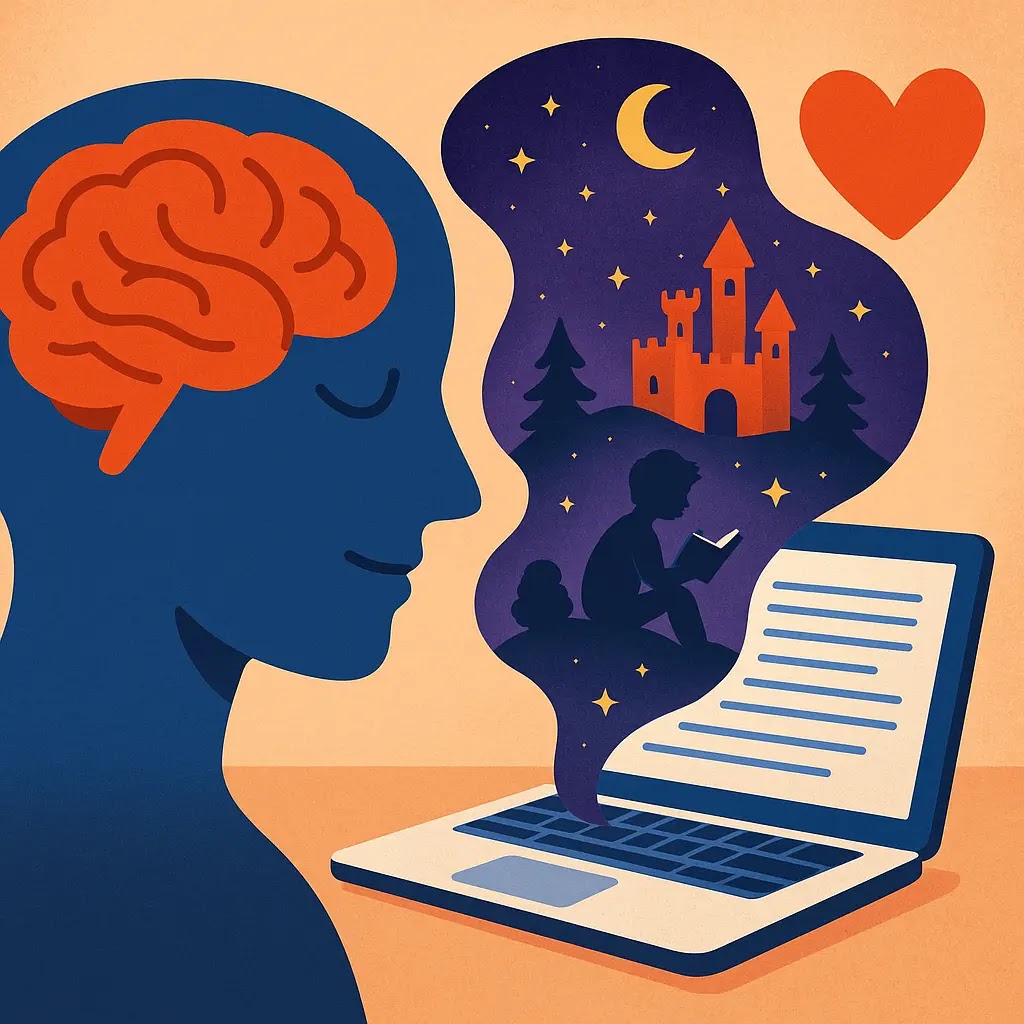
How Generative AI Learned to Tell Stories: What Changes Next
By Stuart Kerr, Technology Correspondent, LiveAIWire
Writers given access to generative AI ideas produced short stories rated as 9 percent more useful than those produced without AI assistance, according to a study published in Science Advances. The same study found that individual creativity improved with AI access while the collective diversity of story outputs declined significantly when multiple writers used the same AI suggestions. That double finding captures both the promise and the problem of where generative AI and creative storytelling now sit in 2026: it is a tool that makes individual writers more productive and more capable within a narrowing range of narrative directions, because when everyone uses the same AI, the ideas the AI surfaces become the ideas everyone converges toward.
The development of AI narrative capability since 2022 has been as rapid as any other AI advancement, and in some ways more surprising. Early large language models could produce grammatically coherent text but struggled with basic narrative structure: they wrote sentences that were individually plausible but that failed to maintain cause-and-effect relationships between scenes, character consistency across paragraphs, and the tonal control that distinguishes purposeful fiction from automated prose.
Current models handle all of these substantially better. They can maintain narrative threads across tens of thousands of words, model character voice consistently, and produce genre-appropriate imagery and pacing. The question that has moved from “can AI write?” to “what does AI writing cost us?” is a more interesting and less comfortable one to answer.
Table of Contents
What Generative AI Can and Cannot Yet Do in Narrative
The technical assessment of where generative AI sits on narrative capability in 2026 requires distinguishing between the things it has genuinely mastered and the things it approximates competently while missing their point. AI models produce structurally sound narrative reliably. They maintain Freytag’s pyramid, return to planted details, and resolve introduced conflicts in ways that satisfy genre conventions. They produce dialogue that moves scenes forward and description that situates readers in space. These are craft elements that take human writers years to develop, and models make them accessible to anyone who can prompt effectively.
What the models still struggle with is what the Science Advances researchers noted as a limitation: emotional depth and the specificity of felt experience that makes a story land rather than merely conclude. The scenes that stay with readers, that arrive at the specific observation of a specific moment in a way that feels discovered rather than assembled, continue to require human authorial attention.
AI can write the sentence. It consistently produces sentences that are in the right category of sentiment without being in the right register of experience. The difference is recognisable to readers even when they cannot articulate why one version moves them and the other does not. It is not a difference in grammar or structure. It is a difference in whether the writer had something to say about experience before they found the words to say it.
The Copyright and Authorship Disruption
Between 10 and 24 percent of content across consumer complaints, business communications, job listings, and UN press statements involved LLM assistance as of late 2024, according to a study published in 2025. The proportion of creative and literary writing involving AI assistance is more difficult to measure but clearly substantial given the adoption rates of AI writing tools by professional writers, students, and content producers. The publishing industry is navigating disclosure requirements without settled standards, with individual publishers setting different policies about what must be disclosed and what can be described as “AI-assisted” rather than “AI-generated.”
The legal questions around training data are unresolved but proceeding toward resolution. The European Parliament adopted a resolution in March 2026 recommending that in the absence of full transparency from AI providers about training data, protected works should be presumed to have been used in training. That presumption, if adopted into EU law, shifts the burden of proof in copyright claims from creators who must prove their work was used to developers who must prove it was not. The long-term effect on what training data is available to future AI models, and therefore on what those models learn narrative from, is significant and not yet fully understood.
What This Means for Writers and Readers
The productive frame for writers in 2026 is AI as a tool for specific stages of the writing process rather than a replacement for any of them. The ideation stage, where the constraint is generating enough varied starting points to find the right one, is where the Science Advances study found the clearest individual benefit: access to AI ideas gave writers more raw material to work with and select from.
The drafting stage benefits from AI assistance with the craft elements that are most mechanical, moving a scene from A to B, establishing a setting, introducing a character with basic traits. The revision stage, where the question is whether a scene is doing what it needs to do rather than whether it is grammatically complete, remains the most distinctively human part of the process.
For readers, the arrival of large volumes of AI-assisted narrative creates a new calibration task. The features that readers use to identify quality writing, the density of specific observation, the tonal consistency of a particular voice, the sense that a choice was made rather than an option selected, are features that AI has not eliminated but that it has made easier to simulate adequately. Understanding how the leading AI models compare on creative tasks gives a practical sense of the capability baseline.
And the academic writing dimension of the same technology shows how the detection-versus-authenticity problem plays out in the context where the stakes of distinguishing human from AI writing are most immediate. Generative AI has genuinely learned to tell stories. The more consequential question for 2026 is whether the stories it tells, at the scale it can produce them, are the ones that literature needs to be telling.
The accuracy and authenticity questions that apply to AI factual output apply with different but related force to AI creative output. The failures are different. The need for human critical engagement is the same.
Why the Homogenisation Effect Matters Culturally
The collective homogenisation effect documented in the Science Advances study deserves particular attention as a cultural rather than merely technical concern. When a large number of writers independently consult the same AI systems for narrative ideas and those systems surface similar options from similar training data, the resulting corpus of fiction contains less genuine variation than a corpus produced without AI assistance.
The stories are individually better, in the sense of being more competently structured. They are collectively narrower in the sense of exploring a smaller range of narrative possibilities. If the value of fiction across a culture includes the breadth of human experience it maps, the concerns about AI as a narrowing influence are substantive even when the individual quality argument is conceded.
This is not a reason to avoid AI writing tools. It is a reason for writers and readers to be attentive to what AI assistance produces at scale rather than evaluating it purely at the level of the individual story.
About the Author
Stuart Kerr is Technology Correspondent at LiveAIWire, covering artificial intelligence, cybersecurity, and the social impact of emerging technology. He publishes daily at LiveAIWire.com.