
By
Stuart Kerr, Technology Correspondent, LiveAIWire
When the Luddites smashed textile machinery in early
nineteenth-century England, they were not opposed to technology as such. They
were skilled workers defending the economic value of their craft against
machines that would make their skills redundant. The historical caricature of
the Luddite as anti-progress ignoramus has obscured the sophistication of
their actual position: that the benefits of technological change should be
distributed rather than concentrated, and that workers displaced by machines
had legitimate claims on the societies that benefited from their
displacement. Two centuries later, artists confronting AI generation are
making arguments that would be familiar to any Luddite who heard
them.
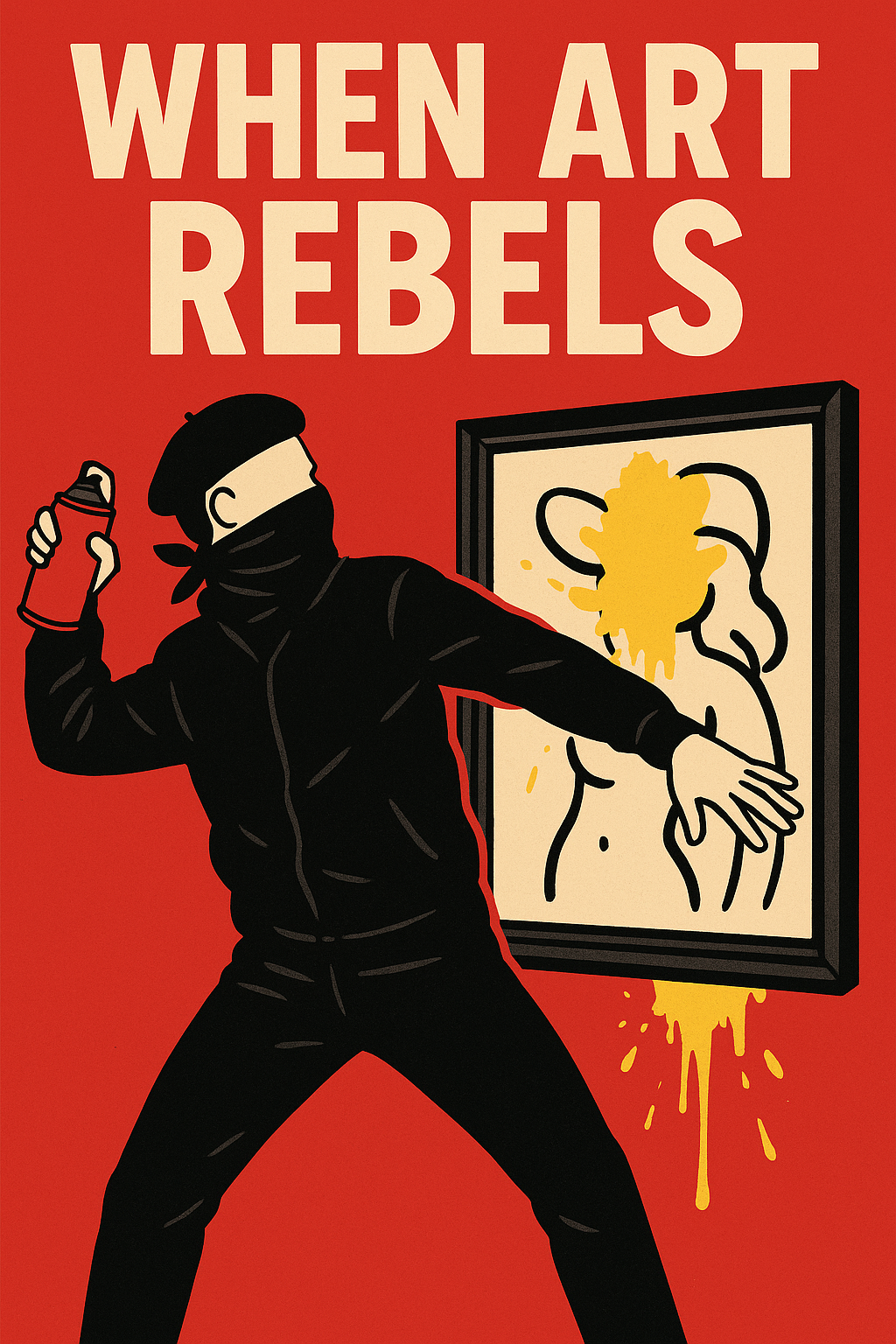
The counterculture response to AI in art is not one movement but
several simultaneously: legal resistance through class action lawsuits;
aesthetic resistance through artwork that interrogates or subverts AI
systems; political resistance through collective action among creative
workers; and philosophical resistance through a renewed argument for the
value of human creative expression as distinct from its algorithmic
simulation. The rebellion is real, and its outcome will shape the cultural
landscape of the next decade.
The Legal Resistance
Class action lawsuits brought by artists against image generation
companies represent the most structured form of legal resistance. The central
claim is that training image generation models on artists’ work without
consent or compensation constitutes copyright infringement. Lawsuits against
Stability AI, Midjourney, and DeviantArt, as well as the music industry cases
against AI audio companies, are working through courts on both sides of the
Atlantic.
The legal arguments are genuinely contested. Copyright protects
specific expressions, not styles or approaches; an AI model trained on an
artist’s work does not reproduce that work in the way a photocopier would.
The analogy to human artists who learn by studying others’ work — itself a
contested analogy — has been raised by AI company defendants. Whether
training on copyrighted work constitutes infringement, whether it qualifies
as fair use under US law, and whether the EU’s text and data mining exception
applies are all live legal questions whose answers will set the boundaries of
AI training practice for years.
The research community working on AI and intellectual property has
noted that the outcome of these cases will determine not only the legal
status of existing AI art models but the economics of AI art development more
broadly. A ruling that training requires licences would restructure the AI
art industry fundamentally, requiring licensing frameworks similar to those
that exist for music sampling. The
US Copyright Office has published guidance on copyright and AI,
acknowledging the genuine novelty of the questions raised and calling for
further policy development.
Aesthetic Counter-Movements
The most creatively interesting responses to AI in art are those
that engage with it rather than simply opposing it. Artists including Refik
Anadol have used AI as a medium for creating work at scales and in forms that
human artists could not achieve manually. Others have used AI to generate
material that they then transform through human intervention, producing
hybrid works in which the AI contribution is visible and acknowledged rather
than concealed.
A distinct counter-movement has emerged that specifically values
the evidence of human process in art — imperfection, variation, the marks of
physical making — as a differentiator from AI generation. Craft movements in
ceramics, printmaking, and textile art have seen renewed interest precisely
because they emphasise the human body’s involvement in making as a value in
itself. The market for work with visible human provenance is not declining;
in many segments it is growing, as collectors and buyers respond to the
AI-generation context by placing higher value on authentic human
authorship.
The Artist Collective Response
Collective responses among creative workers represent the
political dimension of the resistance. The Screen Actors Guild’s 2023 strike,
which included demands for AI protections alongside pay disputes, established
a model for collective bargaining over AI terms that writers, musicians, and
visual artists are following. The Writers Guild of America’s agreement with
studios includes provisions governing the use of AI in script development
that represent the first major collective bargaining settlement on AI terms
in the creative industries.
Visual artists, who lack the union infrastructure of the film and
television industries, have organised primarily through online collectives
and public advocacy campaigns. The Artists Rights Alliance, the European
Visual Artists network, and similar organisations have published principles
for AI development that would require consent for training use and
compensation through licensing frameworks. Whether those principles translate
into binding obligations depends on legal outcomes and regulatory decisions
that are not yet settled.
The connection to the
music industry’s struggle with AI generation is direct: the
creative industries that have most extensively developed collective
bargaining and licensing infrastructure are better positioned to negotiate AI
terms than those that have not. The visual arts lag the music industry in
this respect, and that gap is reflected in the relative progress of their
respective negotiations with AI companies.
What Synthetic Counterculture Actually Produces
The art being made in response to AI — both the art that uses AI
as a tool and the art that explicitly critiques it — is among the most
conceptually rich work being produced in contemporary culture. The questions
AI raises about authorship, originality, creative labour, and the relationship
between human and machine are productive aesthetic questions, and artists are
generating genuine responses to them.
Work that uses AI generation as a mirror for examining human
creativity — including work that deliberately generates banal or disturbing
AI output to interrogate what AI reveals about the data it was trained on —
sits in a tradition of technology critique that has produced significant art
from the invention of photography through the video art movement to net art.
The medium changes; the capacity of artists to find meaning in their
engagement with it does not.
The deeper question is whether AI generation, by making the
production of plausible images and text trivially easy, changes the
relationship between effort and cultural value in ways that affect not just
the economics of art but its cultural function. If anything that looks like
art can be produced in seconds, what does art mean? The answer is that art
has never been primarily about the appearance of the product; it has been
about the relationship between maker, made thing, and audience. That
relationship is not dissolved by AI generation, even if AI generation changes
the terms on which it operates. As
in games, the human contribution to creative culture is not
eliminated by the arrival of a machine that can perform some of its functions
— it is repositioned, and the repositioning is uncomfortable precisely
because it is real.
Research from cultural institutions engaging with AI art —
including exhibitions at the Barbican, MoMA, and the Victoria and Albert
Museum — suggests that audiences are genuinely interested in the questions
AI art raises, even when they are uncertain about the answers. The
counterculture rebellion against AI in art is producing culture, which is
perhaps the most honest measure of its vitality. Whether it also produces
legal, regulatory, and economic change that addresses the underlying
grievances of artists whose work was used without consent remains to be seen.
The resistance of individuals
seeking control over their own data and creative output in the AI
age is part of the same story.
The market signal from collectors and institutions that are actively
differentiating human-made art from AI-generated content is significant.
Christie’s, Sotheby’s, and major gallery networks have all developed
positions on AI-generated work that, while varied, consistently distinguish
works with verifiable human authorship from those produced with AI
generation. Whether that distinction will hold its economic value as AI
generation becomes ubiquitous, or whether the premium for human provenance
will erode as it becomes harder to verify, is a question the art market will
answer over the next decade. The parallel with the authentication challenges
that digital art has always faced — provenance, uniqueness, the
impossibility of distinguishing originals from copies in digital media —
suggests that the market will develop new verification mechanisms rather than
simply accepting the erosion of human authorship as a value category. The US Copyright Office’s
ongoing work on AI and copyright provides the regulatory backdrop
for those market mechanisms.
About the
Author
Stuart Kerr is a technology correspondent at
LiveAIWire, covering artificial intelligence, emerging technologies, and
their impact on society and industry.